.elementor-2710 .elementor-element.elementor-element-1fbc51c{--display:flex;--margin-top:150px;--margin-bottom:0px;--margin-left:0px;--margin-right:0px;}/* Start custom CSS for html, class: .elementor-element-294190e */:root {
  --lns-primary: #1b4690;
  --lns-secondary: #f7911d;
  --lns-rare: #d1e5ff;
  --lns-others: #ffe4c5;
  --lns-important: #c49600;
  --lns-text: #222222;
  --lns-muted: #5d6673;
  --lns-white: #ffffff;
  --lns-border: #dce5f2;
  --lns-danger: #b42318;
  --lns-shadow: 0 16px 42px rgba(27, 70, 144, 0.1);
}

.lns-blog-wrapper,
.lns-blog-wrapper * {
  box-sizing: border-box;
}

.lns-blog-wrapper {
  width: 100%;
  max-width: 100%;
  margin: 0 auto;
  padding: clamp(18px, 3vw, 42px);
  color: var(--lns-text);
  font-family: inherit;
  font-size: clamp(1rem, 0.97rem + 0.15vw, 1.1rem);
  line-height: 1.78;
  background-color: transparent;
  background-image:
    radial-gradient(circle at 1px 1px, rgba(27, 70, 144, 0.11) 1px, transparent 0),
    linear-gradient(135deg, rgba(209, 229, 255, 0.2), rgba(255, 228, 197, 0.14));
  background-size: 28px 28px, 100% 100%;
}

.lns-blog-wrapper > section,
.lns-blog-wrapper > .lns-toc-container,
.lns-blog-wrapper > .lns-required-info {
  width: min(100%, 1180px);
  margin-right: auto;
  margin-left: auto;
}

.lns-blog-wrapper section {
  scroll-margin-top: 90px;
}

.lns-blog-wrapper h1,
.lns-blog-wrapper h2,
.lns-blog-wrapper h3 {
  color: var(--lns-primary);
  font-family: inherit;
  font-weight: 750;
  line-height: 1.25;
  text-wrap: balance;
}

.lns-blog-wrapper h1 {
  max-width: 980px;
  margin: 0 0 1.25rem;
  padding-bottom: 0.7rem;
  border-bottom: 4px solid var(--lns-secondary);
  font-size: clamp(2rem, 5vw, 3.7rem);
}

.lns-blog-wrapper h2 {
  margin: 0 0 1.1rem;
  padding-left: 16px;
  border-left: 5px solid var(--lns-important);
  font-size: clamp(1.55rem, 3vw, 2.25rem);
}

.lns-blog-wrapper h3 {
  margin: 0;
  font-size: clamp(1.05rem, 2vw, 1.25rem);
}

.lns-blog-wrapper p {
  margin: 0 0 1.3rem;
}

.lns-blog-wrapper a {
  color: var(--lns-primary);
  text-decoration-thickness: 2px;
  text-underline-offset: 3px;
}

.lns-blog-wrapper a:hover,
.lns-blog-wrapper a:focus-visible {
  color: #12346f;
}

.lns-content-section {
  margin-top: clamp(2.2rem, 6vw, 4.8rem);
  padding: clamp(20px, 3vw, 38px);
  border: 1px solid rgba(27, 70, 144, 0.1);
  border-radius: 22px;
  background: rgba(255, 255, 255, 0.94);
  box-shadow: var(--lns-shadow);
}

.lns-hero {
  padding: clamp(22px, 4vw, 48px);
  overflow: hidden;
  border: 1px solid rgba(27, 70, 144, 0.12);
  border-radius: 26px;
  background: linear-gradient(135deg, rgba(255, 255, 255, 0.98), rgba(209, 229, 255, 0.72));
  box-shadow: var(--lns-shadow);
}

.lns-answer-block {
  margin: 1.5rem 0;
  padding: 20px 22px;
  border-left: 5px solid var(--lns-primary);
  border-radius: 0 12px 12px 0;
  background: var(--lns-rare);
  box-shadow: 0 8px 20px rgba(27, 70, 144, 0.08);
}

.lns-answer-block p:last-child {
  margin-bottom: 0;
}

.lns-required-info {
  margin-bottom: 1.25rem;
  padding: 14px 18px;
  border: 2px solid var(--lns-danger);
  border-radius: 10px;
  color: var(--lns-danger);
  background: #fff4f2;
  font-weight: 700;
}

.lns-toc-container {
  margin-top: 1.5rem;
  padding: 0;
  overflow: hidden;
  border: 1px solid var(--lns-border);
  border-radius: 16px;
  background: var(--lns-white);
  box-shadow: 0 10px 28px rgba(27, 70, 144, 0.08);
}

.lns-toc-container summary {
  display: flex;
  align-items: center;
  justify-content: space-between;
  gap: 1rem;
  padding: 18px 20px;
  color: var(--lns-primary);
  cursor: pointer;
  font-size: 1.15rem;
  font-weight: 750;
  list-style: none;
}

.lns-toc-container summary::-webkit-details-marker {
  display: none;
}

.lns-toc-container summary::after {
  content: "\f078";
  font-family: "Font Awesome 6 Free";
  font-weight: 900;
  color: var(--lns-secondary);
  transition: transform 0.25s ease;
}

.lns-toc-container[open] summary::after {
  transform: rotate(180deg);
}

.lns-toc-content {
  padding: 2px 20px 20px;
  border-top: 1px solid var(--lns-border);
}

.lns-toc-list {
  columns: 2 320px;
  gap: 34px;
  margin: 1rem 0 0;
  padding: 0;
  list-style: none;
}

.lns-toc-list li {
  break-inside: avoid;
  margin: 0 0 0.7rem;
}

.lns-toc-list a {
  display: inline-flex;
  gap: 9px;
  align-items: flex-start;
  text-decoration: none;
}

.lns-toc-list a::before {
  content: "\f02d";
  margin-top: 0.28rem;
  color: var(--lns-secondary);
  font-family: "Font Awesome 6 Free";
  font-size: 0.78rem;
  font-weight: 900;
}

.lns-blog-wrapper figure {
  margin: 2rem 0;
  text-align: center;
}

.lns-blog-wrapper img {
  display: block;
  width: 100%;
  max-width: 100%;
  height: auto;
  margin: 0 auto;
  border-radius: 18px;
  object-fit: cover;
  box-shadow: 0 16px 38px rgba(27, 70, 144, 0.14);
}

.lns-blog-wrapper figcaption {
  max-width: 900px;
  margin: 0.8rem auto 0;
  color: var(--lns-muted);
  font-size: 0.92rem;
  font-style: italic;
  line-height: 1.55;
}

.lns-table-scroller {
  width: 100%;
  margin: 2rem 0;
  overflow-x: auto;
  border: 1px solid var(--lns-border);
  border-radius: 15px;
  background: var(--lns-white);
  box-shadow: 0 12px 30px rgba(27, 70, 144, 0.08);
  -webkit-overflow-scrolling: touch;
}

.lns-table-scroller table {
  width: 100%;
  min-width: 720px;
  border: 0;
  border-collapse: collapse;
  text-align: left;
}

.lns-table-scroller th,
.lns-table-scroller td {
  padding: 14px 16px;
  border-right: 1px solid var(--lns-border);
  border-bottom: 1px solid var(--lns-border);
  vertical-align: top;
}

.lns-table-scroller th:last-child,
.lns-table-scroller td:last-child {
  border-right: 0;
}

.lns-table-scroller tbody tr:last-child td {
  border-bottom: 0;
}

.lns-table-scroller th {
  color: var(--lns-white);
  background: var(--lns-primary);
  font-weight: 700;
}

.lns-table-scroller tbody tr:nth-child(even) {
  background: #f8fbff;
}

.lns-table-scroller tbody tr:hover {
  background: var(--lns-rare);
}

.lns-check-list,
.lns-level-list {
  margin: 1.4rem 0;
  padding: 0;
  list-style: none;
}

.lns-check-list li,
.lns-level-list li {
  position: relative;
  margin-bottom: 0.85rem;
  padding: 14px 16px 14px 46px;
  border: 1px solid var(--lns-border);
  border-radius: 12px;
  background: #fbfdff;
}

.lns-check-list li::before,
.lns-level-list li::before {
  position: absolute;
  top: 14px;
  left: 16px;
  color: var(--lns-secondary);
  font-family: "Font Awesome 6 Free";
  font-weight: 900;
}

.lns-check-list li::before {
  content: "\f058";
}

.lns-level-list li::before {
  content: "\f19d";
}

.lns-faq-container {
  margin-top: 1.5rem;
}

.lns-faq-item {
  margin-bottom: 12px;
  overflow: hidden;
  border: 1px solid var(--lns-border);
  border-radius: 14px;
  background: var(--lns-white);
  box-shadow: 0 7px 20px rgba(27, 70, 144, 0.05);
}

.lns-faq-question {
  width: 100%;
  display: flex;
  align-items: center;
  justify-content: space-between;
  gap: 1rem;
  padding: 18px 20px;
  border: 0;
  color: var(--lns-primary);
  background: transparent;
  cursor: pointer;
  font: inherit;
  font-weight: 750;
  line-height: 1.4;
  text-align: left;
}

.lns-faq-question::after {
  content: "\2b";
  flex: 0 0 auto;
  color: var(--lns-secondary);
  font-family: "Font Awesome 6 Free";
  font-weight: 900;
  transition: transform 0.25s ease;
}

.lns-faq-question[aria-expanded="true"]::after {
  transform: rotate(45deg);
}

.lns-faq-question:hover,
.lns-faq-question:focus-visible {
  background: #f7faff;
  outline: 0;
}

.lns-faq-answer {
  padding: 0 20px 18px;
  border-top: 1px solid var(--lns-border);
  background: var(--lns-white);
}

.lns-faq-answer p {
  margin: 15px 0 0;
}

.lns-closing-cta {
  text-align: center;
  border: 2px dashed var(--lns-primary);
  background: linear-gradient(135deg, var(--lns-rare), var(--lns-others));
}

.lns-closing-cta h2 {
  display: inline-block;
  padding: 0 0 8px;
  border: 0;
  border-bottom: 4px solid var(--lns-secondary);
}

.lns-cta-button {
  display: inline-flex;
  align-items: center;
  justify-content: center;
  gap: 10px;
  margin: 0.35rem 0 1.4rem;
  padding: 14px 30px;
  border: 2px solid transparent;
  border-radius: 999px;
  color: var(--lns-white) !important;
  background: var(--lns-secondary);
  box-shadow: 0 8px 22px rgba(247, 145, 29, 0.32);
  font-size: 1.1rem;
  font-weight: 750;
  text-decoration: none !important;
  transition: transform 0.2s ease, background 0.2s ease, box-shadow 0.2s ease;
}

.lns-cta-button::before {
  content: "\f075";
  font-family: "Font Awesome 6 Free";
  font-weight: 900;
}

.lns-cta-button:hover,
.lns-cta-button:focus-visible {
  color: var(--lns-white) !important;
  background: var(--lns-primary);
  box-shadow: 0 10px 26px rgba(27, 70, 144, 0.28);
  transform: translateY(-2px);
}

@media (max-width: 767px) {
  .lns-blog-wrapper {
    padding: 14px;
    line-height: 1.7;
  }

  .lns-content-section,
  .lns-hero {
    padding: 20px 16px;
    border-radius: 16px;
  }

  .lns-blog-wrapper h1 {
    font-size: clamp(1.85rem, 9vw, 2.65rem);
  }

  .lns-blog-wrapper h2 {
    padding-left: 12px;
  }

  .lns-toc-list {
    columns: 1;
  }

  .lns-faq-question {
    padding: 16px;
  }

  .lns-faq-answer {
    padding: 0 16px 16px;
  }

  .lns-table-scroller::before {
    content: "Swipe to view the full table →";
    display: block;
    padding: 10px 14px;
    color: var(--lns-primary);
    background: var(--lns-others);
    font-size: 0.85rem;
    font-weight: 700;
  }
}

@media (prefers-reduced-motion: reduce) {
  .lns-blog-wrapper *,
  .lns-blog-wrapper *::before,
  .lns-blog-wrapper *::after {
    scroll-behavior: auto !important;
    transition: none !important;
  }
}
</style>

<!-- Font Awesome dependency -->
<link rel="stylesheet" href="https://cdnjs.cloudflare.com/ajax/libs/font-awesome/6.4.0/css/all.min.css" integrity="sha512-iecdLmaskl7CVkqkXNQ/ZH/XLlvWZOJyj7Yy7tcenmpD1ypASozpmT/E0iPtmFIB46ZmdtAc9eNBvH0H/ZpiBw==" crossorigin="anonymous" referrerpolicy="no-referrer">

<!-- ============================================================
     HTML SNIPPET
     ============================================================ -->
<main class="lns-blog-wrapper" id="lns-spoken-english-bengali-speakers">
  <div class="lns-required-info" role="alert">
    REQUIRED BEFORE PUBLISHING: Replace “ADD TRAINER NAME” in the JSON-LD with the real trainer/author name.
  </div>

  <section class="lns-hero" aria-labelledby="page-title">
    <h1 id="page-title">Why Bengali Speakers Get Stuck in English (And How to Fix It)</h1>

    <figure class="featured-image">
      <img src="/wp-content/uploads/2026/09/spoken-english-bengali-speakers-kolkata-featured.webp" alt="Bengali speaking student practising spoken English in a Kolkata classroom" loading="eager" width="1200" height="675" decoding="async">
      <figcaption>Most people who struggle with spoken English are not weak in English. They are carrying eleven habits from Bengali into it.</figcaption>
    </figure>

    <div class="lns-answer-block">
      <p><strong>You are not bad at English. You are carrying Bengali into it.</strong> Six sound habits, four grammar habits, one rhythm habit. Eleven things in total. Each one has a fix. This page names all eleven and tells you what to practise for each.</p>
    </div>

    <p>We teach <a href="https://lnsacademy.in/language-courses/spoken-english-classes-in-kolkata/">spoken English in Kolkata</a> at our centre near 1 No Airport Gate. Almost every student who walks in says the same line. "Sir, I understand everything. But when I have to speak, nothing comes." So let us start there.</p>
  </section>

  <details class="lns-toc-container">
    <summary>Table of Contents</summary>
    <nav class="lns-toc-content" aria-label="Table of contents">
      <ol class="lns-toc-list">
        <li><a href="#understand-but-cannot-speak">I understand English fully. So why can't I speak it?</a></li>
        <li><a href="#mother-tongue-influence">What is mother tongue influence?</a></li>
        <li><a href="#english-sounds">Which English sounds do Bengali speakers get wrong?</a></li>
        <li><a href="#flat-english">Why does my English sound flat even when the grammar is correct?</a></li>
        <li><a href="#grammar-mistakes">Which grammar mistakes do most Bengali speakers make?</a></li>
        <li><a href="#having-a-doubt">Why do we say "I am having a doubt"?</a></li>
        <li><a href="#bengali-accent">Is a Bengali accent a problem?</a></li>
        <li><a href="#stop-translating">How do I stop translating in my head?</a></li>
        <li><a href="#bengali-medium">Can a Bengali-medium student speak like an English-medium student?</a></li>
        <li><a href="#time-to-fix">How long does it take to fix these habits?</a></li>
        <li><a href="#right-class">What kind of class actually fixes this?</a></li>
        <li><a href="#self-study">Can I fix this on my own, without joining a class?</a></li>
        <li><a href="#english-level">What English level should I aim for?</a></li>
        <li><a href="#course-cost">What does the course cost at LNS?</a></li>
        <li><a href="#location">Where is LNS, and which areas do you cover?</a></li>
        <li><a href="#frequently-asked-questions">Frequently Asked Questions</a></li>
        <li><a href="#free-demo">Want to hear what you cannot hear?</a></li>
      </ol>
    </nav>
  </details>

  <section class="lns-content-section" id="understand-but-cannot-speak">
    <h2>I understand English fully. So why can't I speak it?</h2>

    <p>Because understanding and speaking are two different skills. Understanding is recognising. Speaking is producing, and producing fast.</p>

    <p>When you read or listen, your brain only has to match what it sees to what it knows. That is easy. When you speak, your brain has to pick the word, put it in order, fix the tense, and say it out loud. In about two seconds. That is hard.</p>

    <p>Most Bengali speakers do one extra step in between. You think the sentence in Bengali first. Then you translate. That extra step takes two to four seconds. In a normal conversation, two seconds is a long gap. The other person starts talking. You stop. Next time you speak less. And it keeps going down from there.</p>

    <p>Here is a quick test. Read an English news article. Understand it fully? Good. Now close it and talk about it out loud for sixty seconds. Most people cannot. That gap is the whole problem.</p>
  </section>

  <section class="lns-content-section" id="mother-tongue-influence">
    <h2>What is mother tongue influence?</h2>

    <p>Mother tongue influence, or MTI, means your first language runs underneath your second one. The sounds of Bengali, the word order of Bengali, the habits of Bengali. They do not switch off when you speak English.</p>

    <p>This is normal. Every single person on earth does it. A French person speaking English does it. A Tamil speaker does it. It has nothing to do with intelligence or education.</p>

    <p>The useful part is that MTI is predictable. Bengali speakers make the same mistakes as other Bengali speakers. Not random mistakes. The same ones, again and again. And anything predictable can be fixed.</p>

    <p>So you are not learning English from zero. You are unlearning eleven specific habits.</p>
  </section>

  <section class="lns-content-section" id="english-sounds">
    <h2>Which English sounds do Bengali speakers get wrong?</h2>

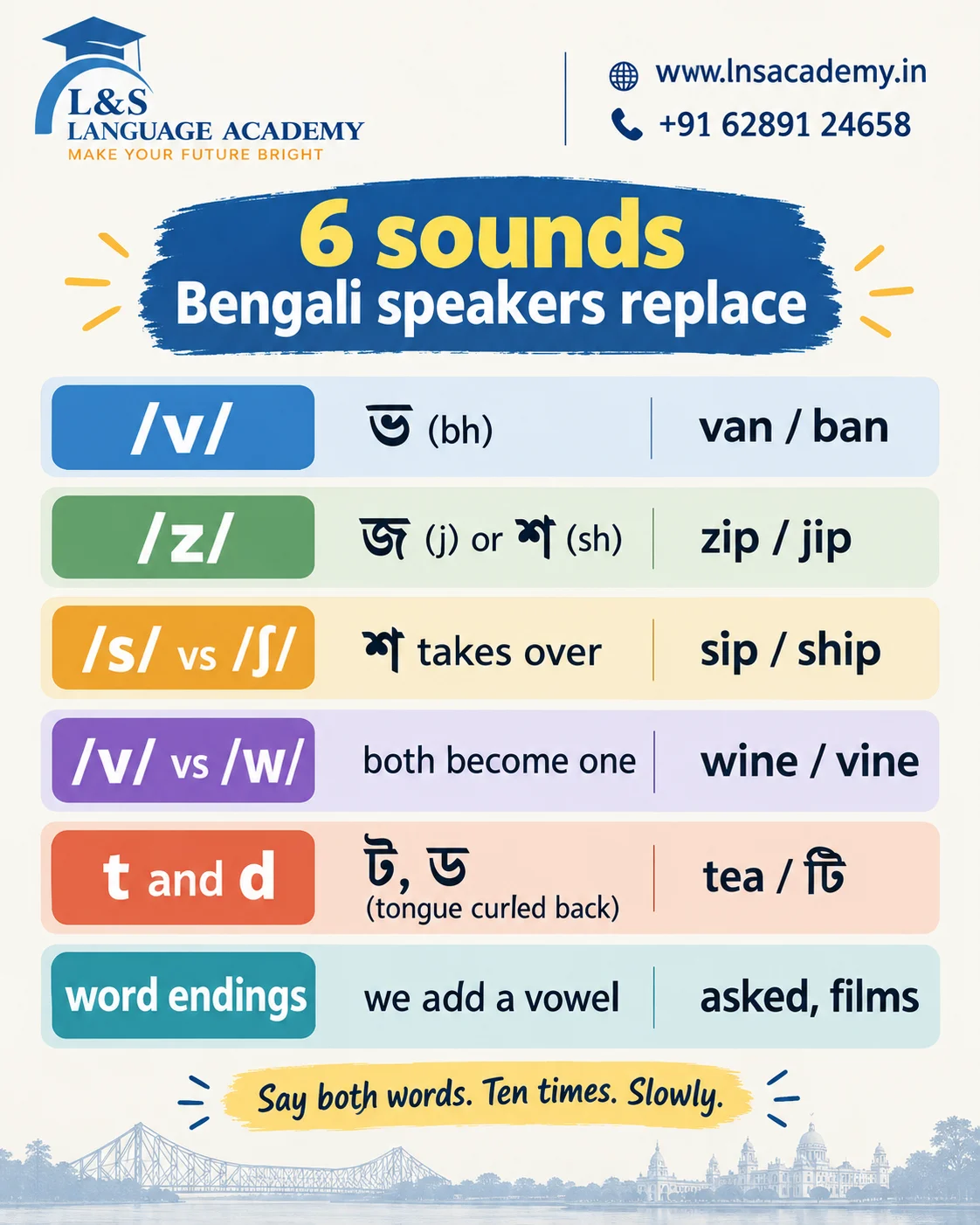
    <p>Six sounds cover most of it. Bengali simply does not have some of these sounds, so your mouth reaches for the nearest one it knows.</p>

    <div class="lns-table-scroller" role="region" aria-label="English sounds Bengali speakers commonly replace" tabindex="0">
      <table>
        <thead>
          <tr>
            <th>Sound</th>
            <th>What we say instead</th>
            <th>Example</th>
            <th>Practise these pairs</th>
          </tr>
        </thead>
        <tbody>
          <tr>
            <td><strong>/v/</strong></td>
            <td>ভ (bh)</td>
            <td>very becomes "bhery"</td>
            <td>van / ban, vote / boat, vest / best</td>
          </tr>
          <tr>
            <td><strong>/z/</strong></td>
            <td>জ (j) or শ (sh)</td>
            <td>zoo becomes "joo", busy becomes "bishi"</td>
            <td>zip / jip, prize / price, buzz / bus</td>
          </tr>
          <tr>
            <td><strong>/s/ vs /ʃ/</strong></td>
            <td>শ takes over</td>
            <td>sun becomes "shun"</td>
            <td>sip / ship, sea / she, sort / short</td>
          </tr>
          <tr>
            <td><strong>/v/ vs /w/</strong></td>
            <td>both become one sound</td>
            <td>west and vest sound same</td>
            <td>wine / vine, wet / vet, worse / verse</td>
          </tr>
          <tr>
            <td><strong>t and d</strong></td>
            <td>Bengali ট, ড (tongue curled back)</td>
            <td>the heavy "Indian t"</td>
            <td>Say "tea" with the tongue behind the front teeth, not on the roof</td>
          </tr>
          <tr>
            <td><strong>Word endings</strong></td>
            <td>we add a vowel or drop a letter</td>
            <td>asked becomes "ask", films becomes "filim"</td>
            <td>asked, helped, films, sixth, clothes</td>
          </tr>
        </tbody>
      </table>
    </div>

    <figure class="content-image">
      <img src="/wp-content/uploads/2026/09/bengali-english-pronunciation-sound-chart.webp" alt="Chart of English sounds Bengali speakers commonly replace, with practice word pairs" loading="lazy" width="1200" height="800" decoding="async">
      <figcaption>Word pairs like these are the fastest way to fix a sound. Say both, ten times, slowly. Your mouth learns the difference before your ear does.</figcaption>
    </figure>

    <p>Do not try to fix all six at once. Pick one. Work on it for a week. Then take the next. That is how it actually sticks.</p>
  </section>

  <section class="lns-content-section" id="flat-english">
    <h2>Why does my English sound flat even when the grammar is correct?</h2>

    <p>This is the big one. And almost nobody teaches it.</p>

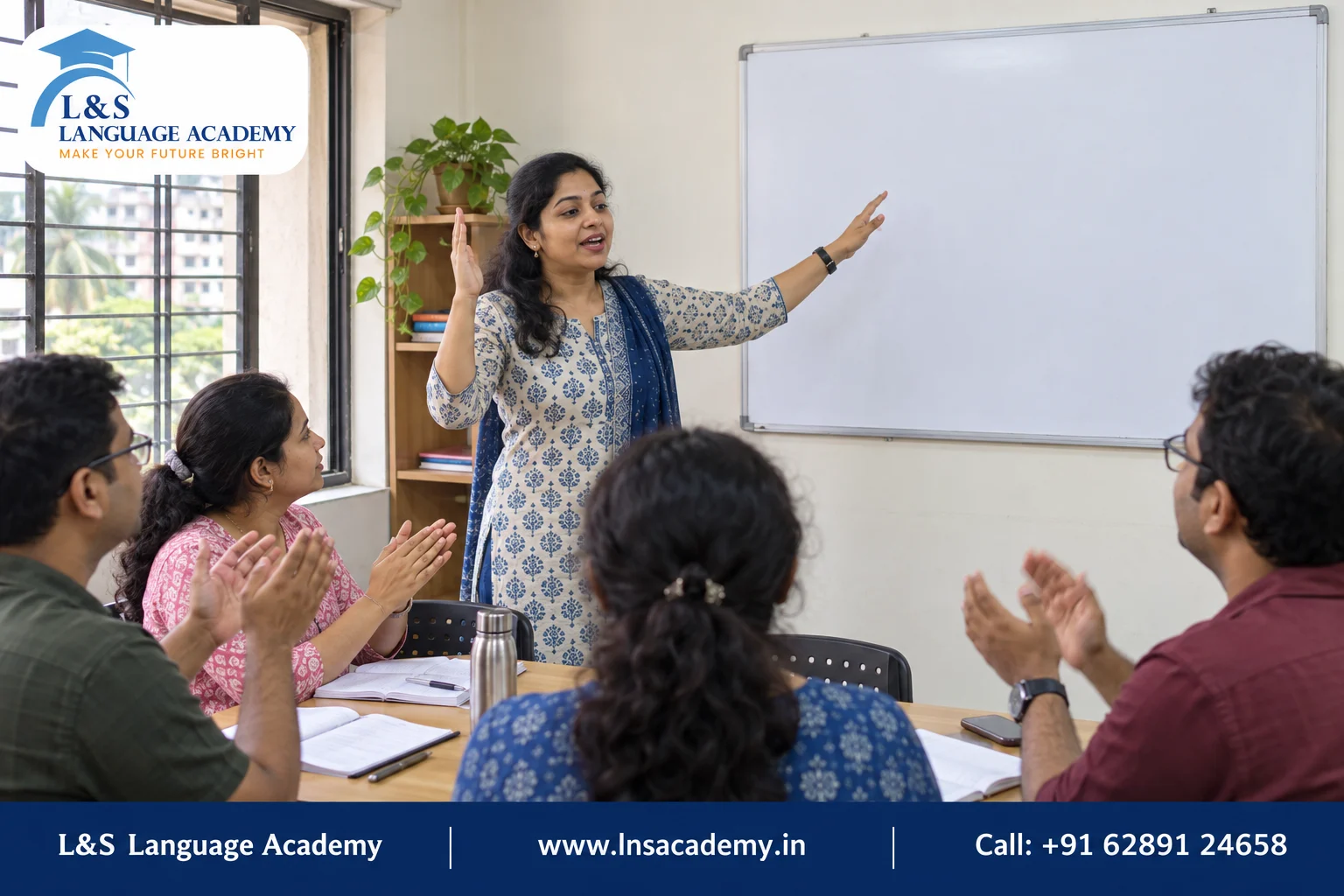
    <p>Bengali gives every syllable roughly equal weight. English does not. English stretches some syllables and squeezes others. Say these out loud:</p>

    <p><strong>PHO</strong>-to-graph. pho-<strong>TO</strong>-gra-phy. pho-to-<strong>GRA</strong>-phic.</p>

    <p>Same word family. The stress moves each time. Get it wrong and the word sounds odd, even if every sound is correct.</p>

    <p>It works at sentence level too. In English, the important words get pushed and the small words get swallowed. "I'm <strong>go</strong>ing to the <strong>off</strong>ice" comes out fast and uneven. Bengali speakers usually say "I am going to the office" with every word the same size. Correct English. Flat sound.</p>

    <p>Flat rhythm costs you more than any single wrong sound. People will understand a "bhery". They struggle more with a whole sentence that has no shape.</p>

    <figure class="content-image">
      <img src="/wp-content/uploads/2026/09/english-word-stress-rhythm-practice-kolkata.webp" alt="Trainer marking stressed syllables on a whiteboard during an English rhythm drill" loading="lazy" width="1200" height="800" decoding="async">
      <figcaption>We mark the stressed syllables and then clap the beat. It feels silly for about two minutes. Then it starts working.</figcaption>
    </figure>

    <p>The fix sounds childish but it is the standard exercise everywhere. Read nursery rhymes and limericks out loud. Clap on the strong beats. English rhythm is built into them.</p>
  </section>

  <section class="lns-content-section" id="grammar-mistakes">
    <h2>Which grammar mistakes do most Bengali speakers make?</h2>

    <p>Four, mainly.</p>

    <p><strong>Articles.</strong> Bengali has no "a" or "an". Our "the" is a suffix, টা or টি, stuck to the end of the word. So in English we either drop articles or put them everywhere. "I am going to office." "I bought the new phone yesterday."</p>

    <p><strong>Present continuous everywhere.</strong> "I am knowing him." "I am having two brothers." "I am not understanding." In English, some verbs do not take -ing. Know, have, understand, believe, want. Just say "I know him."</p>

    <p><strong>Question word order.</strong> Bengali puts the verb at the end. That habit leaks. "You are going where?" "He did what?" In English the question word comes first. "Where are you going?"</p>

    <p><strong>Yes and no.</strong> This one causes real trouble at work. In Bengali, "yes" agrees with the person asking. Someone asks, "You didn't go?" We say "yes", meaning "correct, I didn't go." In English, "yes" means "I went." Opposite meaning. Same word.</p>

    <p>Also watch the small ones. "Discuss about", "return back", "order for", "cope up with". English does not need the extra word.</p>
  </section>

  <section class="lns-content-section" id="having-a-doubt">
    <h2>Why do we say "I am having a doubt"?</h2>

    <p>Because that is normal Indian English. And inside India it is perfectly fine.</p>

    <p>Doubt for question. Prepone. Out of station. Do the needful. Passed out of college. Cousin brother. Revert back. Kindly do it. Every one of these is standard here. Nobody in Kolkata will blink.</p>

    <p>It only becomes a problem in three places. An international voice process. A study abroad or visa interview. A client call with someone outside India. There, "I have a doubt" sounds like you are doubting the other person.</p>

    <p>So the goal is not to stop using them. The goal is to know both, and pick. That is a skill, not a correction.</p>
  </section>

  <section class="lns-content-section" id="bengali-accent">
    <h2>Is a Bengali accent a problem?</h2>

    <p>No. Accent is not the problem. Being hard to understand is the problem.</p>

    <p>These are two different things and people mix them up constantly. An accent is how you sound. An error is something that blocks or changes the meaning. Saying "bhery" is an error, because "van" and "ban" become the same word. Sounding Bengali while saying clear English is just an accent.</p>

    <p>You do not need to sound British. You do not need to sound American. You need the other person to understand you the first time, every time, including on a phone call with background noise.</p>

    <p>We are not fans of the phrase "accent neutralisation". It suggests there is something wrong with how you sound. There isn't. Clarity is the goal.</p>
  </section>

  <section class="lns-content-section" id="stop-translating">
    <h2>How do I stop translating in my head?</h2>

    <p>First, stop worrying about it. Translating is a stage. Everyone goes through it. It fades.</p>

    <p>Four things speed it up.</p>

    <p><strong>Learn phrases, not words.</strong> Store "Could you please", "I'd rather", "What I meant was", "Let me check and get back to you". Whole chunks. Then you pull out a ready piece instead of building one.</p>

    <p><strong>Narrate your day.</strong> Out loud, while you are doing it. "I am opening the door. The bus is late. I will take a cab." Nobody is listening. That is the point.</p>

    <p><strong>Record sixty seconds daily.</strong> Any topic. Play it back once. Do not re-record. Just notice.</p>

    <p><strong>Read out loud.</strong> Ten minutes. Silent reading does nothing for your mouth. Reading aloud does.</p>

    <p>Most students tell us the gap shrinks somewhere around the eighth to twelfth week. Not gone. Shorter.</p>
  </section>

  <section class="lns-content-section" id="bengali-medium">
    <h2>Can a Bengali-medium student speak like an English-medium student?</h2>

    <p>Yes. And the reason is simple.</p>

    <p>English-medium students did not get better teaching. They got more hours. Ten or twelve years of hearing English in class, in the corridor, in the canteen. That is exposure, not talent.</p>

    <p>You can close that gap faster than they built it, because you can do something they never did. Get corrected on purpose. One hour of corrected speaking does more than ten hours of listening with nobody fixing you.</p>

    <p>One honest point. Sounds are easier to change when you are younger. But adults fix grammar and fluency faster than children, because adults can understand a rule and apply it. So starting at 30 or 45 is fine. You will just work differently.</p>

    <p>Our <a href="https://lnsacademy.in/testimonials/">student results page</a> has a few of these stories.</p>
  </section>

  <section class="lns-content-section" id="time-to-fix">
    <h2>How long does it take to fix these habits?</h2>

    <p>Nobody can promise a number. But the stages are fairly consistent.</p>

    <p><strong>Weeks 1 to 4.</strong> You start hearing your own mistakes. This is the real unlock and it feels strange at first.</p>

    <p><strong>Weeks 5 to 12.</strong> The sounds start coming out right when you are being careful.</p>

    <p><strong>Months 3 to 6.</strong> They hold up under pressure. Interviews. Phone calls. Somebody interrupting you.</p>

    <p><strong>After that.</strong> Rhythm and register keep improving for years. That part never really stops.</p>

    <p>Our courses run Beginner, then Intermediate, then Advanced. Two to three months each, about 60 to 80 hours per level. We have written more about realistic timelines in <a href="https://lnsacademy.in/blogs/how-long-to-speak-english-fluently/">how long it takes to speak English fluently</a>.</p>
  </section>

  <section class="lns-content-section" id="right-class">
    <h2>What kind of class actually fixes this?</h2>

    <p>Ask any institute these questions before you pay.</p>

    <ul class="lns-check-list">
      <li>Is the class live, or recorded videos?</li>
      <li>How many students in one batch?</li>
      <li>Is pronunciation a proper module, or something they mention once?</li>
      <li>Will anyone record me and play it back?</li>
      <li>Does the trainer speak Bengali?</li>
    </ul>

    <p>That last one matters more than people expect. A trainer who knows Bengali knows why you said "bhery". A trainer who does not will only tell you it was wrong. Knowing the cause is what makes the fix stick.</p>

    <figure class="content-image">
      <img src="/wp-content/uploads/2026/09/spoken-english-trainer-correction-bengali-student.webp" alt="Trainer correcting a student's pronunciation in a small batch spoken English class" loading="lazy" width="1200" height="800" decoding="async">
      <figcaption>Correction has to happen in the moment. A mistake pointed out three weeks later has already become a habit.</figcaption>
    </figure>

    <p>In our Beginner level, pronunciation and phonetics is its own module. Not a footnote. We also keep an error log for each student, carried forward week to week, so the same mistake does not quietly survive the whole course.</p>
  </section>

  <section class="lns-content-section" id="self-study">
    <h2>Can I fix this on my own, without joining a class?</h2>

    <p>Partly. Let us be straight about which parts.</p>

    <p><strong>You can do alone:</strong> vocabulary, listening, reading, grammar rules, chunk learning, daily recordings.</p>

    <p><strong>You cannot do alone:</strong> pronunciation. Not because you are lazy. Because you cannot hear the mistake. Your ear was trained on Bengali. It hears "bhery" as correct. That is exactly why it stayed wrong for twenty years.</p>

    <p>Same for old grammar habits. After about six months of repeating a mistake without correction, it hardens. Then it takes much longer to remove than it would have taken to learn right.</p>

    <p>If you are going solo anyway, do this. Record yourself weekly. Compare month to month, not day to day. Keep a written error list. Ask one honest person to tell you what they notice.</p>

    <p>We have also compared class formats in <a href="https://lnsacademy.in/blogs/online-vs-offline-spoken-english-classes-kolkata/">online versus offline spoken English classes</a>, and listed some good self-study reading in <a href="https://lnsacademy.in/blogs/best-books-to-improve-spoken-english/">books to improve spoken English</a>.</p>
  </section>

  <section class="lns-content-section" id="english-level">
    <h2>What English level should I aim for?</h2>

    <p>Most institutes use the <a href="https://www.coe.int/en/web/common-european-framework-reference-languages/level-descriptions" target="_blank" rel="noopener noreferrer">CEFR scale</a>. Six levels, A1 to C2. Here it is in plain words.</p>

    <ul class="lns-level-list">
      <li><strong>A1</strong> — a few memorised sentences.</li>
      <li><strong>A2</strong> — simple daily things. Shopping, directions.</li>
      <li><strong>B1</strong> — you can handle most normal work situations. This is the working level.</li>
      <li><strong>B2</strong> — you can argue a point, handle interruptions, follow fast speech. This is the professional level.</li>
      <li><strong>C1</strong> — you can lead a meeting and persuade people.</li>
      <li><strong>C2</strong> — near-native.</li>
    </ul>

    <p>Here is the thing about Bengali-medium students. Your understanding is often B1 or higher. Your speaking sits at A2. That mismatch is this whole article in one line.</p>

    <p>Most jobs in Kolkata want B1 or B2. Not fluency. B1 or B2.</p>
  </section>

  <section class="lns-content-section" id="course-cost">
    <h2>What does the course cost at LNS?</h2>

    <div class="lns-table-scroller" role="region" aria-label="LNS spoken English course cost" tabindex="0">
      <table>
        <thead>
          <tr>
            <th>Level</th>
            <th>Duration</th>
            <th>Offline</th>
            <th>Online</th>
          </tr>
        </thead>
        <tbody>
          <tr>
            <td>Beginner</td>
            <td>2–3 months</td>
            <td>₹5,000–12,000</td>
            <td>₹3,000–8,000</td>
          </tr>
          <tr>
            <td>Intermediate</td>
            <td>2–3 months</td>
            <td>₹6,000–15,000</td>
            <td>₹4,000–10,000</td>
          </tr>
          <tr>
            <td>Advanced</td>
            <td>2–3 months</td>
            <td>₹8,000–25,000</td>
            <td>₹5,000–15,000</td>
          </tr>
        </tbody>
      </table>
    </div>

    <p>Full details are on our <a href="https://lnsacademy.in/language-course-fees-in-kolkata/">course fees page</a>. Call <a href="tel:+916289124658">62891 24658</a> for the current rate and batch timing.</p>

    <p>If you want to work out whether it is worth it, do this sum yourself. Take the monthly salary you are aiming for. Subtract what you earn now. Divide the course fee by that difference. That is how many months it takes to pay for itself. For most people the number is small. But it is your number, so run it with your figures.</p>

    <p>We issue our own completion certificate after an internal test at the end of each level. We do not conduct IELTS, TOEFL, Cambridge or any other outside exam. Those are run by their own bodies. We prepare you, you sit them independently.</p>
  </section>

  <section class="lns-content-section" id="location">
    <h2>Where is LNS, and which areas do you cover?</h2>

    <p>Our centre is at 108, Majumder Para, 1 No Airport Gate, Kolkata 700079. Easy from Dum Dum, Nagerbazar, Baguiati, Kestopur, Lake Town, Birati and Madhyamgram.</p>

    <p>Online batches cover Salt Lake, New Town, Barasat, Behala, Howrah and anywhere else in India.</p>
  </section>

  <section class="lns-content-section" id="frequently-asked-questions">
    <h2>Frequently Asked Questions</h2>

    <div class="lns-faq-container">
      <article class="lns-faq-item">
        <h3><button class="lns-faq-question" type="button" aria-expanded="false" aria-controls="faq-answer-1" id="faq-question-1">Is spoken English harder for Bengali speakers than for other Indians?</button></h3>
        <div class="lns-faq-answer" id="faq-answer-1" role="region" aria-labelledby="faq-question-1" hidden>
          <p>Not harder. Different. Bengali speakers struggle more with v, z and s sounds. Tamil speakers struggle with different ones. Every language group has its own list.</p>
        </div>
      </article>

      <article class="lns-faq-item">
        <h3><button class="lns-faq-question" type="button" aria-expanded="false" aria-controls="faq-answer-2" id="faq-question-2">My English is fine on WhatsApp but bad on a call. Why?</button></h3>
        <div class="lns-faq-answer" id="faq-answer-2" role="region" aria-labelledby="faq-question-2" hidden>
          <p>Typing gives you time to edit. Speaking does not. You are not worse at English on calls. You just lose your edit button.</p>
        </div>
      </article>

      <article class="lns-faq-item">
        <h3><button class="lns-faq-question" type="button" aria-expanded="false" aria-controls="faq-answer-3" id="faq-question-3">I speak better English with strangers than with my own family. Is that normal?</button></h3>
        <div class="lns-faq-answer" id="faq-answer-3" role="region" aria-labelledby="faq-question-3" hidden>
          <p>Very. With family, Bengali is the default, so switching feels unnatural and everyone laughs. With strangers there is no history. Many students practise better outside the house.</p>
        </div>
      </article>

      <article class="lns-faq-item">
        <h3><button class="lns-faq-question" type="button" aria-expanded="false" aria-controls="faq-answer-4" id="faq-question-4">Will I lose my Bengali accent completely?</button></h3>
        <div class="lns-faq-answer" id="faq-answer-4" role="region" aria-labelledby="faq-question-4" hidden>
          <p>No, and you should not want to. We work on clarity, not on erasing how you sound.</p>
        </div>
      </article>

      <article class="lns-faq-item">
        <h3><button class="lns-faq-question" type="button" aria-expanded="false" aria-controls="faq-answer-5" id="faq-question-5">My child corrects my English. Should I let him?</button></h3>
        <div class="lns-faq-answer" id="faq-answer-5" role="region" aria-labelledby="faq-question-5" hidden>
          <p>Let him. Free correction is free correction. Just check the correction is actually right before you accept it.</p>
        </div>
      </article>

      <article class="lns-faq-item">
        <h3><button class="lns-faq-question" type="button" aria-expanded="false" aria-controls="faq-answer-6" id="faq-question-6">Does speaking Bengali all day spoil my English?</button></h3>
        <div class="lns-faq-answer" id="faq-answer-6" role="region" aria-labelledby="faq-question-6" hidden>
          <p>No. This is a common worry and it is wrong. Bilingual people do fine. What slows you is not speaking English at all, not speaking Bengali too much.</p>
        </div>
      </article>

      <article class="lns-faq-item">
        <h3><button class="lns-faq-question" type="button" aria-expanded="false" aria-controls="faq-answer-7" id="faq-question-7">Can I practise with a friend who also makes mistakes?</button></h3>
        <div class="lns-faq-answer" id="faq-answer-7" role="region" aria-labelledby="faq-question-7" hidden>
          <p>Yes for fluency and confidence. No for correction. Two people with the same habits will agree on the wrong thing.</p>
        </div>
      </article>

      <article class="lns-faq-item">
        <h3><button class="lns-faq-question" type="button" aria-expanded="false" aria-controls="faq-answer-8" id="faq-question-8">I only freeze when my boss is listening. Is that a language problem?</button></h3>
        <div class="lns-faq-answer" id="faq-answer-8" role="region" aria-labelledby="faq-question-8" hidden>
          <p>Mostly a pressure problem sitting on top of a small language gap. Mock practice under pressure fixes it faster than more grammar.</p>
        </div>
      </article>

      <article class="lns-faq-item">
        <h3><button class="lns-faq-question" type="button" aria-expanded="false" aria-controls="faq-answer-9" id="faq-question-9">Can complete beginners join?</button></h3>
        <div class="lns-faq-answer" id="faq-answer-9" role="region" aria-labelledby="faq-question-9" hidden>
          <p>Yes. The Beginner level starts from basics. You do not need to form full sentences before joining.</p>
        </div>
      </article>

      <article class="lns-faq-item">
        <h3><button class="lns-faq-question" type="button" aria-expanded="false" aria-controls="faq-answer-10" id="faq-question-10">Do you teach in Bengali or English?</button></h3>
        <div class="lns-faq-answer" id="faq-answer-10" role="region" aria-labelledby="faq-question-10" hidden>
          <p>Both, depending on the level. Beginner batches use more Bengali. By Advanced it is almost fully English.</p>
        </div>
      </article>

      <article class="lns-faq-item">
        <h3><button class="lns-faq-question" type="button" aria-expanded="false" aria-controls="faq-answer-11" id="faq-question-11">Is there an age limit?</button></h3>
        <div class="lns-faq-answer" id="faq-answer-11" role="region" aria-labelledby="faq-question-11" hidden>
          <p>No. We take school students, college students, freshers, working people and homemakers.</p>
        </div>
      </article>

      <article class="lns-faq-item">
        <h3><button class="lns-faq-question" type="button" aria-expanded="false" aria-controls="faq-answer-12" id="faq-question-12">How is this different from IELTS coaching?</button></h3>
        <div class="lns-faq-answer" id="faq-answer-12" role="region" aria-labelledby="faq-question-12" hidden>
          <p>IELTS coaching trains you for an exam format. This trains you to speak. Different goals. Many students do this first, then IELTS.</p>
        </div>
      </article>

      <article class="lns-faq-item">
        <h3><button class="lns-faq-question" type="button" aria-expanded="false" aria-controls="faq-answer-13" id="faq-question-13">Do you have a free demo class?</button></h3>
        <div class="lns-faq-answer" id="faq-answer-13" role="region" aria-labelledby="faq-question-13" hidden>
          <p>Yes. Come and sit through one before you decide anything.</p>
        </div>
      </article>
    </div>
  </section>

  <section class="lns-content-section lns-closing-cta" id="free-demo">
    <h2>Want to hear what you cannot hear?</h2>

    <p>Most students are surprised in the first class. Not by how much they get wrong. By how much they never noticed.</p>

    <p><a class="lns-cta-button" href="#ct-popup-2146">Book a free demo.</a> We will listen to you speak for a few minutes and tell you which of the eleven habits you are carrying. No charge, no pressure.</p>

    <p>Call <strong><a href="tel:+916289124658">62891 24658</a></strong> or write to <strong><a href="mailto:contact@lnsacademy.in">contact@lnsacademy.in</a></strong>. Or see the full <a href="https://lnsacademy.in/language-courses/spoken-english-classes-in-kolkata/">spoken English course details</a>.</p>
  </section>
</main>

<!-- ============================================================
     JAVASCRIPT SNIPPET
     ============================================================ -->
<script>
(function () {
  "use strict";

  var root = document.getElementById("lns-spoken-english-bengali-speakers");
  if (!root) return;

  root.querySelectorAll(".lns-faq-question").forEach(function (button) {
    button.addEventListener("click", function () {
      var answerId = button.getAttribute("aria-controls");
      var answer = document.getElementById(answerId);
      if (!answer) return;

      var isOpen = button.getAttribute("aria-expanded") === "true";
      button.setAttribute("aria-expanded", String(!isOpen));
      answer.hidden = isOpen;
    });
  });

  root.querySelectorAll('.lns-toc-list a[href^="#"]').forEach(function (link) {
    link.addEventListener("click", function (event) {
      var target = document.querySelector(link.getAttribute("href"));
      if (!target) return;

      event.preventDefault();
      target.scrollIntoView({ behavior: "smooth", block: "start" });
      history.replaceState(null, "", link.getAttribute("href"));
    });
  });
})();
</script>

<!-- ============================================================
     JSON-LD SCHEMA SNIPPET
     ============================================================ -->
<script type="application/ld+json">
{
  "@context": "https://schema.org",
  "@graph": [
    {
      "@type": "BlogPosting",
      "@id": "https://lnsacademy.in/blogs/spoken-english-for-bengali-speakers/#article",
      "headline": "Why Bengali Speakers Get Stuck in English (And How to Fix It)",
      "description": "The eleven sound, grammar and rhythm habits Bengali speakers carry into English, and the practice fix for each one.",
      "image": {
        "@type": "ImageObject",
        "url": "https://lnsacademy.in/wp-content/uploads/2026/09/spoken-english-bengali-speakers-kolkata-featured.webp",
        "width": 1200,
        "height": 675
      },
      "datePublished": "2026-09-19",
      "dateModified": "2026-09-19",
      "inLanguage": "en-IN",
      "author": {
        "@type": "Person",
        "name": "ADD TRAINER NAME — REQUIRED BEFORE PUBLISHING",
        "url": "https://lnsacademy.in/about/"
      },
      "publisher": {
        "@id": "https://lnsacademy.in/#organization"
      },
      "mainEntityOfPage": {
        "@type": "WebPage",
        "@id": "https://lnsacademy.in/blogs/spoken-english-for-bengali-speakers/"
      },
      "about": [
        {
          "@type": "Thing",
          "name": "Mother tongue influence"
        },
        {
          "@type": "Thing",
          "name": "English pronunciation"
        },
        {
          "@type": "Language",
          "name": "Bengali"
        }
      ],
      "speakable": {
        "@type": "SpeakableSpecification",
        "cssSelector": [
          "#page-title",
          ".lns-answer-block"
        ]
      }
    },
    {
      "@type": "FAQPage",
      "@id": "https://lnsacademy.in/blogs/spoken-english-for-bengali-speakers/#faq",
      "mainEntity": [
        {
          "@type": "Question",
          "name": "Is spoken English harder for Bengali speakers than for other Indians?",
          "acceptedAnswer": {
            "@type": "Answer",
            "text": "Not harder. Different. Bengali speakers struggle more with v, z and s sounds. Tamil speakers struggle with different ones. Every language group has its own list."
          }
        },
        {
          "@type": "Question",
          "name": "My English is fine on WhatsApp but bad on a call. Why?",
          "acceptedAnswer": {
            "@type": "Answer",
            "text": "Typing gives you time to edit. Speaking does not. You are not worse at English on calls. You just lose your edit button."
          }
        },
        {
          "@type": "Question",
          "name": "I speak better English with strangers than with my own family. Is that normal?",
          "acceptedAnswer": {
            "@type": "Answer",
            "text": "Very. With family, Bengali is the default, so switching feels unnatural and everyone laughs. With strangers there is no history. Many students practise better outside the house."
          }
        },
        {
          "@type": "Question",
          "name": "Will I lose my Bengali accent completely?",
          "acceptedAnswer": {
            "@type": "Answer",
            "text": "No, and you should not want to. We work on clarity, not on erasing how you sound."
          }
        },
        {
          "@type": "Question",
          "name": "My child corrects my English. Should I let him?",
          "acceptedAnswer": {
            "@type": "Answer",
            "text": "Let him. Free correction is free correction. Just check the correction is actually right before you accept it."
          }
        },
        {
          "@type": "Question",
          "name": "Does speaking Bengali all day spoil my English?",
          "acceptedAnswer": {
            "@type": "Answer",
            "text": "No. This is a common worry and it is wrong. Bilingual people do fine. What slows you is not speaking English at all, not speaking Bengali too much."
          }
        },
        {
          "@type": "Question",
          "name": "Can I practise with a friend who also makes mistakes?",
          "acceptedAnswer": {
            "@type": "Answer",
            "text": "Yes for fluency and confidence. No for correction. Two people with the same habits will agree on the wrong thing."
          }
        },
        {
          "@type": "Question",
          "name": "I only freeze when my boss is listening. Is that a language problem?",
          "acceptedAnswer": {
            "@type": "Answer",
            "text": "Mostly a pressure problem sitting on top of a small language gap. Mock practice under pressure fixes it faster than more grammar."
          }
        },
        {
          "@type": "Question",
          "name": "Can complete beginners join?",
          "acceptedAnswer": {
            "@type": "Answer",
            "text": "Yes. The Beginner level starts from basics. You do not need to form full sentences before joining."
          }
        },
        {
          "@type": "Question",
          "name": "Do you teach in Bengali or English?",
          "acceptedAnswer": {
            "@type": "Answer",
            "text": "Both, depending on the level. Beginner batches use more Bengali. By Advanced it is almost fully English."
          }
        },
        {
          "@type": "Question",
          "name": "Is there an age limit?",
          "acceptedAnswer": {
            "@type": "Answer",
            "text": "No. We take school students, college students, freshers, working people and homemakers."
          }
        },
        {
          "@type": "Question",
          "name": "How is this different from IELTS coaching?",
          "acceptedAnswer": {
            "@type": "Answer",
            "text": "IELTS coaching trains you for an exam format. This trains you to speak. Different goals. Many students do this first, then IELTS."
          }
        },
        {
          "@type": "Question",
          "name": "Do you have a free demo class?",
          "acceptedAnswer": {
            "@type": "Answer",
            "text": "Yes. Come and sit through one before you decide anything."
          }
        }
      ]
    },
    {
      "@type": "BreadcrumbList",
      "@id": "https://lnsacademy.in/blogs/spoken-english-for-bengali-speakers/#breadcrumb",
      "itemListElement": [
        {
          "@type": "ListItem",
          "position": 1,
          "name": "Home",
          "item": "https://lnsacademy.in/"
        },
        {
          "@type": "ListItem",
          "position": 2,
          "name": "Blogs",
          "item": "https://lnsacademy.in/blogs/"
        },
        {
          "@type": "ListItem",
          "position": 3,
          "name": "Spoken English for Bengali Speakers",
          "item": "https://lnsacademy.in/blogs/spoken-english-for-bengali-speakers/"
        }
      ]
    }
  ]
}/* End custom CSS */