.elementor-2718 .elementor-element.elementor-element-6fd957f{--display:flex;--margin-top:150px;--margin-bottom:0px;--margin-left:0px;--margin-right:0px;}/* Start custom CSS for html, class: .elementor-element-e1b97b3 */.lns-blog-wrapper {
  --lns-primary: #1b4690;
  --lns-secondary: #f7911d;
  --lns-rare: #d1e5ff;
  --lns-others: #ffe4c5;
  --lns-important: #c49600;
  --lns-text: #222222;
  --lns-muted: #5d6673;
  --lns-white: #ffffff;
  --lns-border: #dce5f2;
  --lns-danger: #b42318;
  --lns-shadow: 0 16px 42px rgba(27, 70, 144, 0.1);
}

.lns-blog-wrapper,
.lns-blog-wrapper * {
  box-sizing: border-box;
}

.lns-blog-wrapper {
  width: 100%;
  max-width: 100%;
  margin: 0 auto;
  padding: clamp(18px, 3vw, 42px);
  color: var(--lns-text);
  font-family: inherit;
  font-size: clamp(1rem, 0.97rem + 0.15vw, 1.1rem);
  line-height: 1.78;
  background-color: transparent;
  background-image:
    radial-gradient(circle at 1px 1px, rgba(27, 70, 144, 0.11) 1px, transparent 0),
    linear-gradient(135deg, rgba(209, 229, 255, 0.2), rgba(255, 228, 197, 0.14));
  background-size: 28px 28px, 100% 100%;
}

.lns-blog-wrapper > section,
.lns-blog-wrapper > .lns-toc-container,
.lns-blog-wrapper > .lns-required-info {
  width: min(100%, 1180px);
  margin-right: auto;
  margin-left: auto;
}

.lns-blog-wrapper section {
  scroll-margin-top: 90px;
}

.lns-blog-wrapper h1,
.lns-blog-wrapper h2,
.lns-blog-wrapper h3 {
  color: var(--lns-primary);
  font-family: inherit;
  font-weight: 750;
  line-height: 1.25;
  text-wrap: balance;
}

.lns-blog-wrapper h1 {
  max-width: 980px;
  margin: 0 0 1.25rem;
  padding-bottom: 0.7rem;
  border-bottom: 4px solid var(--lns-secondary);
  font-size: clamp(2rem, 5vw, 3.7rem);
}

.lns-blog-wrapper h2 {
  margin: 0 0 1.1rem;
  padding-left: 16px;
  border-left: 5px solid var(--lns-important);
  font-size: clamp(1.55rem, 3vw, 2.25rem);
}

.lns-blog-wrapper h3 {
  margin: 0;
  font-size: clamp(1.05rem, 2vw, 1.25rem);
}

.lns-blog-wrapper p {
  margin: 0 0 1.3rem;
}

.lns-blog-wrapper a {
  color: var(--lns-primary);
  text-decoration-thickness: 2px;
  text-underline-offset: 3px;
}

.lns-blog-wrapper a:hover,
.lns-blog-wrapper a:focus-visible {
  color: #12346f;
}

.lns-content-section {
  margin-top: clamp(2.2rem, 6vw, 4.8rem);
  padding: clamp(20px, 3vw, 38px);
  border: 1px solid rgba(27, 70, 144, 0.1);
  border-radius: 22px;
  background: rgba(255, 255, 255, 0.94);
  box-shadow: var(--lns-shadow);
}

.lns-hero {
  padding: clamp(22px, 4vw, 48px);
  overflow: hidden;
  border: 1px solid rgba(27, 70, 144, 0.12);
  border-radius: 26px;
  background: linear-gradient(135deg, rgba(255, 255, 255, 0.98), rgba(209, 229, 255, 0.72));
  box-shadow: var(--lns-shadow);
}

.lns-answer-block {
  margin: 1.5rem 0;
  padding: 20px 22px;
  border-left: 5px solid var(--lns-primary);
  border-radius: 0 12px 12px 0;
  background: var(--lns-rare);
  box-shadow: 0 8px 20px rgba(27, 70, 144, 0.08);
}

.lns-answer-block p:last-child {
  margin-bottom: 0;
}

.lns-required-info {
  margin-bottom: 1.25rem;
  padding: 14px 18px;
  border: 2px solid var(--lns-danger);
  border-radius: 10px;
  color: var(--lns-danger);
  background: #fff4f2;
  font-weight: 700;
}

.lns-toc-container {
  margin-top: 1.5rem;
  padding: 0;
  overflow: hidden;
  border: 1px solid var(--lns-border);
  border-radius: 16px;
  background: var(--lns-white);
  box-shadow: 0 10px 28px rgba(27, 70, 144, 0.08);
}

.lns-toc-container summary {
  display: flex;
  align-items: center;
  justify-content: space-between;
  gap: 1rem;
  padding: 18px 20px;
  color: var(--lns-primary);
  cursor: pointer;
  font-size: 1.15rem;
  font-weight: 750;
  list-style: none;
}

.lns-toc-container summary::-webkit-details-marker {
  display: none;
}

.lns-toc-container summary::after {
  content: "\f078";
  font-family: "Font Awesome 6 Free";
  font-weight: 900;
  color: var(--lns-secondary);
  transition: transform 0.25s ease;
}

.lns-toc-container[open] summary::after {
  transform: rotate(180deg);
}

.lns-toc-content {
  padding: 2px 20px 20px;
  border-top: 1px solid var(--lns-border);
}

.lns-toc-list {
  columns: 2 320px;
  gap: 34px;
  margin: 1rem 0 0;
  padding: 0;
  list-style: none;
}

.lns-toc-list li {
  break-inside: avoid;
  margin: 0 0 0.7rem;
}

.lns-toc-list a {
  display: inline-flex;
  gap: 9px;
  align-items: flex-start;
  text-decoration: none;
}

.lns-toc-list a::before {
  content: "\f02d";
  margin-top: 0.28rem;
  color: var(--lns-secondary);
  font-family: "Font Awesome 6 Free";
  font-size: 0.78rem;
  font-weight: 900;
}

.lns-blog-wrapper figure {
  margin: 2rem 0;
  text-align: center;
}

.lns-blog-wrapper img {
  display: block;
  width: 100%;
  max-width: 100%;
  height: auto;
  margin: 0 auto;
  border-radius: 18px;
  object-fit: cover;
  box-shadow: 0 16px 38px rgba(27, 70, 144, 0.14);
}

.lns-blog-wrapper figcaption {
  max-width: 900px;
  margin: 0.8rem auto 0;
  color: var(--lns-muted);
  font-size: 0.92rem;
  font-style: italic;
  line-height: 1.55;
}

.lns-table-scroller {
  width: 100%;
  margin: 2rem 0;
  overflow-x: auto;
  border: 1px solid var(--lns-border);
  border-radius: 15px;
  background: var(--lns-white);
  box-shadow: 0 12px 30px rgba(27, 70, 144, 0.08);
  -webkit-overflow-scrolling: touch;
}

.lns-table-scroller table {
  width: 100%;
  min-width: 720px;
  border: 0;
  border-collapse: collapse;
  text-align: left;
}

.lns-table-scroller th,
.lns-table-scroller td {
  padding: 14px 16px;
  border-right: 1px solid var(--lns-border);
  border-bottom: 1px solid var(--lns-border);
  vertical-align: top;
}

.lns-table-scroller th:last-child,
.lns-table-scroller td:last-child {
  border-right: 0;
}

.lns-table-scroller tbody tr:last-child td {
  border-bottom: 0;
}

.lns-table-scroller th {
  color: var(--lns-white);
  background: var(--lns-primary);
  font-weight: 700;
}

.lns-table-scroller tbody tr:nth-child(even) {
  background: #f8fbff;
}

.lns-table-scroller tbody tr:hover {
  background: var(--lns-rare);
}

.lns-check-list,
.lns-level-list {
  margin: 1.4rem 0;
  padding: 0;
  list-style: none;
}

.lns-check-list li,
.lns-level-list li {
  position: relative;
  margin-bottom: 0.85rem;
  padding: 14px 16px 14px 46px;
  border: 1px solid var(--lns-border);
  border-radius: 12px;
  background: #fbfdff;
}

.lns-check-list li::before,
.lns-level-list li::before {
  position: absolute;
  top: 14px;
  left: 16px;
  color: var(--lns-secondary);
  font-family: "Font Awesome 6 Free";
  font-weight: 900;
}

.lns-check-list li::before {
  content: "\f058";
}

.lns-level-list li::before {
  content: "\f19d";
}

.lns-faq-container {
  margin-top: 1.5rem;
}

.lns-faq-item {
  margin-bottom: 12px;
  overflow: hidden;
  border: 1px solid var(--lns-border);
  border-radius: 14px;
  background: var(--lns-white);
  box-shadow: 0 7px 20px rgba(27, 70, 144, 0.05);
}

.lns-faq-question {
  width: 100%;
  display: flex;
  align-items: center;
  justify-content: space-between;
  gap: 1rem;
  padding: 18px 20px;
  border: 0;
  color: var(--lns-primary);
  background: transparent;
  cursor: pointer;
  font: inherit;
  font-weight: 750;
  line-height: 1.4;
  text-align: left;
}

.lns-faq-question::after {
  content: "\2b";
  flex: 0 0 auto;
  color: var(--lns-secondary);
  font-family: "Font Awesome 6 Free";
  font-weight: 900;
  transition: transform 0.25s ease;
}

.lns-faq-question[aria-expanded="true"]::after {
  transform: rotate(45deg);
}

.lns-faq-question:hover,
.lns-faq-question:focus-visible {
  background: #f7faff;
  outline: 0;
}

.lns-faq-answer {
  padding: 0 20px 18px;
  border-top: 1px solid var(--lns-border);
  background: var(--lns-white);
}

.lns-faq-answer p {
  margin: 15px 0 0;
}

.lns-closing-cta {
  text-align: center;
  border: 2px dashed var(--lns-primary);
  background: linear-gradient(135deg, var(--lns-rare), var(--lns-others));
}

.lns-closing-cta h2 {
  display: inline-block;
  padding: 0 0 8px;
  border: 0;
  border-bottom: 4px solid var(--lns-secondary);
}

.lns-cta-button {
  display: inline-flex;
  align-items: center;
  justify-content: center;
  gap: 10px;
  margin: 0.35rem 0 1.4rem;
  padding: 14px 30px;
  border: 2px solid transparent;
  border-radius: 999px;
  color: var(--lns-white) !important;
  background: var(--lns-secondary);
  box-shadow: 0 8px 22px rgba(247, 145, 29, 0.32);
  font-size: 1.1rem;
  font-weight: 750;
  text-decoration: none !important;
  transition: transform 0.2s ease, background 0.2s ease, box-shadow 0.2s ease;
}

.lns-cta-button::before {
  content: "\f075";
  font-family: "Font Awesome 6 Free";
  font-weight: 900;
}

.lns-cta-button:hover,
.lns-cta-button:focus-visible {
  color: var(--lns-white) !important;
  background: var(--lns-primary);
  box-shadow: 0 10px 26px rgba(27, 70, 144, 0.28);
  transform: translateY(-2px);
}

@media (max-width: 767px) {
  .lns-blog-wrapper {
    padding: 14px;
    line-height: 1.7;
  }

  .lns-content-section,
  .lns-hero {
    padding: 20px 16px;
    border-radius: 16px;
  }

  .lns-blog-wrapper h1 {
    font-size: clamp(1.85rem, 9vw, 2.65rem);
  }

  .lns-blog-wrapper h2 {
    padding-left: 12px;
  }

  .lns-toc-list {
    columns: 1;
  }

  .lns-faq-question {
    padding: 16px;
  }

  .lns-faq-answer {
    padding: 0 16px 16px;
  }

  .lns-table-scroller::before {
    content: "Swipe to view the full table →";
    display: block;
    padding: 10px 14px;
    color: var(--lns-primary);
    background: var(--lns-others);
    font-size: 0.85rem;
    font-weight: 700;
  }
}

/* WordPress / Blocksy / Elementor colour compatibility overrides */
.entry-content .lns-blog-wrapper,
.elementor-widget-html .lns-blog-wrapper,
.lns-blog-wrapper {
  color: #222222 !important;
}

.entry-content .lns-blog-wrapper h1,
.entry-content .lns-blog-wrapper h2,
.entry-content .lns-blog-wrapper h3,
.elementor-widget-html .lns-blog-wrapper h1,
.elementor-widget-html .lns-blog-wrapper h2,
.elementor-widget-html .lns-blog-wrapper h3,
.lns-blog-wrapper h1,
.lns-blog-wrapper h2,
.lns-blog-wrapper h3 {
  color: #1b4690 !important;
}

.entry-content .lns-blog-wrapper h1,
.elementor-widget-html .lns-blog-wrapper h1,
.lns-blog-wrapper h1 {
  border-bottom-color: #f7911d !important;
}

.entry-content .lns-blog-wrapper h2,
.elementor-widget-html .lns-blog-wrapper h2,
.lns-blog-wrapper h2 {
  border-left-color: #c49600 !important;
}

.entry-content .lns-blog-wrapper a:not(.lns-cta-button),
.elementor-widget-html .lns-blog-wrapper a:not(.lns-cta-button),
.lns-blog-wrapper a:not(.lns-cta-button) {
  color: #1b4690 !important;
}

.entry-content .lns-blog-wrapper .lns-hero,
.elementor-widget-html .lns-blog-wrapper .lns-hero,
.lns-blog-wrapper .lns-hero {
  background: linear-gradient(135deg, #ffffff, #d1e5ff) !important;
}

.entry-content .lns-blog-wrapper .lns-answer-block,
.elementor-widget-html .lns-blog-wrapper .lns-answer-block,
.lns-blog-wrapper .lns-answer-block {
  border-left-color: #1b4690 !important;
  background: #d1e5ff !important;
}

.entry-content .lns-blog-wrapper .lns-content-section,
.elementor-widget-html .lns-blog-wrapper .lns-content-section,
.lns-blog-wrapper .lns-content-section {
  background-color: rgba(255, 255, 255, 0.96) !important;
}

.entry-content .lns-blog-wrapper .lns-toc-container,
.elementor-widget-html .lns-blog-wrapper .lns-toc-container,
.lns-blog-wrapper .lns-toc-container {
  background-color: #ffffff !important;
}

.entry-content .lns-blog-wrapper .lns-toc-container summary,
.elementor-widget-html .lns-blog-wrapper .lns-toc-container summary,
.lns-blog-wrapper .lns-toc-container summary {
  color: #1b4690 !important;
  background-color: #ffffff !important;
}

.entry-content .lns-blog-wrapper .lns-table-scroller th,
.elementor-widget-html .lns-blog-wrapper .lns-table-scroller th,
.lns-blog-wrapper .lns-table-scroller th {
  color: #ffffff !important;
  background-color: #1b4690 !important;
}

.entry-content .lns-blog-wrapper .lns-table-scroller tbody tr:nth-child(even),
.elementor-widget-html .lns-blog-wrapper .lns-table-scroller tbody tr:nth-child(even),
.lns-blog-wrapper .lns-table-scroller tbody tr:nth-child(even) {
  background-color: #f4f8ff !important;
}

.entry-content .lns-blog-wrapper .lns-faq-question,
.elementor-widget-html .lns-blog-wrapper .lns-faq-question,
.lns-blog-wrapper .lns-faq-question {
  color: #1b4690 !important;
  background-color: #ffffff !important;
}

.entry-content .lns-blog-wrapper .lns-faq-question::after,
.elementor-widget-html .lns-blog-wrapper .lns-faq-question::after,
.lns-blog-wrapper .lns-faq-question::after {
  color: #f7911d !important;
}

.entry-content .lns-blog-wrapper .lns-closing-cta,
.elementor-widget-html .lns-blog-wrapper .lns-closing-cta,
.lns-blog-wrapper .lns-closing-cta {
  border-color: #1b4690 !important;
  background: linear-gradient(135deg, #d1e5ff, #ffe4c5) !important;
}

.entry-content .lns-blog-wrapper .lns-cta-button,
.elementor-widget-html .lns-blog-wrapper .lns-cta-button,
.lns-blog-wrapper .lns-cta-button {
  color: #ffffff !important;
  background-color: #f7911d !important;
}

.entry-content .lns-blog-wrapper .lns-cta-button:hover,
.entry-content .lns-blog-wrapper .lns-cta-button:focus-visible,
.elementor-widget-html .lns-blog-wrapper .lns-cta-button:hover,
.elementor-widget-html .lns-blog-wrapper .lns-cta-button:focus-visible,
.lns-blog-wrapper .lns-cta-button:hover,
.lns-blog-wrapper .lns-cta-button:focus-visible {
  color: #ffffff !important;
  background-color: #1b4690 !important;
}

.entry-content .lns-blog-wrapper .lns-required-info,
.elementor-widget-html .lns-blog-wrapper .lns-required-info,
.lns-blog-wrapper .lns-required-info {
  border-color: #b42318 !important;
  color: #b42318 !important;
  background-color: #fff4f2 !important;
}

.lns-number-list {
  counter-reset: lns-step;
  margin: 1.5rem 0;
  padding: 0;
  list-style: none;
}

.lns-number-list li {
  position: relative;
  counter-increment: lns-step;
  margin-bottom: 0.9rem;
  padding: 15px 16px 15px 58px;
  border: 1px solid var(--lns-border);
  border-radius: 12px;
  background: #fbfdff;
}

.lns-number-list li::before {
  content: counter(lns-step);
  position: absolute;
  top: 13px;
  left: 16px;
  width: 30px;
  height: 30px;
  display: grid;
  place-items: center;
  border-radius: 50%;
  color: #ffffff;
  background: #f7911d;
  font-weight: 800;
}

@media (prefers-reduced-motion: reduce) {
  .lns-blog-wrapper *,
  .lns-blog-wrapper *::before,
  .lns-blog-wrapper *::after {
    scroll-behavior: auto !important;
    transition: none !important;
  }
}
</style>

<!-- Font Awesome dependency -->
<link rel="stylesheet" href="https://cdnjs.cloudflare.com/ajax/libs/font-awesome/6.4.0/css/all.min.css" integrity="sha512-iecdLmaskl7CVkqkXNQ/ZH/XLlvWZOJyj7Yy7tcenmpD1ypASozpmT/E0iPtmFIB46ZmdtAc9eNBvH0H/ZpiBw==" crossorigin="anonymous" referrerpolicy="no-referrer">


<!-- ============================================================
     HTML SNIPPET
     ============================================================ -->
<main class="lns-blog-wrapper" id="lns-english-level-for-jobs-kolkata">
  <section class="lns-hero" aria-labelledby="page-title">
<h1 id="page-title">What English Level Do You Actually Need for a Job in Kolkata?</h1>

<figure class="featured-image">
  <img src="/wp-content/uploads/2026/09/english-level-for-jobs-kolkata-featured.webp" alt="Job candidate in a Kolkata office interview speaking English with the panel" loading="eager" width="1200" height="675" decoding="async">
  <figcaption>Almost no job ad in Kolkata names an English level. They all test for one anyway. This is the translation.</figcaption>
</figure>

<div class="lns-answer-block">
<p><strong>Most Kolkata jobs need B1 or B2 English. Not fluency.</strong> A domestic voice process needs B1. An international one needs B2. Client-facing and team-lead roles want B2 to C1. This page maps the roles, explains the automated test most BPOs will make you sit, and shows you how to find your own level today.</p>
</div>

<p>Every job ad says the same three words. Good communication skills. Nobody says B1. Nobody says B2. So you apply, you give the interview, and you get a polite no with no reason attached.</p>

<p>We teach <a href="https://lnsacademy.in/language-courses/spoken-english-classes-in-kolkata/">spoken English in Kolkata</a> and the same question comes up every week. "Sir, how much English do I actually need?" Let us answer it properly.</p>
  </section>

  <details class="lns-toc-container">
  <summary>Table of Contents</summary>
  <nav class="lns-toc-content" aria-label="Table of contents">
    <ol class="lns-toc-list">
      <li><a href="#employer-expectations">What English level do employers in Kolkata actually ask for?</a></li>
      <li><a href="#cefr-levels">What do A1, A2, B1, B2, C1 and C2 actually mean?</a></li>
      <li><a href="#domestic-bpo">What level do you need for a domestic BPO or call centre job?</a></li>
      <li><a href="#versant-test">What is the Versant test, and what score do I need?</a></li>
      <li><a href="#international-process">What do international voice processes expect?</a></li>
      <li><a href="#it-hotels-airport-jobs">What about IT support, hotels and the airport-area jobs?</a></li>
      <li><a href="#client-facing-team-lead">What level do you need for a client-facing or team-lead role?</a></li>
      <li><a href="#study-abroad">What English level do study-abroad applications need?</a></li>
      <li><a href="#interview-rejection">What actually gets people rejected in an English interview?</a></li>
      <li><a href="#check-current-level">How do I find my current level without paying for a test?</a></li>
      <li><a href="#level-jump-time">How long does one level jump take?</a></li>
      <li><a href="#interview-training">What should interview-focused training actually cover?</a></li>
      <li><a href="#certificate">Do employers actually care about a certificate?</a></li>
      <li><a href="#course-cost">What does the course cost at LNS?</a></li>
      <li><a href="#free-options">What free options are there?</a></li>
      <li><a href="#location">Where is LNS, and which areas do you cover?</a></li>
      <li><a href="#frequently-asked-questions">Frequently Asked Questions</a></li>
      <li><a href="#find-your-level">Find out what level you are actually at</a></li>
    </ol>
  </nav>
</details>

  <section class="lns-content-section" id="employer-expectations">
  <h2>What English level do employers in Kolkata actually ask for?</h2>

<p>They ask for none. That is the problem.</p>

<p>Job ads are written in vague words. Good communication. Excellent verbal skills. Fluent in English. None of these mean anything measurable.</p>

<p>Here is a real one. Air India's own cabin crew page lists, in its eligibility criteria, "excellent communication skills in Hindi and English". No test. No score. No level. And that is one of the more specific ones.</p>

<p>So the interview becomes the test, and you find out afterwards whether you passed.</p>

<p>The good news is that the level behind those words is fairly consistent across roles. Once you know it, you can stop guessing and start closing a measurable gap.</p>
</section>

  <section class="lns-content-section" id="cefr-levels">
  <h2>What do A1, A2, B1, B2, C1 and C2 actually mean?</h2>

<p>These are the <a href="https://www.coe.int/en/web/common-european-framework-reference-languages/level-descriptions" target="_blank" rel="noopener noreferrer">CEFR levels</a>. Six of them, used across the world. Here they are without the jargon.</p>

<div class="lns-table-scroller" role="region" aria-label="Scrollable information table 1" tabindex="0">
  <table>
    <thead>
      <tr>
        <th>Level</th>
        <th>In plain words</th>
        <th>At work this means</th>
      </tr>
    </thead>
    <tbody>
      <tr>
        <td><strong>A1</strong></td>
        <td>A few learnt sentences</td>
        <td>You can greet somebody. That is about it.</td>
      </tr>
      <tr>
        <td><strong>A2</strong></td>
        <td>Simple daily things</td>
        <td>Short updates, basic requests, familiar topics only</td>
      </tr>
      <tr>
        <td><strong>B1</strong></td>
        <td>You can handle normal situations</td>
        <td><strong>The working level.</strong> Explain, describe, follow a normal-speed conversation</td>
      </tr>
      <tr>
        <td><strong>B2</strong></td>
        <td>You can hold your own</td>
        <td><strong>The professional level.</strong> Handle interruption, argue a point, understand accents</td>
      </tr>
      <tr>
        <td><strong>C1</strong></td>
        <td>Comfortable and flexible</td>
        <td>Chair a meeting, persuade, write to convince</td>
      </tr>
      <tr>
        <td><strong>C2</strong></td>
        <td>Near-native</td>
        <td>Rarely required for a job. Mostly teaching and translation.</td>
      </tr>
    </tbody>
  </table>
</div>

<p>Two lines are worth remembering. <strong>B1 gets you hired. B2 gets you promoted.</strong> Almost nothing in Kolkata needs C2.</p>
</section>

  <section class="lns-content-section" id="domestic-bpo">
  <h2>What level do you need for a domestic BPO or call centre job?</h2>

<p>B1, with two extra things on top.</p>

<p>What gets tested is not grammar. It is whether you can follow somebody speaking fast on a bad line, and still sound calm. Call-control language matters. "Let me check that for you." "I'll need a moment." "Can I put you on hold?" Those phrases are the job.</p>

<p>The thing that fails most candidates at this level is not vocabulary. It is listening. You miss what was asked, you answer something else, and the call goes sideways.</p>

<p>In our course, this maps to the Intermediate level, where telephone English and group discussion are proper modules rather than something mentioned once.</p>
</section>

  <section class="lns-content-section" id="versant-test">
  <h2>What is the Versant test, and what score do I need?</h2>

<p>If you are applying to a large BPO, there is a good chance you will sit this and nobody will explain it beforehand. So here it is.</p>

<figure class="content-image">
  <img src="/wp-content/uploads/2026/09/bpo-voice-process-english-test-headset.webp" alt="Candidate taking an automated spoken English screening test on a headset" loading="lazy" width="1200" height="800" decoding="async">
  <figcaption>Fifteen minutes, a headset, and a computer marking you. No human on the other end to be patient with you.</figcaption>
</figure>

<p>The Versant English Test is an automated spoken test from Pearson. It takes about fifteen minutes. You do it on a phone or a computer. Results come back within minutes.</p>

<p>It scores you from 20 to 80. And it gives four separate marks: sentence mastery, vocabulary, fluency and pronunciation.</p>

<p>Read those last two again. <strong>Half your score is how you sound, not what you know.</strong> This is why people with good written English still fail it.</p>

<p>Here is how the score lines up with CEFR levels.</p>

<div class="lns-table-scroller" role="region" aria-label="Scrollable information table 2" tabindex="0">
  <table>
    <thead>
      <tr>
        <th>Versant score</th>
        <th>CEFR level</th>
        <th>Roughly what it opens</th>
      </tr>
    </thead>
    <tbody>
      <tr><td>26–35</td><td>A1</td><td>Not hireable for voice work</td></tr>
      <tr><td>36–46</td><td>A2</td><td>Back office, non-voice</td></tr>
      <tr><td>47–57</td><td>B1</td><td>Domestic voice process</td></tr>
      <tr><td>58–68</td><td>B2</td><td>International voice process</td></tr>
      <tr><td>69–78</td><td>C1</td><td>Team lead, quality, training roles</td></tr>
      <tr><td>79–80</td><td>C2</td><td>Above what any BPO asks for</td></tr>
    </tbody>
  </table>
</div>

<p>The test has six parts. Reading out sentences, repeating sentences, short answers, building sentences from scrambled words, retelling a story, and open questions.</p>

<p>Two of those are worth preparing for specifically. <strong>Repeats</strong> catches pronunciation directly. <strong>Story retelling</strong> catches fluency, because you cannot pause and think. Practise both out loud before the day.</p>
</section>

  <section class="lns-content-section" id="international-process">
  <h2>What do international voice processes expect?</h2>

<p>B2. And the jump from B1 to B2 is bigger than it looks.</p>

<p>Three things change. You have to understand accents you did not grow up with. You have to solve a problem the script did not cover. And you have to handle somebody who is annoyed, without matching their tone.</p>

<p>This is where most people plateau. Their English is fine. It just stops being fine the moment the conversation goes off-script.</p>
</section>

  <section class="lns-content-section" id="it-hotels-airport-jobs">
  <h2>What about IT support, hotels and the airport-area jobs?</h2>

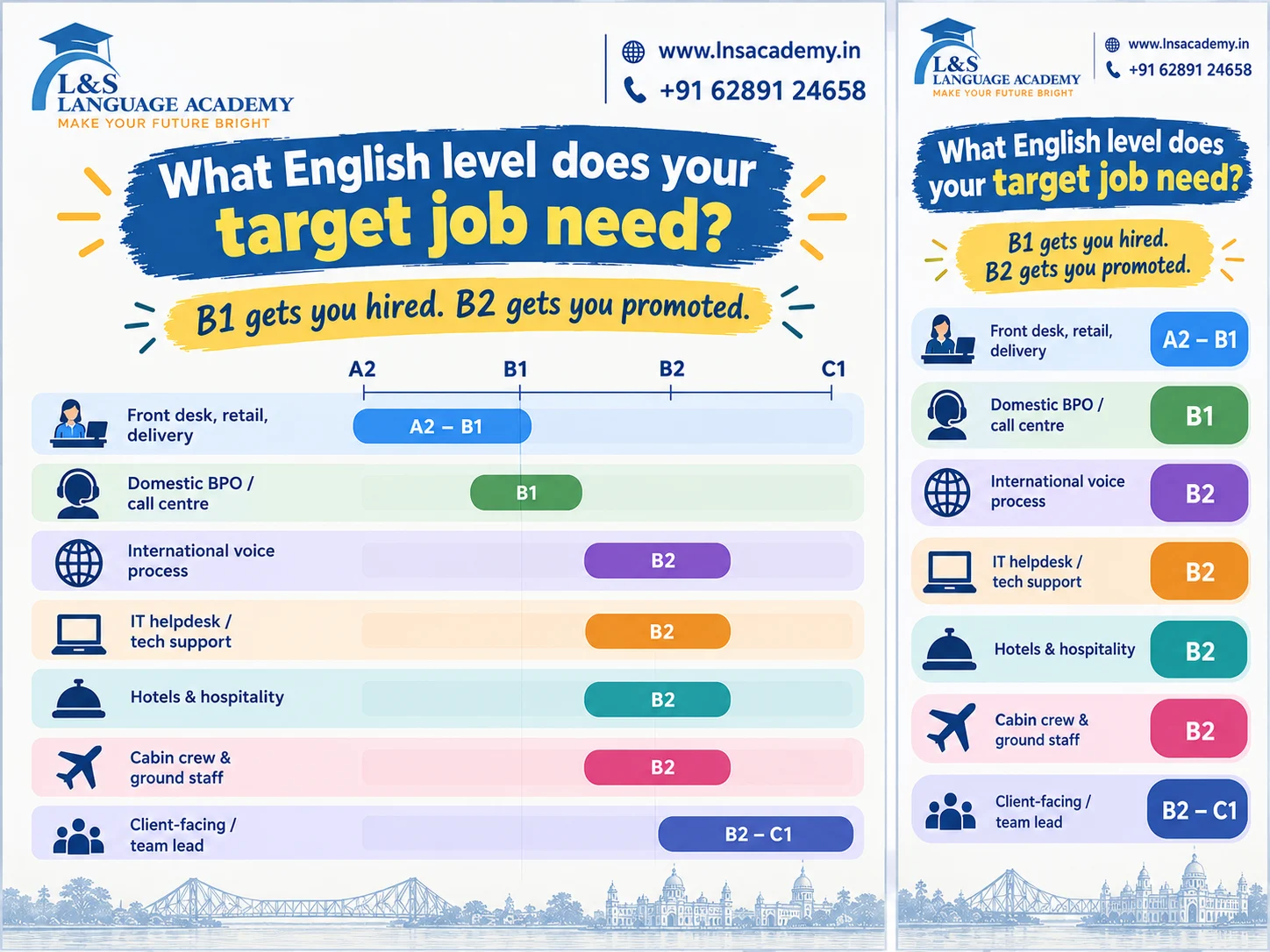
<p>Different work, same level. B2 for most of it.</p>

<p><strong>IT helpdesk and technical support.</strong> B2. Explaining a technical thing in simple words is a language skill, not a technical one. Plenty of people who know the fix cannot say it clearly.</p>

<p><strong>Hotels and hospitality.</strong> B2, plus service language. There is a specific register for this. "May I", "Certainly", "I'm sorry about that, let me sort it out." Complaint handling is its own skill.</p>

<p><strong>Cabin crew and ground staff.</strong> B2. Announcements have to be clear to people who are not listening carefully. Safety instructions have to be clear to people who are frightened.</p>

<p><strong>Front desk, retail, delivery coordination.</strong> A2 to B1 is usually enough.</p>

<p>We are near 1 No Airport Gate, so the airport-corridor roles come up a lot in our batches. If that is your target, the service register matters as much as the grammar.</p>

<figure class="content-image">
  <img src="/wp-content/uploads/2026/09/cefr-english-level-job-roles-kolkata-chart.webp" alt="Chart mapping Kolkata job roles to CEFR English levels A2 to C1" loading="lazy" width="1200" height="900" decoding="async">
  <figcaption>Find your target role, read across, and you have a number to work towards instead of a feeling.</figcaption>
</figure>
</section>

  <section class="lns-content-section" id="client-facing-team-lead">
  <h2>What level do you need for a client-facing or team-lead role?</h2>

<p>B2 going on C1.</p>

<p>The work changes shape here. You are not answering any more. You are framing. Disagreeing without causing offence. Running a meeting. Writing something that makes somebody act.</p>

<p>Plenty of people get stuck at this exact step. They are good at their job, their English is fine for the job, and the promotion goes to somebody who speaks up more easily in the room.</p>

<p>Our Advanced level is built for this. Public speaking, presentations, debate, business English, body language, interview preparation.</p>
</section>

  <section class="lns-content-section" id="study-abroad">
  <h2>What English level do study-abroad applications need?</h2>

<p>This one needs care, because the honest answer is messier than most websites admit.</p>

<p>IELTS is the common test. People want a clean conversion to CEFR levels. IELTS itself says that is not really possible, because it is not a level-based test.</p>

<p>What IELTS does publish is this. Band 5 sits on the border of B1 and B2. Band 6 is generally B2. The C1 threshold falls somewhere between 6.5 and 7. Band 8 is borderline, and 8.5 or higher is C2.</p>

<p>So if a university asks for 6.5, they are asking for solid B2 heading towards C1. That is a useful thing to know before you book the exam.</p>

<p>Two separate jobs here, though. General spoken English builds the ability. Exam coaching trains the format. They are not the same course and you usually want the first before the second. Our <a href="https://lnsacademy.in/language-courses/ielts-coaching-in-kolkata/">IELTS coaching</a> is separate from the spoken English course for exactly this reason.</p>

<p>One thing to be clear about. We prepare students for IELTS, TOEFL, Cambridge and similar exams. We do not conduct them, register students for them, or issue their certificates. Those are run by their own exam bodies and you sit them independently.</p>
</section>

  <section class="lns-content-section" id="interview-rejection">
  <h2>What actually gets people rejected in an English interview?</h2>

<p>Not grammar. Almost never grammar.</p>

<p>Here is what actually costs the offer, roughly in order of how often we see it.</p>

<ol class="lns-number-list">
  <li><strong>Long gaps.</strong> A three-second pause reads as "she doesn't know the answer", not "she's translating".</li>
  <li><strong>Answering the wrong question.</strong> You misheard, and you were too polite to ask again.</li>
  <li><strong>Flat delivery.</strong> No rise, no fall, no stress. You sound bored even when you are not.</li>
  <li><strong>One-word answers.</strong> "Yes." Interview dies. They needed you to keep going.</li>
  <li><strong>Wrong register.</strong> Too casual, or so formal it sounds memorised.</li>
  <li><strong>No recovery.</strong> You make one mistake and the whole answer collapses.</li>
</ol>

<p>Look at that list. Five of the six are fixable in weeks, and none of them need better grammar. They need practice under pressure, which is a different thing entirely.</p>

<p>If your English sounds flat even when it is correct, that is usually rhythm, and we have written about <a href="https://lnsacademy.in/blogs/spoken-english-for-bengali-speakers/">why Bengali speakers sound flat in English</a> and what fixes it.</p>
</section>

  <section class="lns-content-section" id="check-current-level">
  <h2>How do I find my current level without paying for a test?</h2>

<p>Two ways, both free.</p>

<p><strong>The recording test.</strong> Record three minutes about your work, with no preparation. Play it back. Count the gaps longer than two seconds. Under five, you are probably B1 or above. Over ten, you are around A2.</p>

<p><strong>The interruption test.</strong> Get somebody to interrupt you mid-answer with a question. If you can absorb it and carry on, that is B2 behaviour. If you lose the thread completely, you are at B1.</p>

<p>Self-assessment is usually accurate within one level. Most people under-rate themselves, not over-rate. If you think you are A2, you are probably B1.</p>

<p>Or come to a free demo class and we will tell you where you sit.</p>
</section>

  <section class="lns-content-section" id="level-jump-time">
  <h2>How long does one level jump take?</h2>

<p>Each of our levels runs two to three months, roughly 60 to 80 hours.</p>

<p>But the jumps are not equal, and it is worth knowing which one will test your patience.</p>

<p><strong>A2 to B1</strong> feels fast. Lots of visible progress. You go from struggling to functioning.</p>

<p><strong>B1 to B2</strong> is the slow one. This is where people get discouraged. You are already functional, so the improvement is less obvious day to day — but it is the jump that changes what jobs you can apply for.</p>

<p><strong>B2 to C1</strong> is slower again, and by then most people have got the job they wanted.</p>

<p>We have written more about realistic timelines in <a href="https://lnsacademy.in/blogs/how-long-to-speak-english-fluently/">how long it takes to speak English fluently</a>.</p>
</section>

  <section class="lns-content-section" id="interview-training">
  <h2>What should interview-focused training actually cover?</h2>

<figure class="content-image">
  <img src="/wp-content/uploads/2026/09/mock-interview-english-practice-kolkata.webp" alt="Mock interview practice session at a spoken English institute in Kolkata" loading="lazy" width="1200" height="800" decoding="async">
  <figcaption>Recorded mock interviews are uncomfortable and they work. Most people have never heard themselves answer a question.</figcaption>
</figure>

<p>Ask these questions of anyone before you pay.</p>

<ul class="lns-check-list">
  <li>Do you run mock interviews, and are they recorded?</li>
  <li>Do you practise telephone and video calls, not just face to face?</li>
  <li>Do you teach elaboration — how to turn a one-line answer into thirty seconds?</li>
  <li>Do you teach recovery phrases for when somebody makes a mistake mid-sentence?</li>
  <li>Is there group discussion practice?</li>
  <li>Will anybody work on pronunciation, or only grammar?</li>
</ul>

<p>That last one matters more than most people realise, given that pronunciation is a quarter of the Versant score.</p>
</section>

  <section class="lns-content-section" id="certificate">
  <h2>Do employers actually care about a certificate?</h2>

<p>For most Kolkata roles, no. They test you in the room. A certificate does not change what happens in those twenty minutes.</p>

<p>It matters in three places. Visa and study-abroad files. Some company training reimbursements. And as a small tiebreaker on a fresher's CV where there is nothing else to separate two candidates.</p>

<p>We issue our own completion certificate after an internal test at the end of each level. Useful for your file. It is not what gets you the job.</p>
</section>

  <section class="lns-content-section" id="course-cost">
  <h2>What does the course cost at LNS?</h2>

<div class="lns-table-scroller" role="region" aria-label="Scrollable information table 3" tabindex="0">
  <table>
    <thead>
      <tr>
        <th>Level</th>
        <th>Duration</th>
        <th>Offline</th>
        <th>Online</th>
      </tr>
    </thead>
    <tbody>
      <tr>
        <td>Beginner</td>
        <td>2–3 months</td>
        <td>₹5,000–12,000</td>
        <td>₹3,000–8,000</td>
      </tr>
      <tr>
        <td>Intermediate</td>
        <td>2–3 months</td>
        <td>₹6,000–15,000</td>
        <td>₹4,000–10,000</td>
      </tr>
      <tr>
        <td>Advanced</td>
        <td>2–3 months</td>
        <td>₹8,000–25,000</td>
        <td>₹5,000–15,000</td>
      </tr>
    </tbody>
  </table>
</div>

<p>Details on the <a href="https://lnsacademy.in/language-course-fees-in-kolkata/">course fees page</a>. Call <a href="tel:+916289124658">62891 24658</a> for batch timings, including evening and weekend batches for people already working.</p>

<p>Run the sum yourself. Take the monthly salary you are aiming for, subtract what you earn now, then divide the course fee by that difference. That is your break-even in months. Use your own numbers.</p>

<p>There is a second cost nobody puts on a page. Every hiring round you are not ready for is a round you sit out. Those add up quietly.</p>
</section>

  <section class="lns-content-section" id="free-options">
  <h2>What free options are there?</h2>

<p>Plenty, and they work up to a point. Free practice can take you to B1 comfortably. The B1 to B2 jump is where you usually need somebody correcting you, because B2 is mostly about the things you cannot hear yourself doing.</p>

<p>We have laid out a complete free 90-day plan in <a href="https://lnsacademy.in/blogs/spoken-english-free-vs-paid/">can you learn spoken English on your own</a>. Try it first if money is tight. It is a real plan, not a teaser.</p>
</section>

  <section class="lns-content-section" id="location">
  <h2>Where is LNS, and which areas do you cover?</h2>

<p>108, Majumder Para, 1 No Airport Gate, Kolkata 700079. Easy from Dum Dum, Nagerbazar, Baguiati, Kestopur, Lake Town, Birati and Madhyamgram.</p>

<p>Online batches cover Salt Lake, New Town, Barasat, Behala, Howrah and the rest of India.</p>
</section>

  <section class="lns-content-section" id="frequently-asked-questions">
  <h2>Frequently Asked Questions</h2>

<div class="lns-faq-container">
<article class="lns-faq-item">
  <h3><button class="lns-faq-question" type="button" aria-expanded="false" aria-controls="faq-answer-1" id="faq-question-1">I cleared the written round but failed the voice round. What happened?</button></h3>
  <div class="lns-faq-answer" id="faq-answer-1" role="region" aria-labelledby="faq-question-1" hidden>
    <p>Your reading and grammar are ahead of your speaking. Very common. The written round tested what you know. The voice round tested what comes out in two seconds.</p>
  </div>
</article>

<article class="lns-faq-item">
  <h3><button class="lns-faq-question" type="button" aria-expanded="false" aria-controls="faq-answer-2" id="faq-question-2">The interviewer said my English is "good, but". What does that usually mean?</button></h3>
  <div class="lns-faq-answer" id="faq-answer-2" role="region" aria-labelledby="faq-question-2" hidden>
    <p>Nine times out of ten it means fluency, not accuracy. You were correct but slow, or correct but flat. They could not say that politely, so they said "good, but".</p>
  </div>
</article>

<article class="lns-faq-item">
  <h3><button class="lns-faq-question" type="button" aria-expanded="false" aria-controls="faq-answer-3" id="faq-question-3">What English level is needed for a BPO job?</button></h3>
  <div class="lns-faq-answer" id="faq-answer-3" role="region" aria-labelledby="faq-question-3" hidden>
    <p>B1 for domestic voice, B2 for international. On the Versant scale that is roughly 47 and above for domestic, 58 and above for international.</p>
  </div>
</article>

<article class="lns-faq-item">
  <h3><button class="lns-faq-question" type="button" aria-expanded="false" aria-controls="faq-answer-4" id="faq-question-4">Can I apply for an international process with a Bengali accent?</button></h3>
  <div class="lns-faq-answer" id="faq-answer-4" role="region" aria-labelledby="faq-question-4" hidden>
    <p>Yes. Accent is not the bar, clarity is. Plenty of people work international processes with an accent. What gets flagged is sounds that change the meaning of a word.</p>
  </div>
</article>

<article class="lns-faq-item">
  <h3><button class="lns-faq-question" type="button" aria-expanded="false" aria-controls="faq-answer-5" id="faq-question-5">Do I need to know American slang for a US process?</button></h3>
  <div class="lns-faq-answer" id="faq-answer-5" role="region" aria-labelledby="faq-question-5" hidden>
    <p>No. You need to understand it when you hear it. You do not need to use it, and forced slang usually sounds worse than plain English.</p>
  </div>
</article>

<article class="lns-faq-item">
  <h3><button class="lns-faq-question" type="button" aria-expanded="false" aria-controls="faq-answer-6" id="faq-question-6">My English is better than my colleague's but he got promoted. Why?</button></h3>
  <div class="lns-faq-answer" id="faq-answer-6" role="region" aria-labelledby="faq-question-6" hidden>
    <p>Promotion tends to follow the person who speaks in meetings, not the person with better grammar. That is a confidence and elaboration gap, and it is trainable.</p>
  </div>
</article>

<article class="lns-faq-item">
  <h3><button class="lns-faq-question" type="button" aria-expanded="false" aria-controls="faq-answer-7" id="faq-question-7">I have a gap in my CV. Will better English help, or is it pointless?</button></h3>
  <div class="lns-faq-answer" id="faq-answer-7" role="region" aria-labelledby="faq-question-7" hidden>
    <p>It helps, because it changes how you explain the gap. Most gap questions are lost on delivery, not on the gap itself.</p>
  </div>
</article>

<article class="lns-faq-item">
  <h3><button class="lns-faq-question" type="button" aria-expanded="false" aria-controls="faq-answer-8" id="faq-question-8">Does typing speed matter more than English for non-voice jobs?</button></h3>
  <div class="lns-faq-answer" id="faq-answer-8" role="region" aria-labelledby="faq-question-8" hidden>
    <p>For pure back office, often yes. For chat and email support, your written English is the product. Different jobs, different bar.</p>
  </div>
</article>

<article class="lns-faq-item">
  <h3><button class="lns-faq-question" type="button" aria-expanded="false" aria-controls="faq-answer-9" id="faq-question-9">How do I know if I am B1 or B2?</button></h3>
  <div class="lns-faq-answer" id="faq-answer-9" role="region" aria-labelledby="faq-question-9" hidden>
    <p>Get somebody to interrupt you mid-answer. Carry on smoothly and you are B2. Lose the thread and you are B1.</p>
  </div>
</article>

<article class="lns-faq-item">
  <h3><button class="lns-faq-question" type="button" aria-expanded="false" aria-controls="faq-answer-10" id="faq-question-10">Do I need IELTS for a job in India?</button></h3>
  <div class="lns-faq-answer" id="faq-answer-10" role="region" aria-labelledby="faq-question-10" hidden>
    <p>No. IELTS is for study abroad, visas and immigration. Indian employers test you directly.</p>
  </div>
</article>

<article class="lns-faq-item">
  <h3><button class="lns-faq-question" type="button" aria-expanded="false" aria-controls="faq-answer-11" id="faq-question-11">What is the difference between spoken English and business English?</button></h3>
  <div class="lns-faq-answer" id="faq-answer-11" role="region" aria-labelledby="faq-question-11" hidden>
    <p>Spoken English is being understood. Business English is the register on top of it — emails, meetings, presentations, the way you disagree with a senior.</p>
  </div>
</article>

<article class="lns-faq-item">
  <h3><button class="lns-faq-question" type="button" aria-expanded="false" aria-controls="faq-answer-12" id="faq-question-12">Can working professionals attend?</button></h3>
  <div class="lns-faq-answer" id="faq-answer-12" role="region" aria-labelledby="faq-question-12" hidden>
    <p>Yes. We run evening and weekend batches, and online batches for people who cannot travel.</p>
  </div>
</article>

<article class="lns-faq-item">
  <h3><button class="lns-faq-question" type="button" aria-expanded="false" aria-controls="faq-answer-13" id="faq-question-13">Do you run mock interviews?</button></h3>
  <div class="lns-faq-answer" id="faq-answer-13" role="region" aria-labelledby="faq-question-13" hidden>
    <p>Yes, in the Advanced level, recorded and reviewed.</p>
  </div>
</article>

<article class="lns-faq-item">
  <h3><button class="lns-faq-question" type="button" aria-expanded="false" aria-controls="faq-answer-14" id="faq-question-14">How long before I am interview-ready?</button></h3>
  <div class="lns-faq-answer" id="faq-answer-14" role="region" aria-labelledby="faq-question-14" hidden>
    <p>Depends where you start. From B1, a focused Advanced level in two to three months usually does it. From A2, plan for longer and do not rush it.</p>
  </div>
</article>
</div>
</section>

  <section class="lns-content-section lns-closing-cta" id="find-your-level">
  <h2>Find out what level you are actually at</h2>

<p>Guessing costs you interviews. Knowing costs you one <a class="lns-cta-button" href="#ct-popup-2146">free demo class</a>.</p>

<p>Come in, speak for a few minutes, and we will tell you where you sit and what the gap to your target role looks like. No charge and nothing to sign.</p>

<p>Call <strong><a href="tel:+916289124658">62891 24658</a></strong> or email <strong><a href="mailto:contact@lnsacademy.in">contact@lnsacademy.in</a></strong>. Full <a href="https://lnsacademy.in/language-courses/spoken-english-classes-in-kolkata/">spoken English course details</a> are here.</p>
</section>
</main>

<!-- ============================================================
     JAVASCRIPT SNIPPET
     ============================================================ -->
<script>
(function () {
  "use strict";

  var root = document.getElementById("lns-english-level-for-jobs-kolkata");
  if (!root) return;

  root.querySelectorAll(".lns-faq-question").forEach(function (button) {
    button.addEventListener("click", function () {
      var answer = document.getElementById(button.getAttribute("aria-controls"));
      if (!answer) return;

      var isOpen = button.getAttribute("aria-expanded") === "true";
      button.setAttribute("aria-expanded", String(!isOpen));
      answer.hidden = isOpen;
    });
  });

  root.querySelectorAll('.lns-toc-list a[href^="#"]').forEach(function (link) {
    link.addEventListener("click", function (event) {
      var target = document.querySelector(link.getAttribute("href"));
      if (!target) return;

      event.preventDefault();
      target.scrollIntoView({ behavior: "smooth", block: "start" });
      history.replaceState(null, "", link.getAttribute("href"));
    });
  });
})();
</script>

<!-- ============================================================
     JSON-LD SCHEMA SNIPPET
     ============================================================ -->
<script type="application/ld+json">
{
  "@context": "https://schema.org",
  "@graph": [
    {
      "@type": "BlogPosting",
      "@id": "https://lnsacademy.in/blogs/english-level-for-jobs-kolkata/#article",
      "headline": "What English Level Do You Actually Need for a Job in Kolkata?",
      "description": "A role-by-role map of the English level Kolkata employers test for, the CEFR scale in plain words, and how the automated BPO screening test is scored.",
      "image": "https://lnsacademy.in/wp-content/uploads/2026/09/english-level-for-jobs-kolkata-featured.webp",
      "datePublished": "2026-09-19",
      "dateModified": "2026-09-19",
      "inLanguage": "en-IN",
      "author": {
        "@type": "Person",
        "name": "Biplab Podder",
        "url": "https://lnsacademy.in/about/"
      },
      "publisher": {
        "@id": "https://lnsacademy.in/#organization"
      },
      "mainEntityOfPage": "https://lnsacademy.in/blogs/english-level-for-jobs-kolkata/",
      "about": [
        {
          "@type": "Thing",
          "name": "CEFR language levels"
        },
        {
          "@type": "Thing",
          "name": "Business process outsourcing recruitment"
        },
        {
          "@type": "Thing",
          "name": "English language proficiency assessment"
        }
      ],
      "mentions": [
        {
          "@type": "Thing",
          "name": "Versant English Test"
        },
        {
          "@type": "Thing",
          "name": "IELTS"
        }
      ],
      "speakable": {
        "@type": "SpeakableSpecification",
        "cssSelector": [
          "#page-title",
          ".lns-answer-block"
        ]
      }
    },
    {
      "@type": "FAQPage",
      "@id": "https://lnsacademy.in/blogs/english-level-for-jobs-kolkata/#faq",
      "mainEntity": [
        {
          "@type": "Question",
          "name": "I cleared the written round but failed the voice round. What happened?",
          "acceptedAnswer": {
            "@type": "Answer",
            "text": "Your reading and grammar are ahead of your speaking. Very common. The written round tested what you know. The voice round tested what comes out in two seconds."
          }
        },
        {
          "@type": "Question",
          "name": "The interviewer said my English is \"good, but\". What does that usually mean?",
          "acceptedAnswer": {
            "@type": "Answer",
            "text": "Nine times out of ten it means fluency, not accuracy. You were correct but slow, or correct but flat. They could not say that politely, so they said \"good, but\"."
          }
        },
        {
          "@type": "Question",
          "name": "What English level is needed for a BPO job?",
          "acceptedAnswer": {
            "@type": "Answer",
            "text": "B1 for domestic voice, B2 for international. On the Versant scale that is roughly 47 and above for domestic, 58 and above for international."
          }
        },
        {
          "@type": "Question",
          "name": "Can I apply for an international process with a Bengali accent?",
          "acceptedAnswer": {
            "@type": "Answer",
            "text": "Yes. Accent is not the bar, clarity is. Plenty of people work international processes with an accent. What gets flagged is sounds that change the meaning of a word."
          }
        },
        {
          "@type": "Question",
          "name": "Do I need to know American slang for a US process?",
          "acceptedAnswer": {
            "@type": "Answer",
            "text": "No. You need to understand it when you hear it. You do not need to use it, and forced slang usually sounds worse than plain English."
          }
        },
        {
          "@type": "Question",
          "name": "My English is better than my colleague's but he got promoted. Why?",
          "acceptedAnswer": {
            "@type": "Answer",
            "text": "Promotion tends to follow the person who speaks in meetings, not the person with better grammar. That is a confidence and elaboration gap, and it is trainable."
          }
        },
        {
          "@type": "Question",
          "name": "I have a gap in my CV. Will better English help, or is it pointless?",
          "acceptedAnswer": {
            "@type": "Answer",
            "text": "It helps, because it changes how you explain the gap. Most gap questions are lost on delivery, not on the gap itself."
          }
        },
        {
          "@type": "Question",
          "name": "Does typing speed matter more than English for non-voice jobs?",
          "acceptedAnswer": {
            "@type": "Answer",
            "text": "For pure back office, often yes. For chat and email support, your written English is the product. Different jobs, different bar."
          }
        },
        {
          "@type": "Question",
          "name": "How do I know if I am B1 or B2?",
          "acceptedAnswer": {
            "@type": "Answer",
            "text": "Get somebody to interrupt you mid-answer. Carry on smoothly and you are B2. Lose the thread and you are B1."
          }
        },
        {
          "@type": "Question",
          "name": "Do I need IELTS for a job in India?",
          "acceptedAnswer": {
            "@type": "Answer",
            "text": "No. IELTS is for study abroad, visas and immigration. Indian employers test you directly."
          }
        },
        {
          "@type": "Question",
          "name": "What is the difference between spoken English and business English?",
          "acceptedAnswer": {
            "@type": "Answer",
            "text": "Spoken English is being understood. Business English is the register on top of it — emails, meetings, presentations, the way you disagree with a senior."
          }
        },
        {
          "@type": "Question",
          "name": "Can working professionals attend?",
          "acceptedAnswer": {
            "@type": "Answer",
            "text": "Yes. We run evening and weekend batches, and online batches for people who cannot travel."
          }
        },
        {
          "@type": "Question",
          "name": "Do you run mock interviews?",
          "acceptedAnswer": {
            "@type": "Answer",
            "text": "Yes, in the Advanced level, recorded and reviewed."
          }
        },
        {
          "@type": "Question",
          "name": "How long before I am interview-ready?",
          "acceptedAnswer": {
            "@type": "Answer",
            "text": "Depends where you start. From B1, a focused Advanced level in two to three months usually does it. From A2, plan for longer and do not rush it."
          }
        }
      ]
    },
    {
      "@type": "BreadcrumbList",
      "@id": "https://lnsacademy.in/blogs/english-level-for-jobs-kolkata/#breadcrumb",
      "itemListElement": [
        {
          "@type": "ListItem",
          "position": 1,
          "name": "Home",
          "item": "https://lnsacademy.in/"
        },
        {
          "@type": "ListItem",
          "position": 2,
          "name": "Blogs",
          "item": "https://lnsacademy.in/blogs/"
        },
        {
          "@type": "ListItem",
          "position": 3,
          "name": "English Level for Jobs in Kolkata",
          "item": "https://lnsacademy.in/blogs/english-level-for-jobs-kolkata/"
        }
      ]
    }
  ]
}/* End custom CSS */