Book Your Free Demo Class
Submit this form and get an instant call from us. We will share you a demo class schedule.

Yes, you can. Further than most institutes will admit. Ninety days of daily free practice can take a serious learner to confident everyday English. What free practice cannot do is fix what you cannot hear. This page gives you the full plan, and an honest test for when you have hit that wall.
We run spoken English in Kolkata, so you would expect us to say "join a class". We will not say that yet. Most people who come to us have already tried on their own. Some of them did not need us at all. They needed a plan.
So here is the plan first. Then the honest part about where it stops.
Yes, for most of it.
Think of English as two halves. The taking-in half is listening and reading. The putting-out half is speaking and writing.
The taking-in half is completely free. Nobody needs to pay for listening practice. Nobody needs to pay to read. You can build vocabulary, train your ear, and get comfortable with fast English without spending a rupee.
The putting-out half is where it gets tricky. You can practise speaking alone. You can talk to yourself, record yourself, narrate your day. All free. All useful.
But nobody is telling you what went wrong. And that one gap is the whole story of this article.
Knowing is recognising. Speaking is producing.
When you read a word, your brain only has to match it to something stored. When you speak, your brain has to find the word, order the sentence, fix the tense, and push it out of your mouth. Roughly two seconds. No time to check.
This is why so many people say the same line. "I understand everything. I just cannot speak."
Nothing is wrong with your English. You have built one half and not the other. Free practice can build a lot of that second half. Just not all of it.
If you do it daily, properly, here is a fair expectation.
You will get: around 1,000 to 1,500 useful words you can actually use, comfortable listening at normal speed, confident prepared speech, and much less hesitation.
You will not get: smooth unprepared conversation, corrected pronunciation, the right tone for the right situation, or interview-level performance under pressure.
That is not a small result. Somebody who cannot speak a full sentence today can be introducing themselves comfortably in three months. Free. That is worth saying out loud.
Thirty to forty-five minutes a day. Nothing to buy. Your phone is enough.
| Weeks | What to do daily | You know it worked when |
|---|---|---|
| 1–2 | Learn 20 words a day, but always inside a full sentence. Walk around your room and name things out loud. Read anything aloud for ten minutes. | You can talk about your room, out loud, for one minute |
| 3–4 | Shadowing. Play five minutes of English audio and repeat half a second behind the speaker. Record a 60-second voice note every day. | Your voice note has fewer than five long gaps |
| 5–6 | Say word pairs out loud that you tend to mix up. Narrate your commute as it happens. Start writing down every mistake you catch. | You can name three mistakes you make again and again |
| 7–8 | Switch your phone to English. Read one article, then close it and explain it out loud in your own words. | You stop building the sentence in Bengali first |
| 9–10 | Five-minute unprepared talk on a random topic. No stopping, no correcting. Then go back and re-drill your mistake list. | You can go five minutes without freezing |
| 11–12 | Answer common interview questions out loud. Record, listen, record again. Do "tell me about yourself" until it is boring. | You can answer it cold, twice, cleanly |
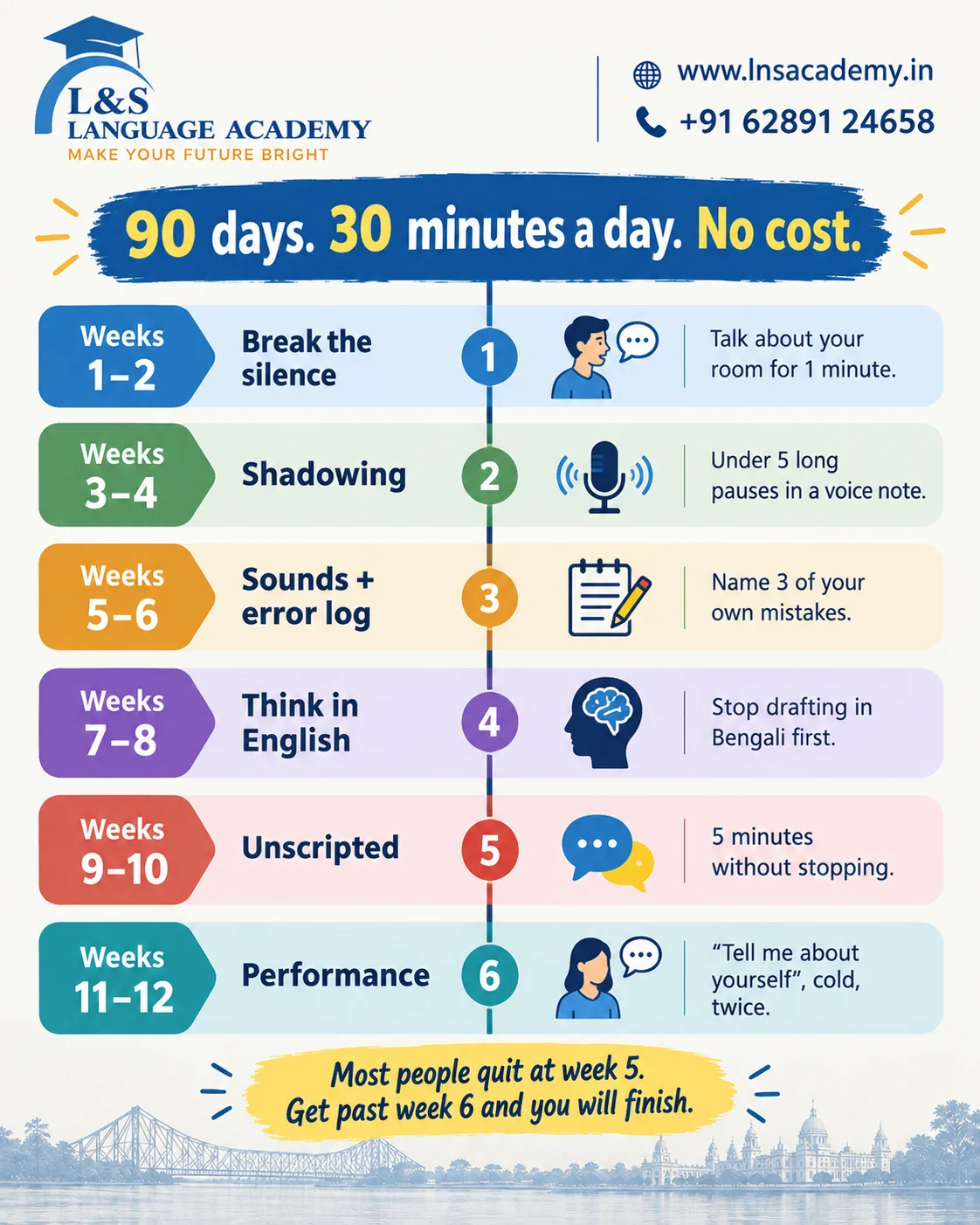
You do not need any paid app for this. A free dictionary with audio, any podcast app, and your phone's voice recorder will do everything on that list.
One warning. Most people quit around week five. The novelty is gone, progress feels slow, and nobody is checking. If you get past week six you will probably finish.
Download the Free 90-Day Spoken English Plan (PDF, 2 pages)Because watching is input. Speaking is output. They do not convert on their own.
You can watch English content for ten years and still not speak. Plenty of people have. Your understanding goes up, your speaking stays flat, and the gap between the two gets wider.
The fix is to turn watching into speaking. Pause and say what just happened. Repeat one dialogue out loud. Tell somebody the story afterwards, in English.
A rough guide. For every three minutes you listen, speak for one. Most people listen for three hours and speak for zero.
This is the one thing worth understanding before you decide about paying.
Fossilisation is when a mistake stops being a mistake and becomes just how you talk. The linguist Larry Selinker named it back in 1972, and it has been studied ever since.
Here is the part that surprises people. One of the main causes is success.
If you say "I am having a doubt" and the other person understands you, your brain gets a tick mark. Message delivered. Job done. So it files that sentence as correct and moves on. Nothing in your daily life ever tells you otherwise.
Repeat that for a few years and it is no longer something you say by mistake. It is your English.
Researchers do not agree on how long this takes, and anyone who gives you a clean number is guessing. What they do agree on is the cause. Errors that keep working, and nobody correcting them.
So the danger of practising alone is not slow progress. It is confident progress in the wrong direction.
If you are going solo anyway, there are three things that help. Record yourself weekly and compare month to month, not day to day. Keep a written list of mistakes. And find one honest person who will tell you what they notice.
Apps are genuinely good at some things. Streaks, reminders, vocabulary that sticks, grammar you can recognise.
What no app can do is judge whether your mouth actually made the right sound, or whether your answer suited the situation. Speech recognition will accept a lot of things a human would stop you on.
Use an app for vocabulary and habit. Do not expect it to make you fluent. An app plus daily speaking beats an app alone by a wide margin.
Do this honestly. Five questions.
Three or more "no" means you have hit the correction wall.
That is not failure. It means you have taken free practice as far as it goes, and the only thing left to change is having somebody listen.
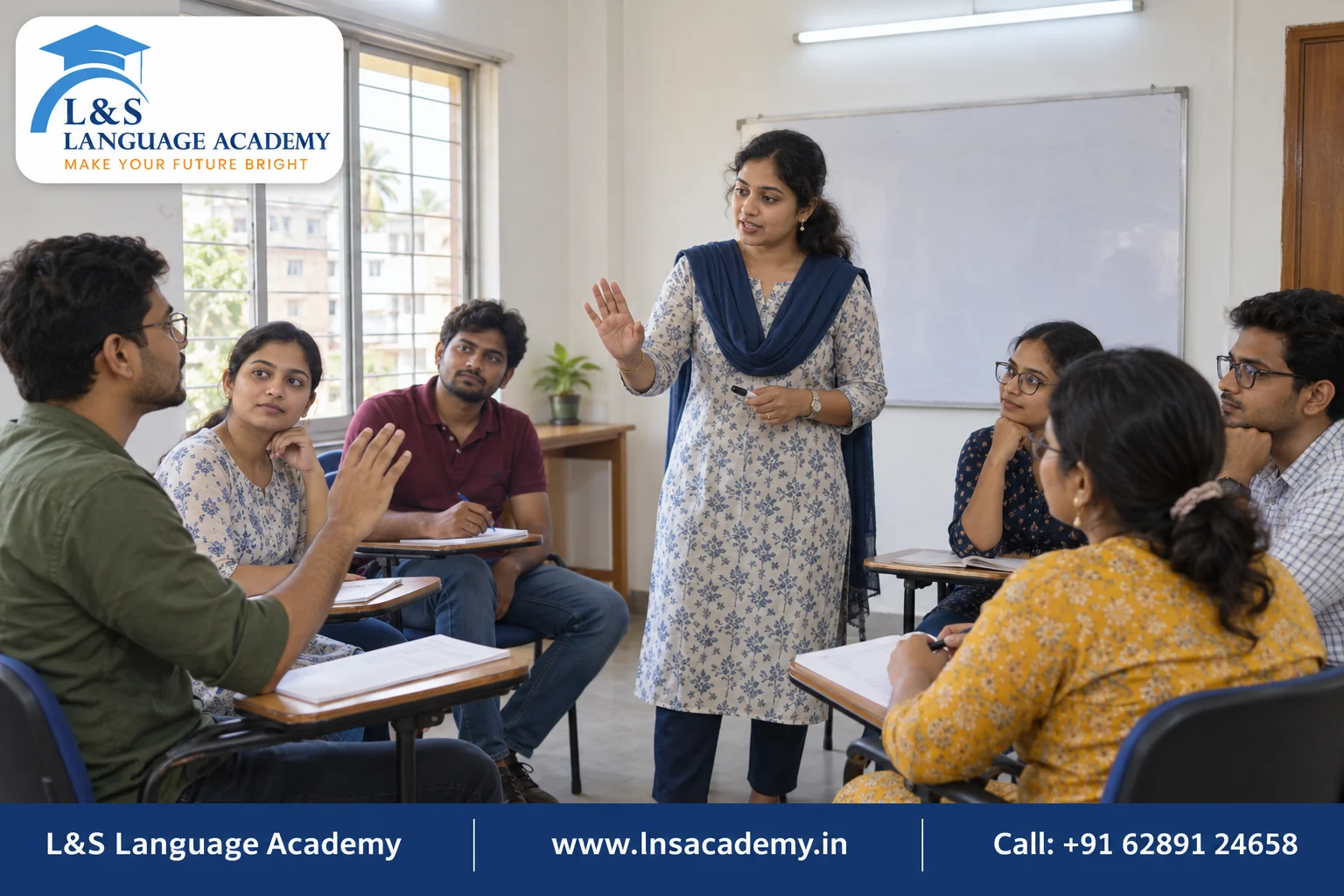
Four things. That is all, but they are the four you cannot arrange alone.
Somebody names the mistake you cannot hear. Your ear was trained on Bengali. It hears your own errors as correct. That is exactly why they survived.
You are forced to speak on a schedule. Nobody skips a class the way they skip a plan on a fridge door.
The correction happens in the moment. Not three weeks later, when it has already set.
You get unpredictable conversation. Talking to yourself is safe. A batch of eight people asking you things you did not prepare for is not, and that is the point.
Notice what is not on that list. Information. Grammar rules, word lists, tenses, phrases. All of it is free and always was. You are not paying for information.
| Your situation | What we would honestly suggest |
|---|---|
| You have never tried a daily routine | Do the 90-day plan first. Free. Come back after. |
| You read and listen well but freeze when speaking | A class. This is the correction problem exactly. |
| You have an interview in six weeks | A class. No time for the slow route. |
| Money is very tight right now | Free plan, seriously done. It works better than a half-attended course. |
| You have been "learning English" for years with no change | A class. Something has fossilised and you cannot see it. |
| You just want more vocabulary | Free. Do not pay for word lists. |
We would rather you did the free plan and came back in three months than paid us today and dropped out in week four.
| Level | Duration | Offline | Online |
|---|---|---|---|
| Beginner | 2–3 months | ₹5,000–12,000 | ₹3,000–8,000 |
| Intermediate | 2–3 months | ₹6,000–15,000 | ₹4,000–10,000 |
| Advanced | 2–3 months | ₹8,000–25,000 | ₹5,000–15,000 |
Full details are on our course fees page. Call 62891 24658 for batch timings.
Worth doing the sum yourself before you decide. Take the salary you are aiming for, subtract what you earn now, then divide the fee by that monthly difference. That is how many months it takes to pay for itself. Use your own figures, not somebody else's example.
One thing to check anywhere, not just here. A very low quote usually means a big batch, recorded videos, or no correction at all. Ask how many students are in the room and whether anybody will stop you mid-sentence. That answer tells you more than the price does.
For most jobs in Kolkata, no. The interview is the test. Nobody asks to see a spoken English certificate.
It matters in three places. Study abroad and visa files. Some company training reimbursements. And as a small tiebreaker on a fresher's CV.
There are international English exams — IELTS, TOEFL, Cambridge, TOEIC. Each is run by its own exam body. We prepare students for them. We do not conduct them, register students for them, or issue their certificates. You sit those independently.
What we do give is our own completion certificate, after an internal test at the end of each level.
Yes, and this is what actually works best.
A class gives you three or four hours a week of correction. That is not enough hours on its own. Nobody becomes fluent on four hours a week.
The free plan gives you volume. The class gives you accuracy. Together they beat either one alone, by a lot.
Our students who improve fastest are always the ones doing thirty minutes at home on top of class. Not the ones with the best English on day one.
If you want to compare class formats, we have written about online versus offline spoken English classes. For reading material to use alongside, see books to improve spoken English. And if you are wondering how long any of this takes, we have written honestly about that too.
Our centre is at 108, Majumder Para, 1 No Airport Gate, Kolkata 700079. Convenient from Dum Dum, Nagerbazar, Baguiati, Kestopur, Lake Town, Birati and Madhyamgram.
Online batches cover Salt Lake, New Town, Barasat, Behala, Howrah and the rest of India.
Both, honestly. Fluency improves. Accuracy does not, because nobody is correcting you. Keep doing it, but do not assume it is fixing anything.
Usually because you have been consuming, not producing. Five years of listening with no speaking gives you a very good ear and no output.
Serials, if speaking is your goal. News English is formal and read from a script. Serials give you the way people actually talk.
Both, in that order. Watch once with subtitles, once without. Subtitles always on and your ear never has to work.
For grammar and explanation, yes, it is often easier. For pronunciation and listening, you need English audio. Use both for different jobs.
For confidence, yes. For interviews, no. Speed with errors sounds fluent until somebody actually listens. Aim for clear, then faster.
As writing practice, yes. It does nothing for speaking. Many people write good English and cannot hold a phone call.
Thirty to forty-five minutes, every day, beats three hours on Sunday. Consistency wins this one.
No. You can become noticeably more confident in 30 days. That is a real result and worth doing. Fluent is a different word.
Some do. Very few employers in Kolkata will ask to see it. Choose free courses for the practice, not the certificate.
Record three minutes unprepared and use the five questions above. Or come to a free demo and we will tell you.
Yes, usually. Our online fees run lower across all three levels. Whether it suits you depends on your schedule and how much you need the room.
When three of those five questions came back "no". Not before.
Genuinely. Print the twelve weeks, do it properly, and see where you land.
If you hit the wall, come and sit through a free demo class. We will listen to you for a few minutes and tell you exactly which mistakes you have stopped hearing. No charge, and no pressure to sign anything.
Call 62891 24658 or write to contact@lnsacademy.in. The full spoken English course details are here.