Book Your Free Demo Class
Submit this form and get an instant call from us. We will share you a demo class schedule.
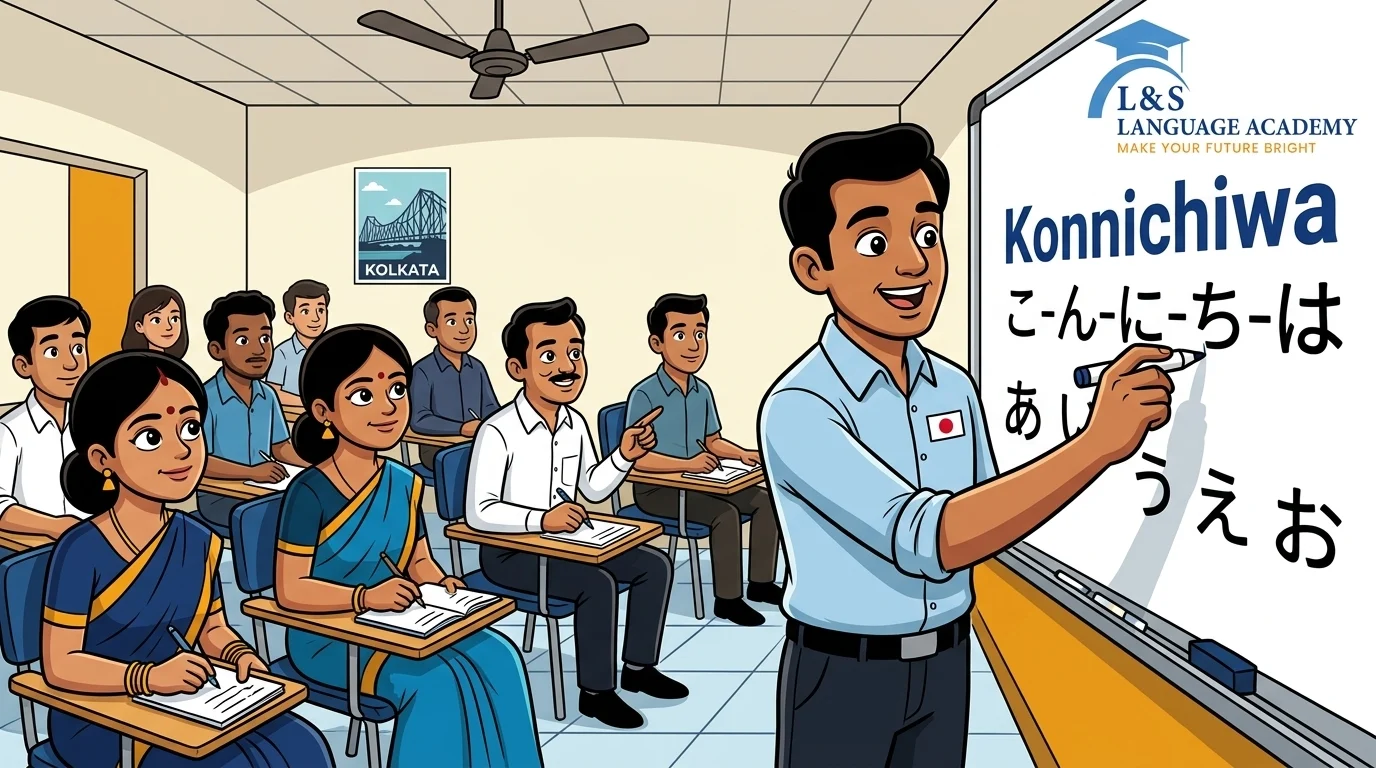
At L&S Language Academy (LNS Academy), we offer Japanese language courses in Kolkata from JLPT N5 to N1 — Hiragana, Katakana, Kanji, grammar (Bunpou) and conversation (Kaiwa) — with flexible online/offline batches near Dum Dum and Airport Gate. Whether your goal is a Japan IT job, the SSW visa, anime-level fluency or a JLPT certificate, we build the right foundation. Book a free Japanese demo class and see how we teach before you decide anything.
Japanese isn't just for anime fans. It's increasingly a career language — and a smart one.
Japan is one of India's largest trading partners. Japanese companies like Toyota, Honda, Suzuki, Sony, Panasonic, Fujitsu and NTT actively hire Indian professionals, both in India and in Japan. In Japan's IT sector specifically, there's a documented shortage of tech talent, and Indians with Japanese language skills are in genuine demand for software, automotive and electronics roles.
Then there's the SSW (Specified Skilled Worker) visa — a pathway Japan opened specifically to fill labour shortages in 12 sectors including caregiving, agriculture, hospitality, construction, food processing and automotive. The SSW is one of the most accessible Japan work visa routes for Indians without a university degree. Japanese at the N4 level is the minimum.
And of course, there's the cultural angle. Anime, manga, J-pop and Japanese pop culture have built a huge base of enthusiastic language learners across Kolkata and West Bengal. Many of our students start learning because they love Japanese content — and end up discovering a solid career path.
Japanese at LNS is taught in two parallel tracks that build together as you progress.
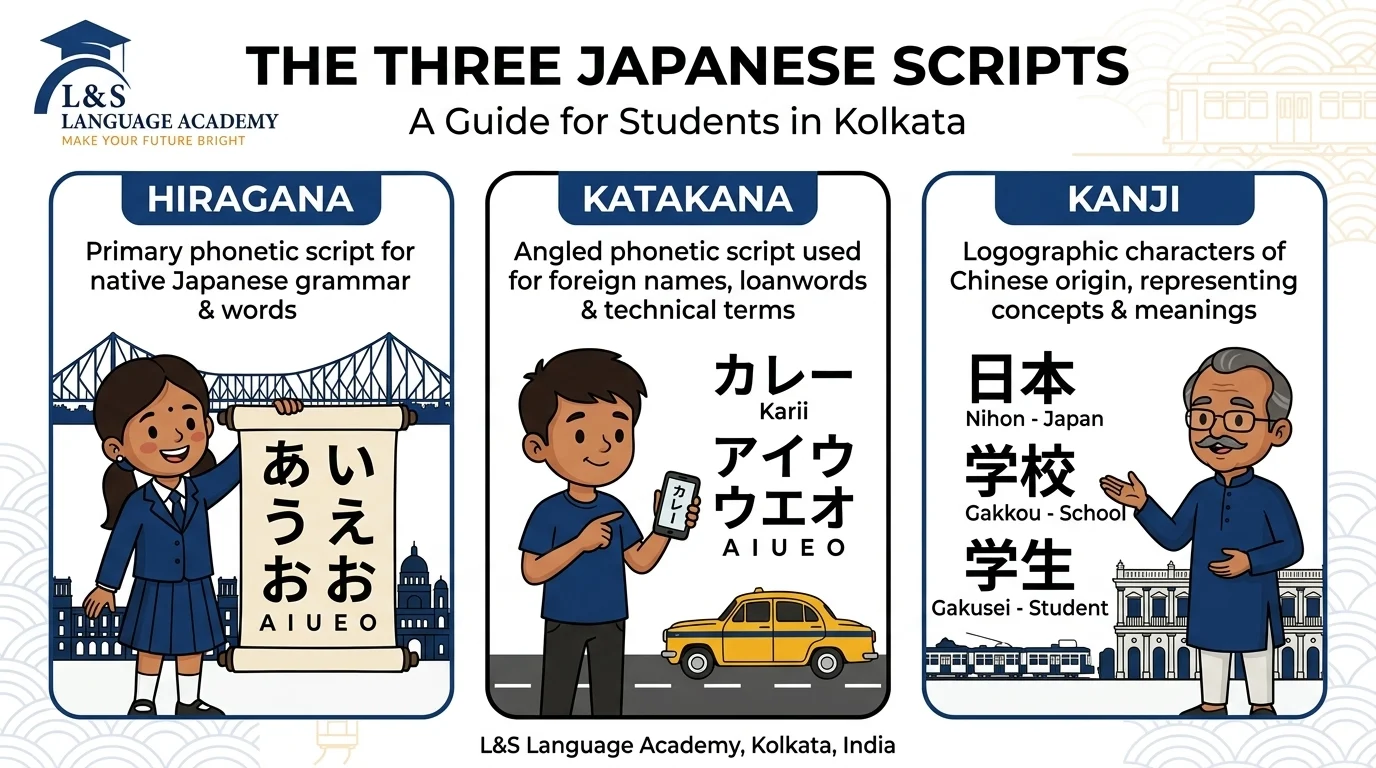
Japanese uses three scripts. Don't let that intimidate you. Each has its purpose and they're learned in a specific order.
Hiragana (46 characters): The foundational Japanese script. Every Japanese word can be written in Hiragana. Students typically learn the full Hiragana alphabet in the first 3–4 weeks. It looks curvy and round.
Katakana (46 characters): The same sounds as Hiragana but used specifically for foreign words (like terebi for television, koohii for coffee) and technical terms. Learned alongside or right after Hiragana.
Kanji: These are the Chinese-origin characters used in Japanese. JLPT N5 requires about 100 Kanji; N4 about 300; N3 about 650; N2 about 1,000; N1 over 2,000. Kanji take sustained daily practice — but they're systematic and learnable with the right method.
We teach scripts step-by-step, with recognition and writing drills built into every session. In our experience, students who spend 15–20 minutes on Kanji daily outside class progress twice as fast as those who save it for class time.
Script reading is just one part. The other is using Japanese to actually communicate — speaking (Kaiwa) and grammar (Bunpou).
We run speaking practice in every session from N5 onward. Greetings, self-introduction, shopping, work situations, giving directions, expressing opinions — we cover the real-life patterns at each JLPT level. Grammar is taught in context, not as isolated rules. By N3, students can hold comfortable conversations about daily topics. By N2, you can function in a Japanese workplace.
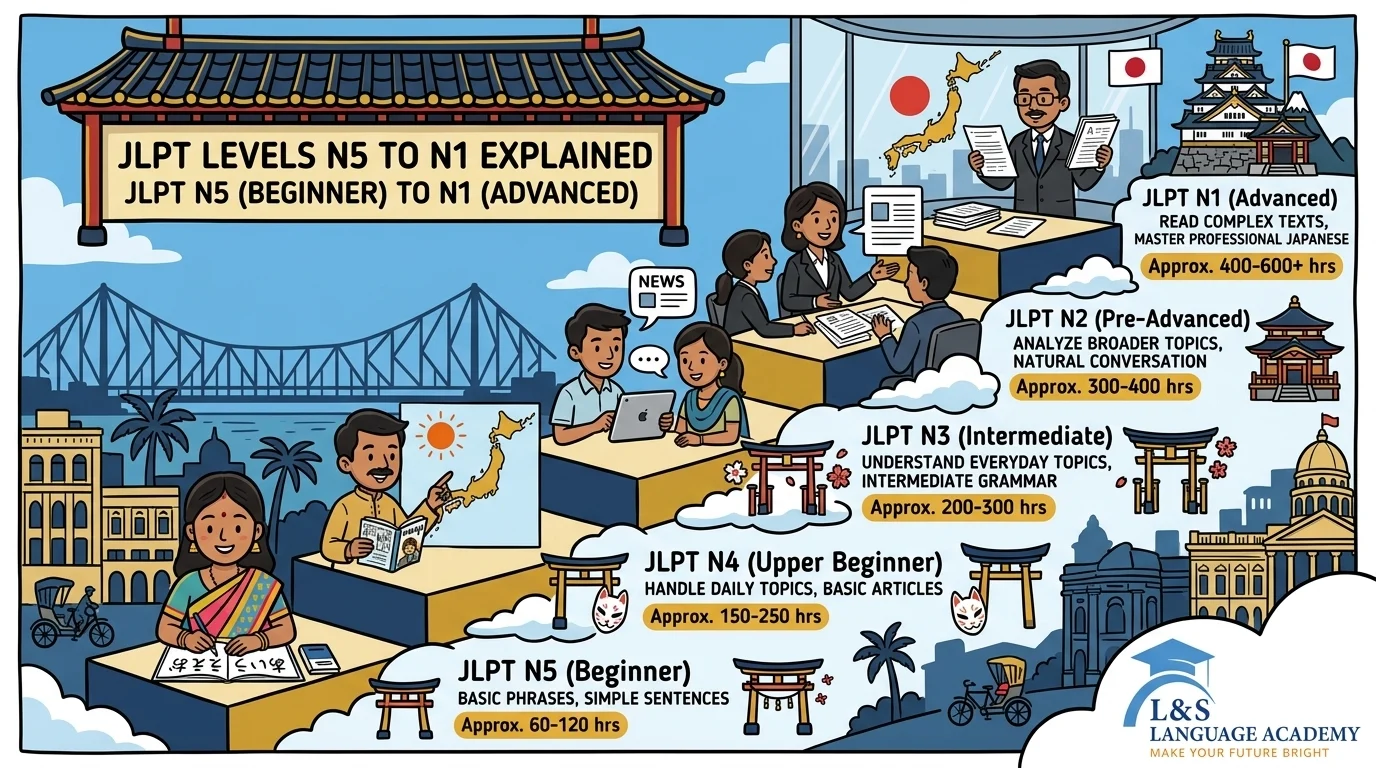
The JLPT (Japan Language Proficiency Test) runs from N5 (beginner) to N1 (advanced). Here's the full level breakdown with our fee structure:
| Level | Requirement | Duration | Hours | Offline fee | Online fee | Key outcome |
|---|---|---|---|---|---|---|
| N5 | ~100 Kanji, ~800 vocab, Hiragana + Katakana | 2–3 months | 60–80 hrs | ₹6,000–30,000 | ₹5,000–20,000 | Basic daily conversations; SSW eligibility starts at N4 |
| N4 | ~300 Kanji, ~1,500 vocab, basic grammar | 3–4 months | 80–100 hrs | ₹8,000–30,000 | ₹5,000–20,000 | Elementary Japanese; SSW visa minimum; JFT-Basic alternative |
| N3 | ~650 Kanji, ~3,750 vocab, intermediate grammar | 5–6 months | 100–120 hrs | ₹10,000–30,000 | ₹8,000–22,000 | Intermediate; most IT/automotive entry-level roles |
| N2 | ~1,000 Kanji, ~6,000 vocab, formal communication | 6–12 months | 120–150 hrs | ₹12,000–35,000 | ₹10,000–25,000 | Professional communication; most Japanese company jobs |
| N1 | ~2,000 Kanji, ~10,000 vocab, near-native comprehension | 12+ months | 150+ hrs | ₹15,000–40,000 | ₹12,000–30,000 | Full professional fluency; translation/interpretation |
Duration is per level, assuming 3–4 classes per week with daily Kanji and vocabulary review. The wide fee range reflects the Kolkata market — from RMIC (₹6,000 for basic N5) to Kazumi/Henry Harvin (₹30,000 offline). See our Japanese course fees page or call 62891 24658 for the current LNS batch rate.
N5 is where everyone starts. You learn Hiragana, Katakana, the first 100 Kanji, basic greetings, numbers, simple present/past sentences and everyday vocabulary. It's the entry point — and most students reach it in 2–3 months.
N4 builds on N5 with more Kanji, verb conjugations, sentence patterns and simple formal communication. Critically, N4 is the minimum JLPT level for the SSW visa in most sectors. It's also a milestone level for most Japan IT internship programmes.
N3 is the bridge between basic and professional Japanese. You can handle everyday situations, read simplified newspapers and understand most conversations. Most Japan-bound IT and automotive professionals target N3 as their first major career milestone.
N2 is what Japanese companies typically ask for in their Indian operations. It covers business emails, workplace communication and advanced grammar. Most JLPT aspirants working toward a Japan role aim for N2 as their practical career goal.
N1 is near-native. It takes sustained commitment — 18–24 months from N5 — but it opens translation, interpretation and senior roles in Japan.
This is important practical information that most Japanese course pages get wrong or skip entirely.
The JLPT in Kolkata is managed by IJWCA — Indo-Japan Welfare and Cultural Association, the only official JLPT host institution for all of Eastern India. IJWCA serves candidates from West Bengal, Odisha, Bihar, Jharkhand and the North-East.
JLPT 2026 dates: July 5, 2026 and December 6, 2026
July 2026 exam venues in Kolkata (confirmed by IJWCA):
IJWCA registration details:
Registration for December 2026 opens in August–September 2026. Seats fill quickly — register early. Registration is online through the IJWCA portal.
At LNS, we structure our mock tests and exam-prep sessions around the actual JLPT format — vocabulary (Goi), grammar (Bunpou), reading (Dokkai) and listening (Choukai). We also remind students of registration deadlines and help them plan their prep timeline against the exam dates. The JLPT is a separate, independent exam — LNS prepares you for it; you register directly with IJWCA. We run our own internal assessment and issue an LNS Academy certificate at the end of each course level.
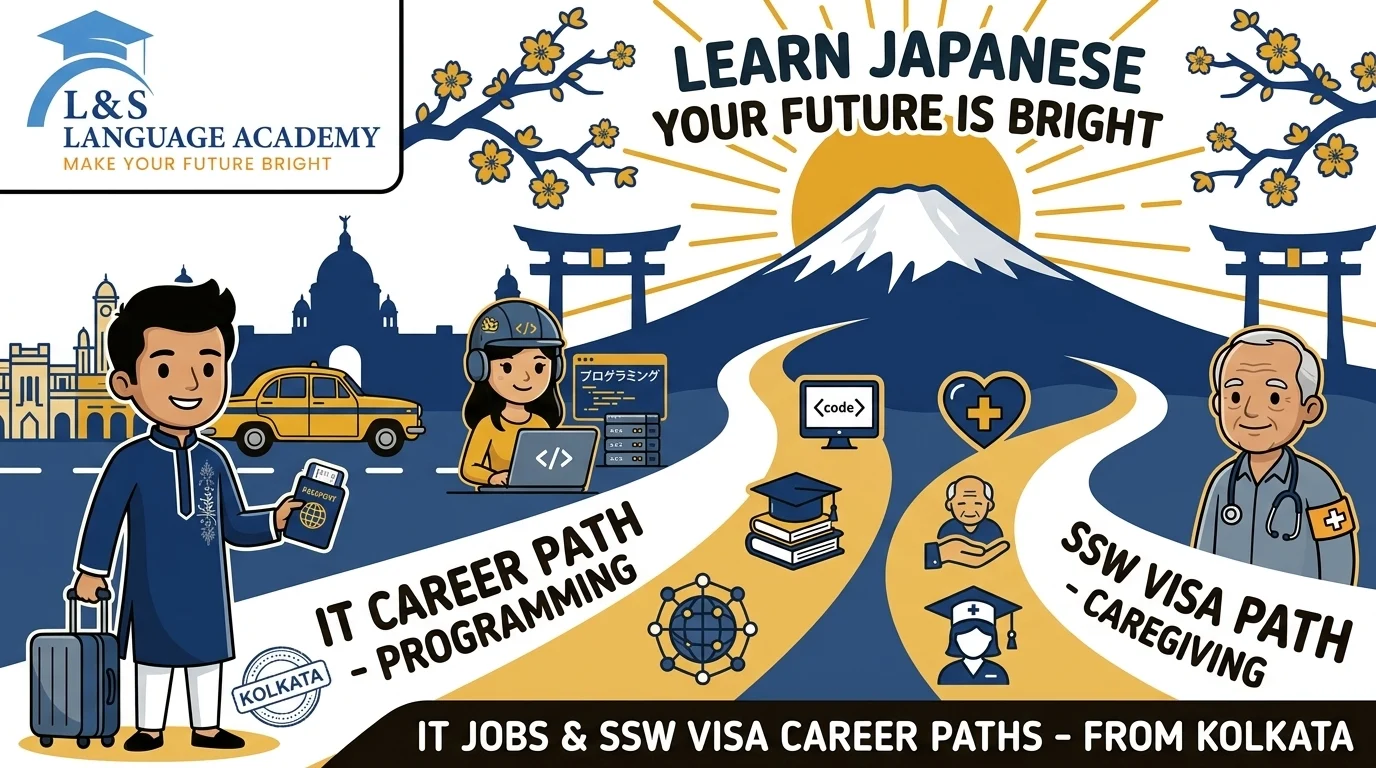
Japan has a documented tech talent shortage. Companies like Fujitsu, NTT, Hitachi, Sony, Toyota, Honda and Suzuki all hire Indian professionals — both in their Indian offices and in Japan. N3 Japanese is typically the minimum for IT entry-level roles in Japan; N2 is what most employers ask for, especially for roles with local team interaction. Companies in Pune's Japanese technology park and in Gurugram/Bengaluru also value N2+ Japanese speakers.
Salaries for Japanese-speaking IT professionals in India can be 20–40% higher than equivalent non-Japanese roles, particularly at Japan-linked companies.
The SSW visa is Japan's government-created programme to fill labour shortages in 12 specific sectors. These include:
For most SSW sectors, you need JLPT N4 or the JFT-Basic (Japan Foundation Test for Basic Japanese) — a simpler, computer-based alternative to the JLPT for SSW purposes specifically. You also need a skills test for your sector, which varies.
Salary in Japan for SSW workers: approximately ¥180,000–¥280,000/month depending on sector and location — roughly ₹1–1.5 lakh/month, tax-free style savings given employer-provided accommodation in many roles.
N4 is the gateway. N3 and above makes you significantly more competitive and opens supervisory SSW-2 pathways.
The Japan Student Services Organisation (JASSO) and the MEXT (Ministry of Education) scholarship are Japan's main study funding routes for Indians. MEXT fully funds tuition, accommodation and a monthly stipend. Japanese N2+ is typically required or strongly preferred for Japanese-taught programmes. Many English-taught programmes in Japanese universities are available at N1 or even without JLPT.
The fee range in Kolkata's Japanese market is genuinely wide. Here's an honest breakdown:
RMIC (Ramakrishna Mission Institute of Culture), Golpark: Very affordable (approximately ₹6,000 for a basic 20-hour course), JLPT exam venue. Limited level progression — not ideal for N3 and above.
IJWCA: Official JLPT host and a language school; runs 125-hour courses for N5/N4 and 150-hour courses for N3/N2. Fees based on semester structure — check at ijwca.org. Excellent quality but fixed semester schedule.
Henry Harvin / Kazumi: Online ₹20,000 per level; offline ₹30,000 per level for approximately 48 hours. Higher fee per hour but reputed for JLPT mock structure.
IITT / Nili / Kotoba: ₹8,000–₹15,000 per level typically.
| Level | Duration | Offline Fee (₹) | Online Fee (₹) |
|---|---|---|---|
| N5 – Beginner | 2–3 months | 6,000–30,000 | 5,000–20,000 |
| N4 – Elementary | 3–4 months | 8,000–30,000 | 5,000–20,000 |
| N3 – Intermediate | 5–6 months | 10,000–30,000 | 8,000–22,000 |
| N2 – Upper-Intermediate | 6–12 months | 12,000–35,000 | 10,000–25,000 |
| N1 – Advanced | 12+ months | 15,000–40,000 | 12,000–30,000 |
* Lowest price = Batch/group classroom study | Highest price = Individual 1:1 dedicated teacher–student sessions.
View full Japanese course fees, JLPT exam dates & SSW visa details →
LNS Academy: See the fee table above for market-range context. Call 62891 24658 or visit our Japanese course fees page for the current batch rate. We keep fees fair and are transparent about what's included (books are sometimes extra — we'll confirm upfront).
Key insight: When comparing fees, always look at hours-per-rupee, not just the headline cost. A ₹6,000 course for 20 hours is a very different product from a ₹15,000 course for 80 hours.
Our centre is at 108, Majumder Para, 1no Airport Gate, Kolkata 700079 — near Dum Dum metro, convenient for north Kolkata and the Airport area.
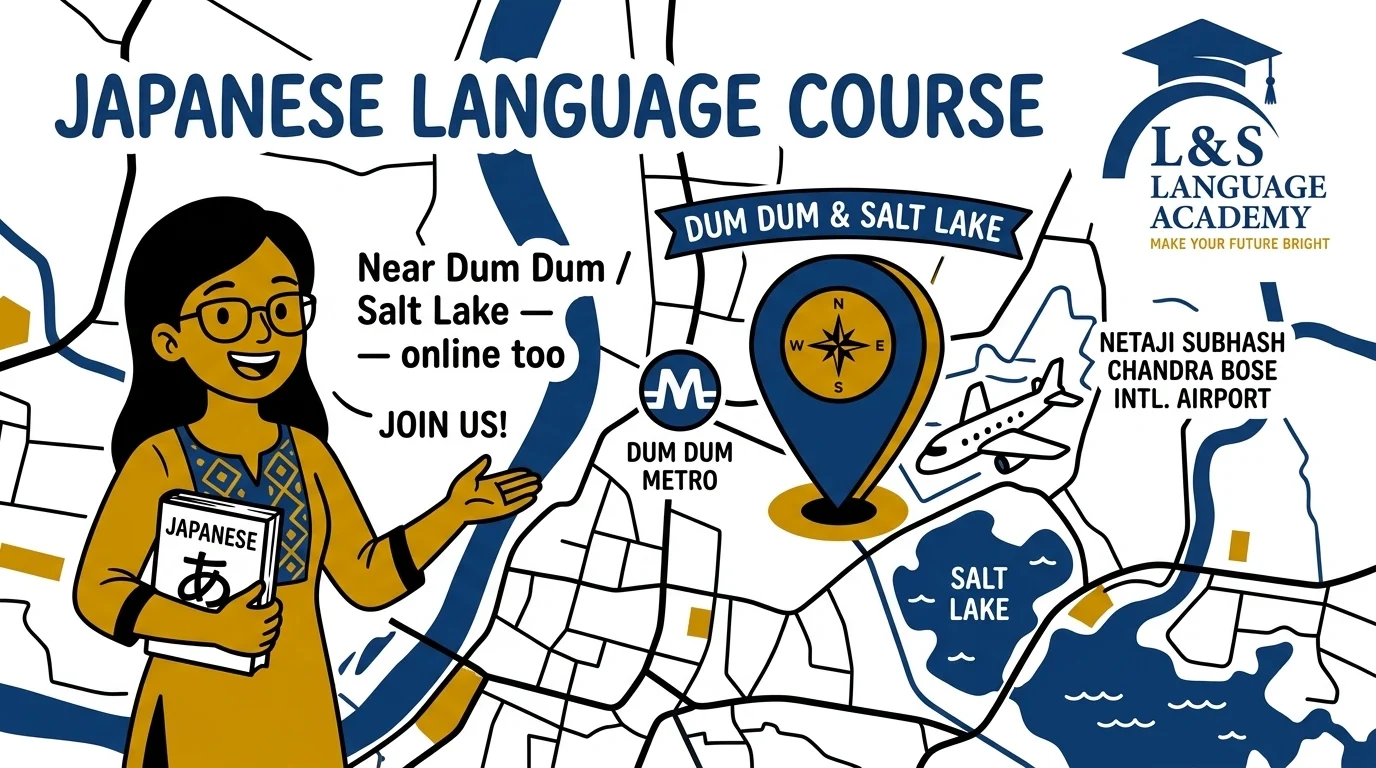
Offline batches run in small groups at our Dum Dum centre. If you've been searching "Japanese class near Dum Dum" or "Japanese language course near me Kolkata" — LNS offers structured JLPT-aligned teaching close to north Kolkata.
Online batches are fully live — real-time instruction with a trainer, not recorded videos. Students from Salt Lake, New Town, Behala, Howrah and cities across India attend our online Japanese batches. Online also works well for Kanji and script practice — you can see the board clearly and pause for questions.
Batch options:
Japanese takes longer than European languages — that's just honest. Three scripts, a completely different grammar structure and thousands of Kanji require genuine sustained effort. But the learning curve is manageable with the right approach.
Here's a realistic timeline:
The single biggest accelerator is daily Kanji practice outside class — even 15 minutes a day makes a measurable difference within weeks. Students who watch anime, listen to Japanese music and practise shadowing improve speaking speed noticeably faster. Language apps like Anki for Kanji flashcards genuinely help.
Here's what we specifically offer:
Also, if Japan isn't your only option and you're comparing Asian language career paths, check our Chinese (Mandarin) language course in Kolkata. HSK-based Mandarin and JLPT-based Japanese are both solid career investments — the right choice depends on your industry and target market. For European career pathways, see our German language course in Kolkata.
"I started from zero Japanese — didn't even know Hiragana. The LNS trainer taught the scripts very systematically, with enough drilling that recognition became natural within a month. I cleared JLPT N5 at the IJWCA Kolkata centre on my first attempt. Now doing N4."
— Aritro Sen, Salt Lake (JLPT N5, targeting SSW caregiving visa)
"I'm an anime fan first — Japanese language was always on the list but I never committed. LNS made it accessible. The conversation practice alongside the script teaching meant I could understand dialogue in anime much earlier than I expected. It's motivating in a way that just studying grammar never was."
— Riya Biswas, New Town (Japanese for anime and culture)
"I needed N3 for a Japan IT internship application. LNS's N3 prep was thorough — especially the reading comprehension (Dokkai) section, which is where most students lose marks. Cleared N3 in December. The internship application is in progress."
— Tanya Ghosh, Behala (JLPT N3, Japan IT internship)

Try a free demo first. You'll see how we teach the scripts, how we approach JLPT prep and whether our style suits you — before paying anything.
Morning · Evening · Weekend slots available. Online and offline both open. WhatsApp response same day.
LNS Academy is among the best places to learn Japanese in Kolkata — structured JLPT N5–N1 courses covering Hiragana, Katakana, Kanji and Kaiwa, with experienced trainers, flexible online/offline batches near Dum Dum and transparent fees. We prep you specifically for the JLPT exam and the SSW visa pathway.
JLPT N5 typically takes 2–3 months at LNS with 3–4 classes per week and daily Hiragana/Katakana/Kanji practice. Reaching N1 from scratch usually takes around 18–24 months with consistent study. The key variable is daily practice outside class, especially Kanji.
Yes — Japanese opens Japan IT and automotive roles and the SSW (Specified Skilled Worker) visa pathway in caregiving, agriculture, hospitality, food service and 8 other sectors. JLPT N4 or the JFT-Basic test is the minimum for most SSW sectors. N3 and N2 significantly widen your career options.
The JLPT certifies Japanese from N5 (basic) to N1 (advanced). In Kolkata, it's managed by IJWCA (Indo-Japan Welfare and Cultural Association) at 2B Asraf Mistri Lane, Kolkata 700019. 2026 exam dates: July 5 and December 6. July 2026 venues: AJC Bose College (N1–N4) and RMIC Golpark (N5). Register early — seats fill fast.
Japanese course fees in Kolkata vary widely — from ₹6,000 at RMIC for basic N5 (20 hours) to ₹30,000 at Kazumi/Henry Harvin (48 hours offline). LNS keeps fees competitive and transparent. See our Japanese course fees page or call 62891 24658. Always compare hours-per-rupee, not just the headline price.
Yes — LNS runs fully live online Japanese classes with weekday, evening and weekend batches. Not pre-recorded. Students join a real-time session with a trainer. Online works well for script learning too — the board is clearly visible on screen.
Japanese has three scripts, but with a step-by-step path — Hiragana first, then Katakana, then Kanji in batches — it becomes manageable. Grammar structure is very different from English but internally consistent once learned. Most students reach JLPT N5 within 2–3 months at LNS with daily practice.
Yes — LNS Academy is at 1no Airport Gate, Dum Dum, convenient for north Kolkata and the Airport area. Online batches serve Salt Lake, New Town, Behala, Howrah and the rest of Kolkata and India.
Yes — LNS Academy conducts its own internal exam at the end of each level and issues an LNS Academy course completion certificate, backed by our ISO 9001:2015 quality standard. The official JLPT certificate is issued by The Japan Foundation after you sit and pass the exam independently at IJWCA Kolkata. These are two separate documents.
Registration for the July 5, 2026 exam was open March–April 2026 (now closed). Registration for the December 6, 2026 exam opens August–September 2026 at IJWCA (ijwca.org). Seats are limited and fill on a first-come, first-served basis. Start your preparation now so you're ready when registration opens.
The JFT-Basic (Japan Foundation Test for Basic Japanese) is a computer-based test specifically designed for the SSW visa pathway. Unlike JLPT, it's taken at designated computer-based testing (CBT) centres and tests basic conversational Japanese. JFT-Basic is an alternative to JLPT N4 specifically for SSW visa applications — not for general job or educational purposes.
Yes — and it's a genuinely effective motivator. Many of our most consistent students started learning for anime. Japanese for anime means learning Hiragana, Katakana, basic grammar and vocabulary — which also gets you most of the way to JLPT N4. The conversational track at LNS covers the everyday dialogue patterns you hear in anime. It's a practical starting point that leads to real proficiency.