French Language Classes in Kolkata — A1 to C2 at LNS Academy

At L&S Language Academy (LNS Academy), we offer French language classes in Kolkata from A1 to C2 — CEFR-aligned, with DELF and TEF/TCF Canada exam preparation, certified trainers and flexible online/offline batches near Dum Dum and Airport Gate. Whether you're targeting Canada PR, planning to study in France or simply want to learn the world's second most-studied language — we've got a batch that fits your schedule. Book a free French demo class before you commit to anything.
Table of Contents
- Why Learn French in Kolkata in 2026?
- French Course Levels at LNS: A1 to C2
- Learn French for Canada PR & Immigration
- DELF, DALF, TEF & TCF — Which French Exam Do You Need?
- French Language Course Fees in Kolkata
- Online & Offline French Classes Across Kolkata
- How Long Does It Take to Learn French (and Reach B2)?
- Why Choose LNS for Your French Course
- Student Results & Reviews
- Book a Free French Demo Class
- Frequently Asked Questions
Why Learn French in Kolkata in 2026?
French is having a moment. And it's not just about travel or culture.
Canada's immigration system has made French proficiency one of the most powerful tools an Express Entry applicant can have. More on that in the section below. But beyond immigration, French is the official language of 29 countries, spoken by around 320 million people. It opens doors across Africa, Europe, the Caribbean and parts of the Middle East. And in India, companies like Capgemini, L'Oréal, Schneider Electric, BNP Paribas and Michelin — all French multinationals — actively hire French-proficient professionals.
For Kolkata specifically, French also matters for study in France (where tuition at public universities starts as low as €170 per year even for international students). Furthermore, translation, tourism, content localisation and French-language teaching are all growing career paths. And for many students, learning French is just... the most enjoyable language journey they've taken. It's musical, structured and, once you get past the silent letters, genuinely fun.
French Course Levels at LNS: A1 to C2
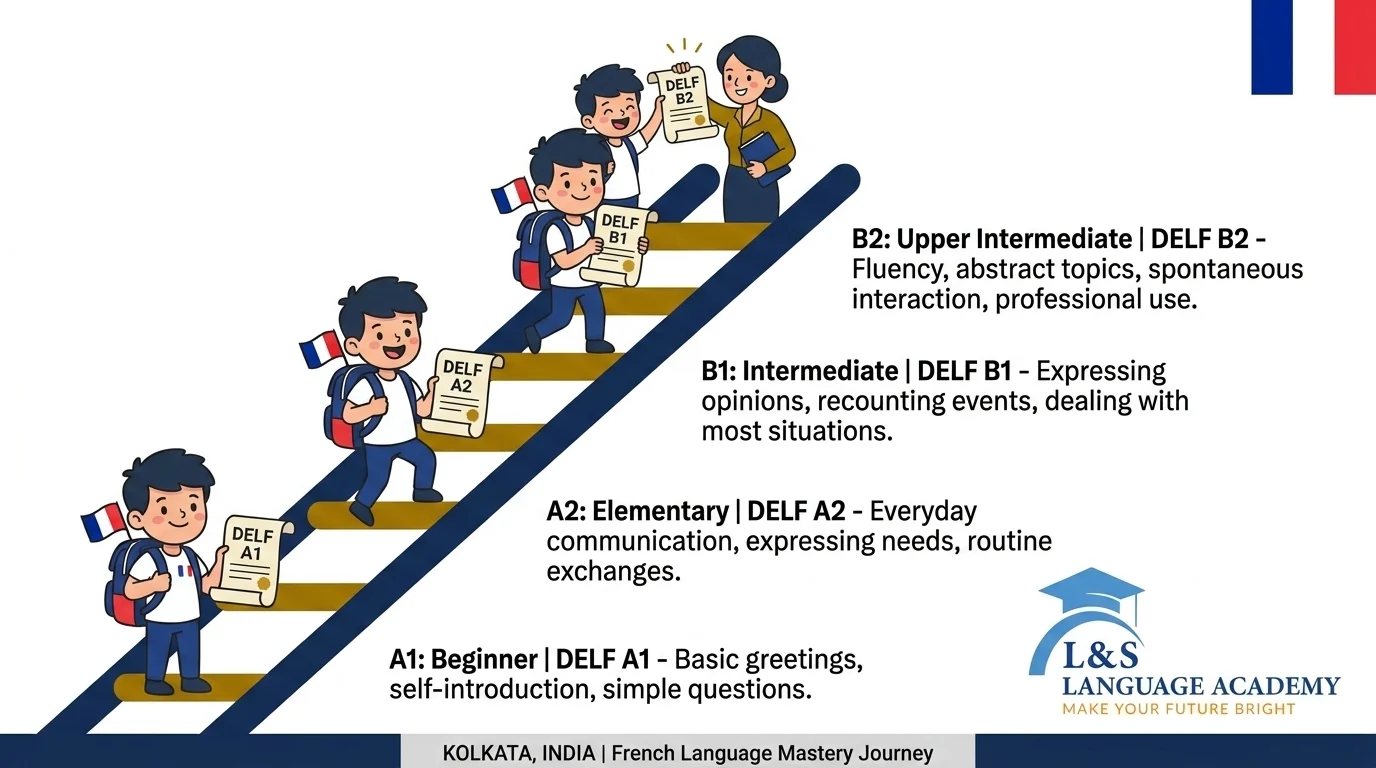
French follows the CEFR A1–C2 framework at LNS. We teach all six levels. Before enrolling, we do a quick placement check to confirm the right starting point.
| Level | What you learn | Duration (approx) | Matching exam | Common goal |
|---|---|---|---|---|
| A1 | Alphabet, pronunciation, greetings, present tense, numbers, everyday vocab | 6–10 weeks | DELF A1 | Foundation; entry-level French |
| A2 | Past tense, daily routines, simple letters, travel, shopping | 6–10 weeks | DELF A2 | Basic communication; continues A1 |
| B1 | Opinions, work contexts, media, past/conditional tenses | 8–12 weeks | DELF B1 | Study/work threshold; French nationality qualification |
| B2 | Academic writing, debate, advanced reading, formal French | 10–14 weeks | DELF B2 | University admission; Canada PR target ≈ NCLC 7 |
| C1 | Nuanced expression, literary and academic texts, advanced phonetics, professional register | 14–18 weeks | DALF C1 | Postgraduate study in France; translation work; senior professional roles |
| C2 | Near-native precision, academic writing, literary analysis, introduction to interpretation | 14–18 weeks | DALF C2 | Mastery; teaching, interpreting, academic and diplomatic careers |
Duration assumes 3–4 classes per week with daily practice. Intensive batches can compress timelines. Your actual pace depends on consistency outside class.
A1 & A2 (Beginner)
A1 starts from zero — the alphabet, French phonetics (those nasal sounds!) and the very basics of present tense. By the end of A2, you can write a short letter, describe your daily routine and have a basic conversation about yourself, your work and your surroundings. DELF A1 and A2 are the beginner certificates — useful as a formal record of progress, though not required for most visa or study purposes at this level.
We've found that the A1–A2 phase is where most students either fall in love with French or lose momentum. We structure the sessions to keep things moving — plenty of spoken practice, not just grammar rules — because French really rewards learners who start speaking early, even badly.
B1 & B2 (Intermediate)
B1 is when French starts feeling useful. You can handle real conversations, express opinions, navigate the French media and manage most workplace situations. DELF B1 is the certificate that qualifies you for French nationality (if that's your pathway). It's also where study-abroad applications often start asking for language proof.
B2 is the target level for most of our career and immigration-driven students. DELF B2 is accepted by French and Francophone universities for admission. And NCLC 7 — the minimum for Canada PR French-language draws — corresponds roughly to a strong B2. If Canada PR is your goal, B2 is where you need to land.
C1 & C2 (Advanced & Mastery)
C1 is where French stops being a subject you study and becomes a language you think in. You can follow two native speakers talking to each other at full speed without straining, read a novel or a technical report without reaching for a dictionary, and argue a position with nuance rather than just stating it. DALF C1 — issued, like DELF, by France Éducation international — is accepted by French and Francophone universities for postgraduate admission, and it is roughly the level at which serious translation and interpretation work becomes possible.
C2 is mastery, and we'll be honest about who needs it: not many people. It's for those heading into teaching, interpreting, academic research, or senior roles where precision matters more than fluency. Most of our students stop at B2, and for career and immigration goals that is usually the right call. We teach C1 and C2 for the students who don't stop there — and the classes look different at this level: smaller groups, far more reading and writing, and most of the time spent on the last twenty percent of French that separates "fluent" from "sounds like they grew up with it".
Learn French for Canada PR & Immigration
This section covers what almost no French institute in Kolkata explains clearly. So let's lay it out.

Why French is now the most powerful Express Entry strategy
In March 2025, IRCC permanently removed job offer points from the CRS scoring system. That changed everything. Strong French proficiency is now the single highest-impact controllable factor in your Express Entry profile.
Here's what the numbers look like in 2026:
- NCLC 7 French + CLB 5+ English = 50 additional CRS points. That's a bigger boost than most education or work-experience upgrades.
- French-language category draws have CRS cutoffs around 379–419 — compared to 515+ for general draws. The February 2026 French draw issued 8,500 ITAs — the largest French-specific draw in Express Entry history.
- Canada has exceeded its Francophone immigration target for four consecutive years, and the government is accelerating it further.
So if you're in the Express Entry pool with a mid-range CRS score, learning French to NCLC 7 could literally be the difference between waiting years and getting an Invitation to Apply within months.
What NCLC 7 means in practice
NCLC stands for Niveaux de compétence linguistique canadiens — Canada's own language scale. NCLC 7 corresponds roughly to a strong B2 on the CEFR scale. You need to hit NCLC 7 in ALL four skills: Speaking, Listening, Reading and Writing. One weak module (say, B1 in Writing) disqualifies you from the French category draws.
From zero, reaching NCLC 7 typically takes 600–800 hours of guided study — roughly 14–20 months with consistent daily practice. That timeline makes starting early critical.
Which French test for Canada — TEF or TCF?
Only two French tests are accepted by IRCC for Express Entry: TEF Canada and TCF Canada. The DELF is NOT accepted for immigration purposes. Keep that distinction clear.
| Test | Best for | Format note |
|---|---|---|
| TEF Canada | Conversational learners | Role-play style speaking tasks |
| TCF Canada | Grammar-focused learners | Structured, task-based format |
Both are equally valid for IRCC. Results are valid for two years. You choose based on which format plays to your strengths. LNS prepares you for either.
Important: Express Entry is for provinces OUTSIDE Quebec
Express Entry covers immigration to Ontario, British Columbia, Alberta, New Brunswick and other provinces — not Quebec. If you want to settle in Montreal or Quebec City, you'd apply through the Programme de l'expérience québécoise (PEQ) or the Regular Skilled Worker Program via the Arrima portal. However, TEF and TCF results are accepted for both federal Express Entry and Quebec programmes, so your preparation at LNS works for either path.
For official Canadian language requirements, refer to IRCC's Express Entry page.
And if Canada PR also requires an English proof, our IELTS coaching in Kolkata covers that side of the bilingual requirement.
DELF, DALF, TEF & TCF — Which French Exam Do You Need?
The French exam space is confusing. Let's cut through it.

DELF (Diplôme d'études en langue française): A1 to B2. Issued by France Éducation international. Permanent, non-expiring certificate. Used for: general proficiency, study in France/Francophone countries, French nationality (B1), university admission (B2). NOT accepted for Canada PR. DELF and DALF are sat at the accredited exam centre in Kolkata.
DALF (Diplôme approfondi de langue française): C1 and C2. Same issuing body as DELF. For advanced users. Used for advanced academic and professional contexts.
TEF Canada: Issued by the Paris Chamber of Commerce (CCI Paris Île-de-France). Specifically designed for Canadian immigration. Accepted by IRCC for Express Entry. Valid 2 years.
TCF Canada: Issued by France Éducation international. Also accepted by IRCC. TCF is sat at an accredited centre in Kolkata. Valid 2 years.
Which one do you need?
- Study or work in France / general proof → DELF
- Canada PR / Express Entry → TEF Canada or TCF Canada (not DELF)
- French nationality → DELF B1
- University in France / Francophone university → DELF B2 or DALF C1
LNS Academy prepares you for whichever exam matches your goal. We run mock tests, timed practice sessions and targeted feedback for DELF and TEF/TCF Canada preparation. The actual exam is booked and taken independently at the relevant centre — we don't administer exams ourselves.
French Language Course Fees in Kolkata
Here is what a French course costs at LNS, level by level. One fee per level, and no separate registration charge on top of it.
| Level | Duration | Offline Fee (₹) | Online Fee (₹) |
|---|---|---|---|
| A1 – Beginner | 3–4 months | 9,000–18,000 | 6,500–13,000 |
| A2 – Elementary | 3–4 months | 9,500–19,000 | 7,000–13,500 |
| B1 – Intermediate | 4–6 months | 12,000–24,000 | 8,500–17,000 |
| B2 – Upper-Intermediate | 4–6 months | 13,000–26,000 | 9,500–18,500 |
| C1 – Advanced | 5–7 months | 15,000–28,000 | 11,000–20,000 |
| C2 – Mastery | 5–7 months | 16,500–30,000 | 12,000–22,000 |
Lower figure = group batch in the classroom. Higher figure = one-to-one sessions with a teacher dedicated to you. Online rates sit lower because there is no classroom cost to pass on.
View full French course fees, DELF/TEF exam options & Canada PR details →
Books are sometimes an extra cost, and we tell you that before you pay. For the exact rate of the batch starting next, call or WhatsApp 62891 24658.
At the end of our French course, LNS Academy conducts its own internal exam and issues an LNS Academy course completion certificate. Students who want the internationally recognised DELF, TEF Canada or TCF Canada certificate sit those exams independently at the respective centres.
Online & Offline French Classes Across Kolkata
Our centre is at 108, Majumder Para, 1no Airport Gate, Kolkata 700079 — near Dum Dum metro, convenient for north Kolkata, Barrackpore and the Airport catchment.

Offline batches run in small groups at our Dum Dum centre. If you've been searching "French classes near Dum Dum" or "French class near Airport Kolkata" — this is the closest dedicated option in the north Kolkata area.
Online batches are fully live — real-time instruction via a video platform, not pre-recorded videos. Students from Salt Lake, New Town, Behala, Howrah, Garia and Barasat attend online. So do students from Darjeeling, Siliguri and other cities in West Bengal and across India.
Batch options at LNS:
- Weekday batches (morning and evening)
- Weekend batches (Saturday + Sunday)
- Intensive batches (daily, for Canada PR candidates with a deadline)
- One-to-one sessions (on request)
Both online and offline include mock tests, speaking practice and feedback on writing — the two skills most students underestimate in French.
How Long Does It Take to Learn French (and Reach B2)?
We get asked this every day. Here's the honest answer, not the optimistic one.
French A1: 6–10 weeks with 3–4 classes per week.
French B1: 7–10 months from scratch with consistent study and daily practice.
French B2 (NCLC 7 territory): 14–20 months from zero. From zero specifically to NCLC 7 (the Canada PR target), most candidates need 600–800 hours of guided study — roughly 14–20 months at 1–2 hours of daily practice.
The key variable is what you do outside class. French pronunciation and grammar consolidate through repetition. If you listen to French podcasts during your commute, practise speaking with a language partner and review vocabulary daily — you'll progress significantly faster than someone who only shows up to class.
And one more thing: don't delay. If your Canada PR profile is in the Express Entry pool right now and you don't have a French score yet — every month of delay is a month without the 50 CRS points that French proficiency could add. Starting today is always better than starting three months from now.
Also explore our Learn French for Canada PR blog guide for a detailed study plan.
Why Choose LNS for Your French Course in Kolkata
Fair question. Here is exactly what you get when you learn French with us.
| What matters | What you get at LNS |
|---|---|
| Teaching standard | The full CEFR framework, A1 to C2. Every level follows the structure the exams are built on. |
| Exam preparation | DELF and DALF preparation, plus a dedicated TEF and TCF Canada track for PR applicants. |
| Canada PR focus | B2 preparation built around the TEF/TCF Canada format, not just general French. |
| Batch options | Weekday, weekend, evening, intensive and live online. You pick what fits your job. |
| Batch size | Small groups, so you speak in class instead of just listening. One-to-one available too. |
| Fees | One clear fee per level. No separate registration charge. |
| Location | Near Dum Dum and 1no Airport Gate. Easy from Barasat, Barrackpore and North Kolkata. |
| Certification | ISO 9001:2015 certified institute. You receive the LNS completion certificate after each level. |
If Canada immigration is your goal, that focus matters more than anything else on this page. A general French course gets you the language. We build your B2 work around the actual TEF and TCF Canada question formats, so you walk into the test knowing its shape.
And if you are learning French for study in France, for work, or simply because you want to, the same CEFR path takes you there. Come and sit in a free demo class first. Judge the teaching for yourself before you pay anything.
We are a certified foreign language training institute in Kolkata with ISO 9001:2015 certification. That standard underpins everything we do.
Student Results & Reviews

"I joined LNS specifically for the Canada PR track. I needed to reach B2/NCLC 7 and I had about 12 months to do it. The trainer mapped the entire journey — A1 through B2 — and we followed a structured plan. I gave TEF Canada at the end and cleared NCLC 7 in all four skills. Got my ITA within three months of submitting the score."
— Sohini Dutta, New Town (Canada Express Entry, French draw)
"I was already at A2 from a previous course but was stuck. LNS's B1 classes pushed me through the wall — particularly the speaking and writing practice. I passed DELF B1 and am now applying to a French university for my master's."
— Rahul Sarkar, Salt Lake (study in France)
"Weekend batches were the only option for me because of my job. LNS accommodated that without any compromise in coverage. A1 to A2 in six months, and now B1 is going well. Good teaching and good availability."
— Pritha Mukherjee, Behala (learning French for work and travel)
Book a Free French Demo Class

Try a free class first. You'll see how we teach, how we approach Canada PR preparation and whether our style works for you — all before paying anything.
📍 Address: 108, Majumder Para, 1no Airport Gate, Kolkata 700079
📞 Call / WhatsApp: 62891 24658
📧 Email: contact@lnsacademy.in
Morning · Evening · Weekend slots available. Online and offline both open. WhatsApp response same day.
Frequently Asked Questions
1. How much do French classes cost in Kolkata?
+
At LNS, French costs ₹9,000 to ₹18,000 per level offline at A1, and ₹6,500 to ₹13,000 online. The lower figure is a group batch, the higher one is one-to-one with a dedicated teacher. B1 and above run longer, so they cost more. See our French course fees page or call 62891 24658 for the current batch rate.
2. Does learning French help with Canada PR?
+
Yes — significantly. NCLC 7 French (on TEF Canada or TCF Canada) + CLB 5+ English earns you up to 50 extra CRS points in Express Entry. In 2026, French-language category draws have had CRS cutoffs as low as 379–400 versus 515+ for general draws. In February 2026, IRCC issued 8,500 ITAs in the French draw alone — the largest in history. French is now the highest-impact strategy you can control in your Express Entry profile.
3. Which French exam do I need — DELF, TEF or TCF?
+
For general proficiency or study in France, take the DELF (or DALF at C1/C2). For Canada immigration (Express Entry), take TEF Canada or TCF Canada — the DELF is NOT accepted by IRCC for immigration. LNS prepares you for whichever matches your goal. You book and sit the actual exam independently at the accredited centre.
4. How long does it take to learn French and reach B2?
+
French A1 takes about 6–10 weeks from scratch. Reaching B2 — the level corresponding to NCLC 7 for Canada PR — typically takes 14–20 months of regular study with 3–4 classes per week and daily practice outside class. From zero to NCLC 7 requires approximately 600–800 hours of guided study total.
5. Is French or German better for Indian students?
+
It depends entirely on your goal. French is the right choice for Canada PR, study in France, Francophone careers and global multilingual roles. German is the right choice for study/work in Germany, engineering, IT and the nursing/healthcare visa route. Both are excellent and in high demand. LNS teaches both — check our German language course in Kolkata if you're comparing.
6. Do you offer online French classes in Kolkata?
+
Yes — LNS runs fully live online French classes with weekday, evening and weekend batches. Not pre-recorded. You join a real-time session with a trainer and other students. Students from across Kolkata and India attend our online batches. The curriculum, mock tests and feedback are identical to offline.
7. What makes LNS different from other French institutes in Kolkata?
+
Three things. We teach the full CEFR path from A1 to C2, so you are not stuck at B2 if you want to go further. Our B2 work is built around the TEF and TCF Canada formats, which matters if immigration is your goal. And batches run weekday, weekend, evening, intensive and live online, so a job does not stop you. You sit the actual DELF, TEF or TCF exam independently at the accredited centre, so what you are really buying from any institute is the quality of the preparation. Come to a free demo class and judge ours before you pay anything.
8. Do you teach French near Dum Dum or the Airport?
+
Yes — LNS is at 1no Airport Gate, Dum Dum. Students from north Kolkata, Barrackpore, Belgachia, Lake Town and the Airport area attend offline batches. Online batches serve Salt Lake, New Town, Behala, Howrah and the rest of Kolkata and India.
9. Can a complete beginner join the French course?
+
Absolutely. Our A1 course starts from zero — the alphabet, basic pronunciation (those tricky French sounds!), greetings and present tense. No prior French knowledge needed. We do a short orientation in the first session to confirm your starting point.
10. What certificate do I receive after the French course at LNS?
+
LNS Academy conducts its own internal exam at the end of each level and issues an LNS Academy course completion certificate. This is separate from the internationally recognised DELF, TEF Canada or TCF Canada. Those are independent exams you book and sit yourself. LNS prepares you thoroughly for those exams — we don't administer them.
11. What's the difference between TEF Canada and TCF Canada?
+
Both tests are accepted by IRCC for Canadian immigration. TEF Canada (by CCI Paris) uses role-play speaking tasks — better for conversational learners. TCF Canada (by France Éducation international) uses structured, task-based format — better for grammar-focused learners. Both results are valid for 2 years. LNS prepares you for either format based on your learning style.
12. Should I learn Spanish alongside French?
+
Both are Romance languages and share many similarities — students with B1 French often pick up Spanish faster than average. If you're weighing Romance languages, also explore our Spanish language course in Kolkata. For global careers and immigration, French + English bilingualism currently offers stronger structured pathways than Spanish in the Indian context.