Book Your Free Demo Class
Submit this form and get an instant call from us. We will share you a demo class schedule.

Your child can score 90 in French and still not hold a conversation. That is not the child's fault and usually not the school's either. In the CBSE French paper, none of the 80 written marks test speaking. In ICSE, speaking is worth 5 marks out of 100. The exam is doing what it was designed to do. It just was not designed to make your child speak.
We teach French classes in Kolkata and a lot of our enquiries come from parents. Usually the same sentence. "She gets good marks but she cannot say two lines."
Let us look at why, using the actual mark sheets.
Yes, on both major boards, and in the international-curriculum schools as well.
Most schools introduce it around Class 5 or 6 as a third language option. It continues to Class 8, and then becomes an optional board subject in Classes 9 and 10 for children who want to carry it forward.
Different schools do this differently, so check with yours rather than assuming. Some drop it after Class 8 entirely.
This is worth looking at properly, because the answer explains almost everything.
CBSE French is subject code 018. The paper is out of 100 — 80 marks for the written exam and 20 for internal assessment. Here is how the 80 breaks up.
| Section | What it tests | Marks |
|---|---|---|
| A | Reading comprehension | 10 |
| B | Writing | 20 |
| C | Grammar | 30 |
| D | Culture and civilisation | 20 |
| Speaking | 0 | |
Read the last row again. Zero of eighty marks test whether your child can speak French.
Grammar alone is 30 marks. That is more than reading and speaking put together.
The CBSE guidelines do recommend that listening and speaking be practised in class, through role play and skits. Recommend. Not test. And in a school year with a syllabus to finish, what gets tested is what gets time.
ICSE handles this better, though still not the way most parents imagine.
Also out of 100. Eighty marks for the external paper, three hours, covering comprehension, grammar, dialogue and translation, and a letter or composition.
The remaining 20 marks are internal assessment, and this is where ICSE differs. Of those 20 marks, 5 are for speaking, 5 for listening, and 10 for creative writing.
In the speaking test the child speaks on a topic for about two minutes, then discusses it with the examiner for three more.
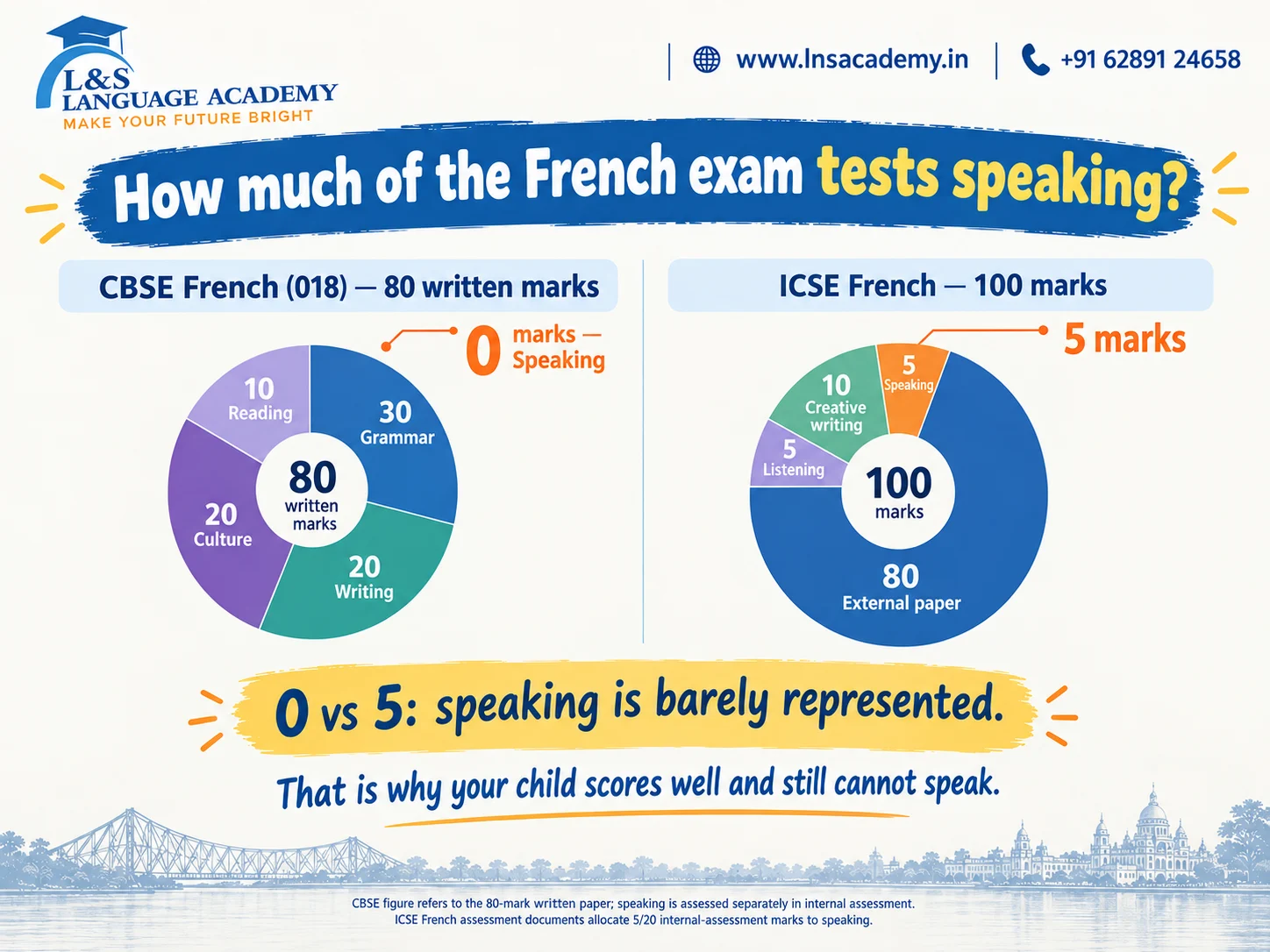
So ICSE does test it. Five marks out of a hundred.
That is five percent of the grade for the only skill most parents actually care about. A child can ignore speaking entirely, lose five marks, and still finish with 95.
No school timetable is going to spend serious time on something worth five marks. That is not a criticism of teachers. That is how examinations shape teaching, everywhere in the world.
Now you have the answer, and it is a relief to most parents.
Nothing is wrong with your child. Nothing is wrong with the school. Your child has been trained for the paper, and has become good at the paper.
Writing French and speaking French use different parts of the skill. Writing gives you time to think, check and correct. Speaking gives you two seconds and no eraser.
A child who has written hundreds of French sentences and spoken perhaps twenty will write beautifully and freeze when asked a question.
The fix is not more grammar. Your child already has the grammar. The fix is speaking time with somebody who corrects.
Here is an honest framework rather than a sales answer.
Pick French if your child enjoys languages, or there is some plausible long-term direction — higher studies abroad, immigration someday, an international career. Also pick it if your child simply likes it. Interest beats strategy at this age.
Think twice if the only reason is that French looks like an easy scoring subject, and there is no intention of continuing after Class 8.
Here is the part parents miss. Three years of French, dropped at Class 8, is three years spent for almost nothing. The child keeps a few phrases and loses the rest.
Three years of French, continued properly, becomes a real asset by the time they finish college. Different outcome entirely, from the same starting point.
Often yes, at school level. The syllabus is narrow, the paper is predictable, and grammar rewards preparation.
But look at what that means. Thirty marks of CBSE French is grammar, which is memorisable. A child who works through the grammar book will score.
So a high board mark in French frequently sits alongside A1 level real ability. The mark is genuine. It is just measuring something narrower than parents assume.
Worth asking yourself which one you want. Marks, or the language. Both are fair answers. They need different support.
There is something in progress, and parents ask about it, so here it is straight.
CBSE has been discussing treating foreign languages as skill subjects for Classes 9 to 12, under the National Credit Framework. The reason is technical. The curriculum framework wants two of the three languages a school offers to be Indian languages, and English usually occupies the third slot. Putting French and the others into the skill-subject category would let schools keep offering them.
As of now this is a draft proposal, not a decision. No implementation date has been announced. Schools were sent the framework for feedback.
What it does not change is anything about learning French. If your child is studying it now, carry on. We will update this page when there is something firm to report.
Useful to know, because it prevents a disappointing surprise later.
Language levels worldwide run A1, A2, B1, B2, C1, C2. That scale is called the CEFR.
A child who studies French from Class 6 to Class 10 typically lands around A1 to A2. Sometimes A2 if the school is strong.
And the two halves are usually uneven. Reading and writing might be a solid A2. Speaking is often A1, or barely that.
So a student who feels they have "done five years of French" often starts a formal course at A1 or A2, not at B1. Knowing that early saves a lot of frustration. It is not a step backwards. It is where they actually are.
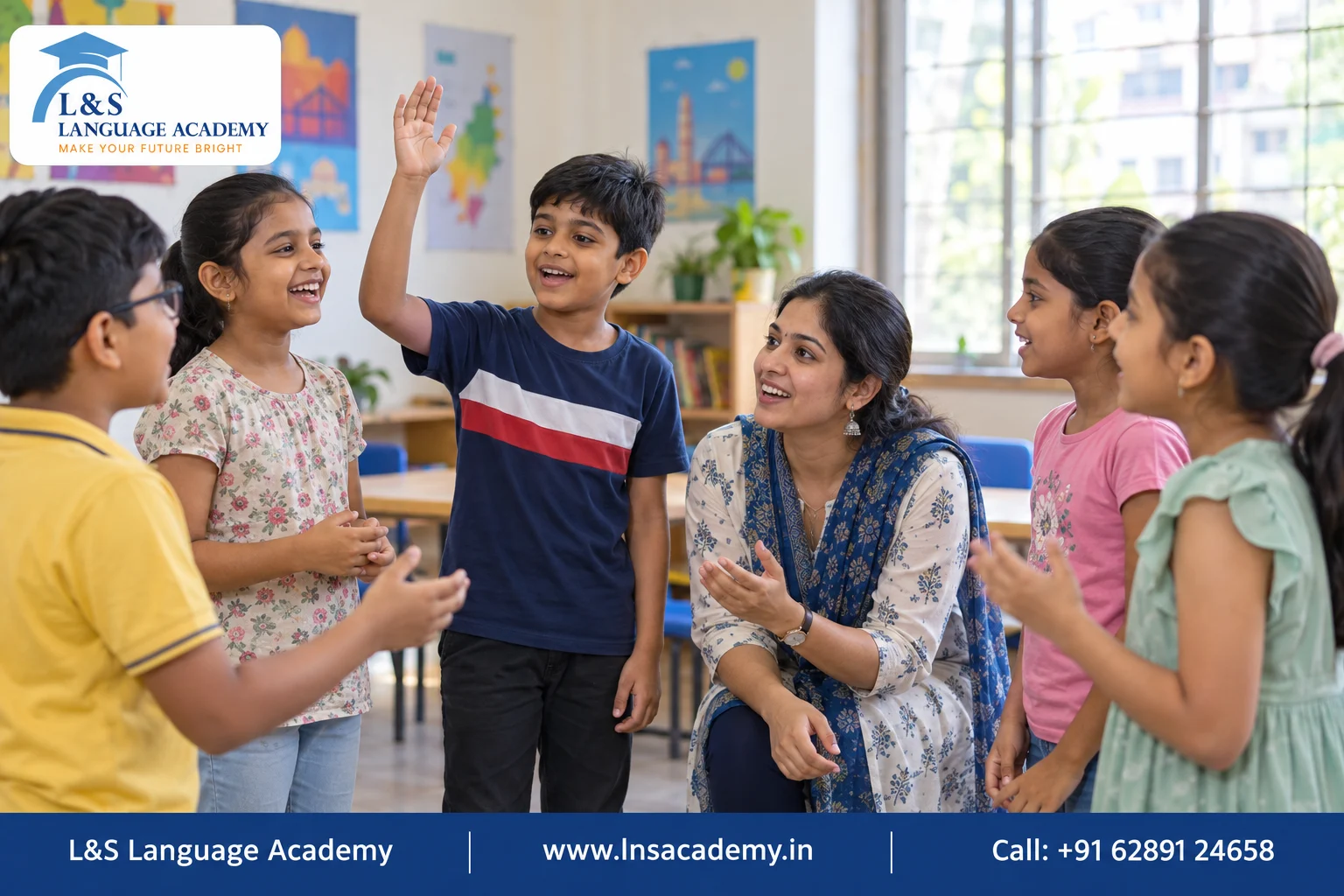
Earlier is better for pronunciation specifically. Young children copy sounds without effort and without embarrassment, which is half the battle.
For everything else, older is often faster. A fifteen-year-old can understand a rule and apply it. An eight-year-old cannot, and has to absorb it slowly through use.
Rough guide by age.
If your child is fifteen and has not started, that is not late. Plenty of people begin at thirty.
Completely different, and a class that mixes them serves neither.
Children learn through use. Repetition, stories, songs, physical activity, games. Grammar arrives later and quietly. Tell a nine-year-old about the subjunctive and you have lost them.
Teenagers need their school syllabus respected. If the class ignores their exam, they will drop it. But they also need speaking added, because school is not giving them any.
Adults want the rule first. Explain the pattern and they apply it immediately.
So when you enquire anywhere, ask about batch composition. A class with a ten-year-old and a thirty-year-old in it is working at the wrong pace for both.
Depends entirely on what you want, and these are two different products.
Board exam support. Aligned to the school syllabus, targeting the paper. Grammar drills, comprehension practice, composition structure. If the goal is marks, this is what you want.
Communicative French. Targeting an actual CEFR level and real speaking ability. Different material, different classroom, different outcome.
Many families want both, and that is fine. Just be aware that they are not the same class, and be careful of anywhere that sells one while describing the other.
If your child is scoring well and you are happy with the marks, you may not need us at all. If your child is scoring well and cannot speak, that is the second product.
Nine questions. Ask all of them.
That last one separates the good classes from the average ones. Every batch has a quiet child. What happens to that child is the whole question.
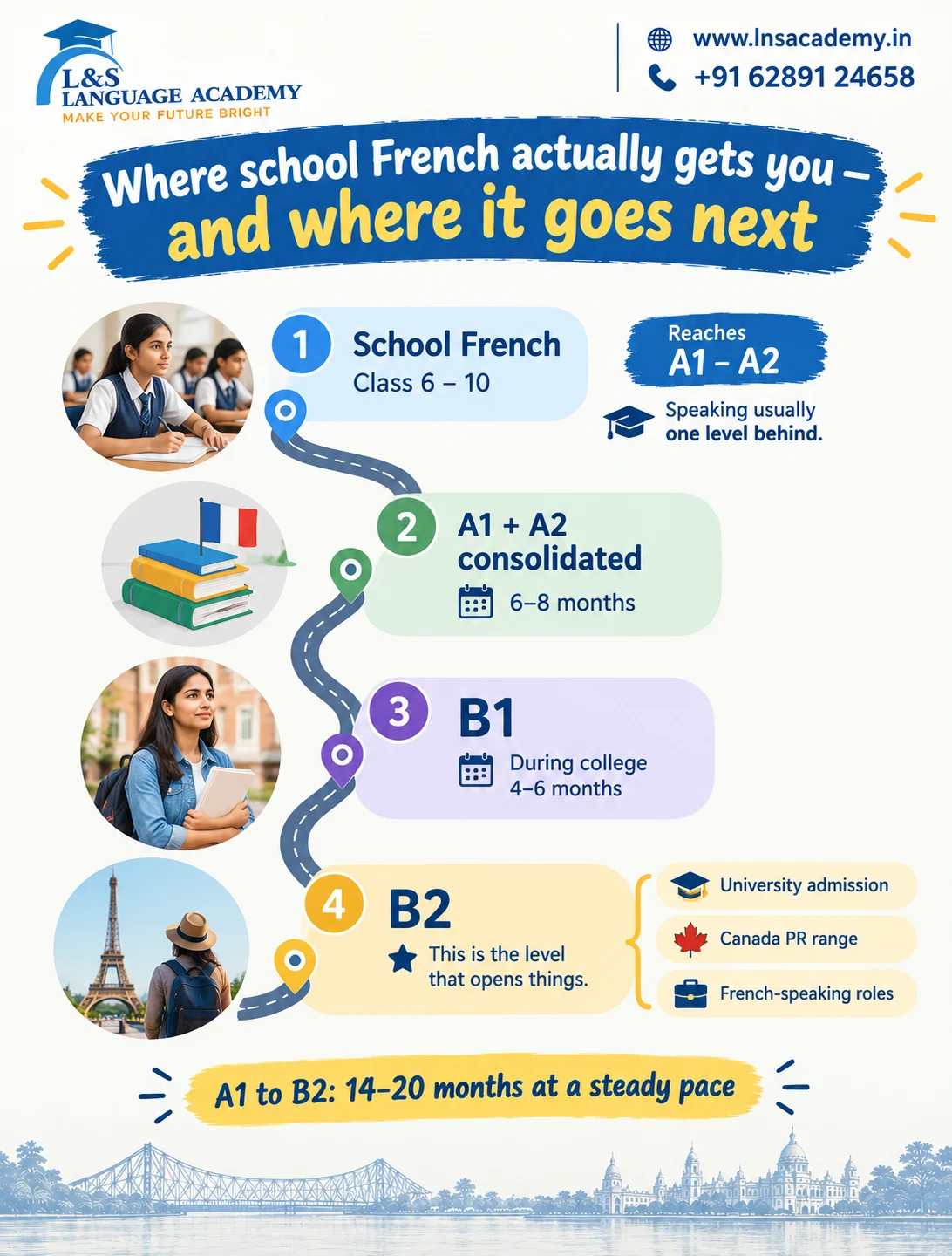
Here is the route most families end up on.
School French takes the child to roughly A1 or A2 by Class 10. A proper A1 and A2 course during or just after school consolidates that. B1 comes during college. B2 by graduation, if they keep going.
B2 is the level that actually opens things. University admission in French-taught programmes. The proficiency level relevant to Canadian immigration. Roles at companies that want French.
Time-wise, A1 to B2 is roughly fourteen to twenty months of steady study. Starting at sixteen means being there well before the job hunt begins.
We teach all six levels, A1 through C2. If your child eventually looks at Canada, we have written about French for career and Canada PR separately.
There are age-appropriate options, and they are optional.
France Éducation international issues DELF Prim for younger children and DELF Junior, also called DELF Scolaire, for school-age students. These cover the A1 to B2 range with topics suited to that age group rather than adult material.
Is it necessary? No. Most children never take one and lose nothing.
It is worth doing if your child may apply abroad later, because it is a portable record of level that any country reads. A school mark sheet does not travel the same way.
One thing to be clear about. We prepare students for these exams. We do not conduct them, register students for them, or issue their certificates. Those are run by their own exam bodies and taken independently. At the end of each level with us there is an internal test and our own institute certificate.
| Level | Duration | Offline | Online |
|---|---|---|---|
| A1 | 3–4 months | ₹10,000–26,000 | ₹6,000–15,000 |
| A2 | 3–4 months | ₹10,000–26,000 | ₹6,000–15,000 |
| B1 | 4–6 months | ₹12,000–48,000 | ₹8,000–20,000 |
| B2 | 4–6 months | ₹12,000–48,000 | ₹8,000–20,000 |
Full details on our course fees page. Call 62891 24658 for batch timings, including after-school and weekend slots.
Budget ₹500 to ₹2,000 separately for books.
One way to think about the money. This is not a term expense like a tuition class. It is a multi-year asset. The alternative is your child restarting French from zero at twenty-two because a job or a visa needs it, and paying for the whole thing again with less time to spare.
Some of it, genuinely.
What works well for children: French songs, cartoons dubbed in French, picture dictionaries, labelling things around the house. All free and all effective for vocabulary and for the ear.
What does not work: self-paced apps for under-twelves without an adult sitting with them, and grammar worksheets, which kill interest quickly.
The honest limit is the same as for any language. A child cannot correct their own pronunciation, and a parent who does not speak French cannot correct it either. Free builds interest and vocabulary. Somebody has to fix the sounds.
If you want to understand what is genuinely hard about French and what is easier than it looks, we have written that out here.
108, Majumder Para, 1 No Airport Gate, Kolkata 700079. Convenient from Dum Dum, Nagerbazar, Baguiati, Kestopur, Lake Town, Birati and Madhyamgram.
Online batches cover Salt Lake, New Town, Barasat, Behala, Howrah and the rest of India.
For grammar and the exam, not much. For pronunciation, yes. A child copies what they hear, and habits picked up at nine are the hardest to change later.
If there is no intention of ever continuing, dropping it is honest. If there is any chance of picking it up later, continuing is far cheaper than restarting.
Almost always the teaching method for that age. Grammar tables bore an eleven-year-old. The same child in a class built around speaking and games usually comes back interested.
If Maths is genuinely struggling, fix that first. A language is a long game and it will still be there next year. Do not add a class on top of a child who is already underwater.
For board support, yes, usually — you would be adding load at the worst time. Start the summer after boards instead. That gap is the best window there is.
It helps, because a lot of French vocabulary is familiar to an English reader. But it is not a requirement. French can be taught in Bengali or Hindi.
No, not directly. It is not part of those exams. It helps for study abroad, and it helps on a CV later. Be clear about which one you are buying.
It can, and this is the most common reason children drop out. Pick a slot with breathing room around it. Two calm hours a week beats four rushed ones.
We take children from about eight. Before that, the attention span usually works against it.
No. It is an option, and schools decide what they offer. Check with your school.
Both are available. Tell us which one you want when you call, because the classes are genuinely different.
Yes, there are junior and primary versions. It is optional and we will tell you honestly whether it is worth it for your child.
For teenagers, usually yes. For under-twelves, offline works much better. Young children need the room.
Call 62891 24658 for current batch details. Ask about the age range in the batch, not just the size.
Bring your child in for one class. Watch how they respond. You will know within forty minutes whether it suits them.
We will also tell you honestly where their French actually sits, which is usually different from what the report card suggests.
Call 62891 24658 or write to contact@lnsacademy.in. Full French course details are here, and if you want to see what the first three months look like week by week, we have mapped that out.