Book Your Free Demo Class
Submit this form and get an instant call from us. We will share you a demo class schedule.


Four things about French are genuinely hard. Gender on every noun, the amount of verb conjugation, silent letters, and the French R. Five things are easier for you than for an English speaker — starting with nasal sounds, which you already make every day in Bengali and Hindi and never think about.
We teach French classes in Kolkata, from A1 right through to C2. The first question in almost every enquiry call is some version of "is it very difficult?"
Here is the honest version, with the hard parts named properly and the easy parts not oversold.
Moderately hard. Less hard than its reputation.
The US Foreign Service Institute, which has trained diplomats in languages for decades, puts French in its easiest group. Category I. They estimate 24 to 30 weeks, or 600 to 750 class hours, to reach professional working proficiency.
Take that ranking, not those hours. Those numbers describe full-time diplomatic training — people studying all day, every day, with nothing else to do. An evening class twice a week is a different thing and will take longer.
What the ranking does tell you is where French sits. Easier than German. Much easier than Japanese, Chinese or Arabic. Roughly level with Spanish and Italian.
The real difficulty is not spread evenly, though. It is packed into the first six weeks, before the sound system clicks. Get through that and it opens up.
Four things, in the order they cause trouble.
Notice what is not on the list. Grammar complexity in general, word order, and the script. Those are all fine.
It feels arbitrary because it mostly is. La table. Le livre. Nothing about a table is feminine.
The shortcut that actually works is simple, and most beginners ignore it. Never learn a noun alone. Learn it with its article. Do not learn table. Learn une table. It costs nothing extra and saves you two years of guessing.
Word endings also get you a long way.
| Ending | Usually | Examples |
|---|---|---|
| -tion, -sion | Feminine | la nation, la décision |
| -té | Feminine | la liberté, la qualité |
| -ette | Feminine | la baguette |
| -ance, -ence | Feminine | la chance, la patience |
| -age | Masculine | le voyage, le message |
| -ment | Masculine | le moment, le gouvernement |
| -eau | Masculine | le bureau, le château |
| -isme | Masculine | le tourisme |
These patterns cover most nouns, not all. There are exceptions and you will meet them. But learning eight endings is faster than memorising ten thousand nouns one at a time.
And here is something nobody tells Indian learners. If you speak Hindi, you already do this. अच्छा लड़का, अच्छी लड़की — the adjective changes with the gender of the noun. You have been doing agreement since childhood. An English speaker meets this idea for the first time at thirty. You only have to learn which French nouns are which. The concept is already in your head.
No. And this is the biggest advantage you have.
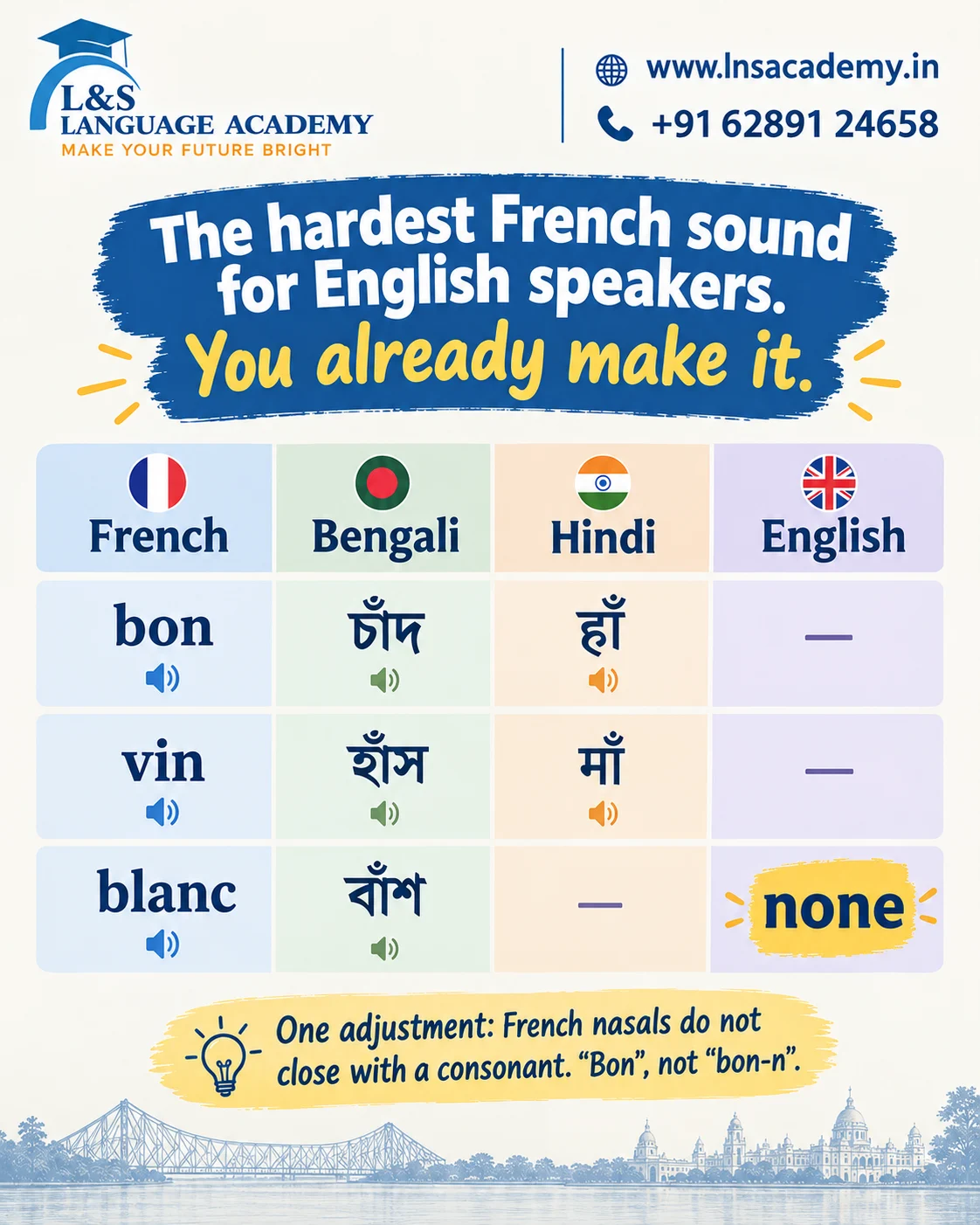
French nasal vowels are the classic stumbling block. Bon. Vin. Blanc. Air goes through the nose as well as the mouth.
English has no nasal vowels. None. So an English learner has to build the sound from nothing.
Bengali and Hindi both have them, and you mark them in writing. চন্দ্রবিন্দু in Bengali — চাঁদ, হাঁস, বাঁশ. चंद्रबिंदु in Hindi — हाँ, माँ. You produce these without thinking about it.
So walk into your first French class knowing this. The thing everyone warns you about is the thing you can already do.
One correction you will need. French nasals do not close with a consonant. Bon is one nasal sound, not "bon-n". Let the sound end in the nose and stop. That adjustment takes a few days, not weeks.
A small point on how many there are. French traditionally has four nasal vowels, but the one in un and brun is disappearing. Many French speakers, especially younger ones in Paris, now say it the same as the sound in vin. So in practice you are learning three, and the fourth will not cost you anything if you skip it.
This one is genuinely new, and we will not pretend otherwise.
The French R comes from the back of the throat. Not rolled like the Bengali র. Not the English r either. It is closer to a soft gargle.
Most students take two to four weeks to get it. Some take longer. Start from the position where you say খ or ख, then soften it until it is barely there.
The good news is that it costs you very little to get wrong. A slightly off R sounds like a mild accent. Nobody misunderstands you. Compare that with a wrong nasal vowel, which can turn one word into a different word. So if you are choosing what to worry about, worry about the nasals, not the R.
Yes, and faster than you expect.
The rules are short. Final consonants are usually silent — petit, beaucoup, temps. The -ent on a verb ending is silent. Final -e is silent. The letter h is always silent.
Then a small set of letter combinations, which never change. eau is "o". ou is "oo". ai is "e". oi is "wa".
And here is the part that surprises people. French spelling is more reliable than English spelling. Once you know the rules, you can read out a French word you have never seen and get it right. English never gives you that. Think about though, through, tough, thought — four spellings, four different sounds, no rule at all.
French looks harder for two weeks and then becomes easier permanently.
Liaison is when a silent final consonant wakes up because the next word starts with a vowel. Les amis is said "lez-ami". Vous avez becomes "voo-zavay".
There are three kinds. Compulsory, forbidden, and optional. That sounds like a lot to learn.
It is not, if you do it in the right order. At A1, learn only the compulsory ones. There are not many and they come up constantly. Leave the rest until B1, by which point you will have picked most of them up by ear anyway.
Getting liaison wrong sounds like an accent, not an error. Nobody will fail to understand you.
Five things, and they are not small.
The script. Same alphabet you already use. A few accent marks. Compare this with starting Japanese, Chinese, Arabic or Russian, where you spend the first two months just learning to read.
The vocabulary you already own. More on this below, because it is the biggest one.
Nasal sounds. Covered above. Free advantage.
Tu and vous. French has an informal "you" and a formal "you". English speakers find this genuinely confusing because English has only one. You have তুমি and আপনি. Or तुम and आप. You already know exactly when to switch, and why it matters socially. Same instinct, different words.
Word order. French is subject-verb-object, like English. Bengali and Hindi put the verb at the end. So here your English is the useful bridge, and it works well.
A lot. After 1066, English absorbed an enormous amount of French vocabulary, and it never gave it back.

Read these. You have not learned any French yet.
Nation. Important. Possible. Difficulté. Information. Restaurant. Table. Animal. Question. Université. Gouvernement. Intelligent. Service. Culture. Moment. Nature.
You understood all of them.
There are conversion patterns too. English words ending in -tion are usually the same in French. English -ty becomes -té — city, cité; quality, qualité. English -ly becomes -ment — exactly, exactement.
So you are not starting from zero. You are starting with a large passive vocabulary you did not know you had. This is why French feels slow for two weeks and then suddenly speeds up.
Both. Here is the honest split.
| Helps you | Gets in the way |
|---|---|
| Nasal vowels already in your sound system | Verb-at-the-end habit creeping into long sentences |
| Formal and informal "you" feels natural | Retroflex ট, ড instead of French dental t, d |
| Grammatical gender already familiar (Hindi) | Aspiration carried over from Bengali consonants |
| Used to juggling two or three languages daily | Adding a vowel to break up consonant clusters |
Net result — you are ahead of a monolingual English speaker. Not behind. Almost nobody tells Indian learners this, and it changes how people approach the first month.
Words that look like English but mean something else. These cause more embarrassment than grammar mistakes ever will.
| French word | Looks like | Actually means |
|---|---|---|
| actuellement | actually | currently |
| librairie | library | bookshop |
| sensible | sensible | sensitive |
| assister à | to assist | to attend |
| attendre | to attend | to wait |
| journée | journey | day |
| monnaie | money | small change |
| coin | coin | corner |
Learn these eight early. They come up in real conversation far more often than their difficulty suggests.
| Level | Duration | Hours | What you can do |
|---|---|---|---|
| A1 | 3–4 months | 60–80 | Introduce yourself, ask and answer simple personal questions |
| A2 | 3–4 months | 60–80 | Handle routine tasks, describe your background |
| B1 | 4–6 months | 80–100 | Manage most situations, describe experiences, give opinions |
| B2 | 4–6 months | 80–100 | Speak fluently, follow complex texts, write structured essays |
| C1 | 5–7 months | 100+ | Express yourself spontaneously, work professionally in French |
| C2 | 5–7 months | 100+ | Understand almost everything, express fine shades of meaning |
Those A1 to C2 labels are the CEFR scale, used across Europe and by most language institutes worldwide. We teach all six levels.
Realistically, A1 to B2 takes fourteen to twenty months at a steady pace. B2 is where most people stop, and for most goals that is the right place to stop.
If you want the detail on what the first three months actually feel like, we have written that out week by week in French from zero: your first 90 days.
Compared to Spanish, French is a little harder to pronounce and to spell. The grammar is about the same. Spanish is written closer to how it sounds.
Compared to German, French is easier. German has four cases, which changes the words around the noun constantly, and compound nouns that run to twenty letters. French has more tenses but no cases.
Honestly though, difficulty is the wrong thing to choose on. Pick by what you want it for. French opens Canada, France and a long list of African countries. German opens Germany and Austria. Spanish opens Latin America.
Pick the destination first. Then the difficulty stops mattering, because you will have a reason to push through week six.
Most learners do not need one. Say that out loud, because plenty of people pay for an exam they had no use for.
Here is the map. DELF covers A1 to B2 and DALF covers C1 to C2. Both are issued by France Éducation international. TEF Canada and TCF Canada are different exams, used in Canadian immigration. TCF also has a general version.
You need an exam in three situations. Immigration. A university place taught in French. Or a job that asks for documented proof.
One mistake costs people real money, so it is worth saying plainly. DELF is not the exam for Canada PR. That route uses TEF Canada or TCF Canada. People prepare for the wrong one and find out late.
We prepare students for all of these. We do not conduct them, register students for them, or issue their certificates — those are run by their own exam bodies, and you sit them independently. At the end of each level with us there is an internal test and our own institute certificate.
If Canada is your reason for learning, we have written about that separately in French for career and Canada PR.
Partly, and the split is the same as for any language.
Free works for vocabulary, grammar rules, reading and listening. There is plenty of good free material and you should use it.
Free struggles with three specific things in French. Gender drilling, because you need somebody to catch you when you say le table. The R, because you cannot hear your own throat. And nasal precision, where small differences change the word.
Our full method for free practice is written out in this piece on learning a language on your own. The plan is for English, but the routine transfers directly.

| Level | Offline | Online |
|---|---|---|
| A1 and A2 | ₹10,000–26,000 | ₹6,000–15,000 |
| B1 and B2 | ₹12,000–48,000 | ₹8,000–20,000 |
| C1 and C2 | ₹15,000–48,000 | ₹10,000–22,000 |
Per level. Full details on our course fees page. Call 62891 24658 for current batches.
Budget separately for books, usually ₹500 to ₹2,000. Ask any institute whether material is included before you compare two prices.
Worth thinking about the cost of waiting too. A1 to B2 is fourteen to twenty months. If B2 is your goal, starting six months late pushes the finish six months out. That is the real number, not the fee.
108, Majumder Para, 1 No Airport Gate, Kolkata 700079. Convenient from Dum Dum, Nagerbazar, Baguiati, Kestopur, Lake Town, Birati and Madhyamgram.
Online batches cover Salt Lake, New Town, Barasat, Behala, Howrah and the rest of India.
Usually yes, but it goes much faster. School French sits in there somewhere and comes back quicker than it went in. Do a placement check rather than guessing.
Easier in feel, harder in content. The sounds stop fighting you around A2. The grammar gets heavier at B1. Most people find B1 the least enjoyable level and B2 the most.
Because French runs words together. Liaison and dropped sounds mean a sentence is one long stream, not separate words. This is a listening problem, and listening practice is the only fix.
It is slow, not wrong. Everyone goes through it. The middle step drops out on its own around A2 if you are speaking regularly.
Yes. You lose the free vocabulary advantage, so it takes a bit longer. But French is taught in Bengali and Hindi too, and plenty of our students learn that way.
No. Bengali র is rolled at the front. French R sits at the back of the throat. Different sound entirely, and this is the most common mistake in the first month.
No. The opposite, usually. The second foreign language is easier than the first because you already know how to learn one.
Yes. French companies operate here, and translation, tourism and hospitality all use it. It is less useful than English for daily life, obviously, but it is not only for people going abroad.
Grammar, yes. Spelling, no — French spelling is far more consistent than English. Pronunciation is harder at the start and easier later.
About 500 to 700 active words gets you through A1. Far fewer than people fear.
Yes. Sounds are slightly easier when you are younger. Grammar and progress are faster when you are older, because you can apply a rule consciously. It evens out.
Only if you need documented proof for immigration, study or a job. Otherwise no.
For grammar and vocabulary, yes. For the first six weeks of sound work, being in the room helps. Many students start offline and move online later.
Yes. Come and sit through one before deciding anything.
Most people walk into their first French class braced for the worst. Then they discover the nasal sounds are already theirs, and half the vocabulary is familiar, and the formal-informal thing works just like আপনি and তুমি.
Come to a free demo and see where you actually stand. No charge, nothing to sign.
Call 62891 24658 or write to contact@lnsacademy.in. Full French course details are here, and if your English needs work alongside it, here is what level Kolkata employers look for.