German Language Course in Kolkata — A1 to C2 Classes at LNS Academy
 German classes at LNS Language Academy, Kolkata
At L&S Language Academy (LNS Academy), we offer German language courses in Kolkata from A1 to C2. Courses follow the CEFR framework, with qualified trainers, Goethe-exam preparation and flexible online/offline batches near Dum Dum and Airport Gate. Whether you're a fresher who wants to work in Germany, a nurse planning to migrate, or simply curious about the language — we start where you are. Book a free demo class and see what the first session feels like before you decide anything.
Table of Contents
- Why Learn German in Kolkata in 2026?
- German Course Levels at LNS: A1, A2, B1, B2, C1, C2
- German Language Course Fees in Kolkata
- Goethe Exam Preparation in Kolkata
- Learn German for Jobs, Study & Nursing Visa in Germany
- Online & Offline German Classes Across Kolkata
- How Long Does It Take to Learn German?
- LNS vs Goethe-Institut & Others — Why Choose Us
- Student Results & Reviews
- Book a Free German Demo Class
- Frequently Asked Questions
- Authoritative External References
Why Learn German in Kolkata in 2026?
Germany is Europe's largest economy. And right now, it needs workers — badly.
The demand for German speakers from India is real and growing. Engineering, IT, automotive, healthcare and nursing are all actively recruiting internationally. Germany's public universities charge little to no tuition for international students — some charge zero. And the country offers multiple visa pathways: student visa, Ausbildung (vocational training), skilled worker visa and the nursing/healthcare route.
Closer to home, German-speaking professionals in India command premium packages at companies like Siemens, Bosch, BMW, SAP, KPMG and Deutsche Bank. German-to-English translation and interpretation is also a well-paying, low-competition career in Kolkata.
So there's a very practical answer to "why learn German." It opens one of the best-paying migration and career corridors for Indians — with structured, predictable pathways that don't rely on lottery draws or employer sponsorship (unlike some other countries).
German Course Levels at LNS: A1, A2, B1, B2, C1, C2
German follows the CEFR framework — the international A1 to C2 scale. Each level builds on the previous one. At LNS, we teach all six levels with a placement test to confirm where you should start.
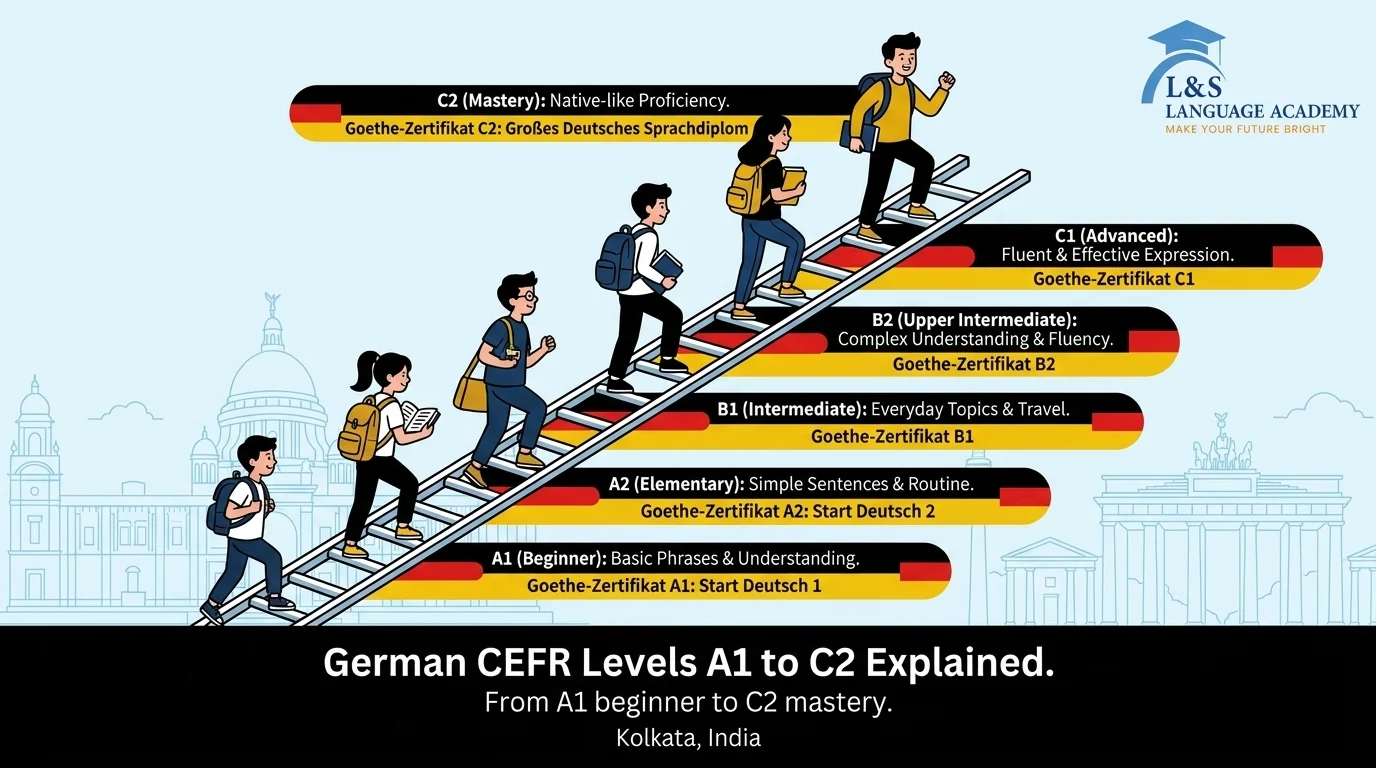 German language levels from A1 beginner to C2 mastery — with Goethe exam mapping
| Level | What you learn | Duration (approx) | Matching Goethe exam | Common goal |
|---|---|---|---|---|
| A1 | Greetings, present tense, numbers, self-intro | 6–10 weeks | Start Deutsch 1 | Beginner foundation |
| A2 | Past tense, daily routines, simple letters | 6–10 weeks | Start Deutsch 2 | Anerkennungspartnerschaft visa entry |
| B1 | Opinions, workplace German, complex sentences | 8–12 weeks | Goethe-Zertifikat B1 | Study/work/Ausbildung visa minimum |
| B2 | Academic reading, essays, debate | 10–14 weeks | Goethe-Zertifikat B2 | Most engineering/IT roles; university admission |
| C1 | Academic/professional fluency | 12–16 weeks | Goethe C1 | University, senior professional roles |
| C2 | Near-native proficiency | 16+ weeks | Goethe C2 | Translation, academic research |
Note: This table shows typical durations for students attending 3–4 classes per week with daily practice outside class. Intensive batches can compress timelines. Your actual pace may vary.
A1 & A2 (Beginner) — Start Deutsch
A1 and A2 are where everyone begins. There's no prior knowledge required — not even the alphabet. We start with pronunciation (those German vowel sounds like ü and ö), then greetings, articles (der/die/das — yes, it confuses everyone at first), present tense and basic sentences. By the end of A2, you can read a simple letter, write a short message and hold a basic conversation.
Goethe-Institut runs the Start Deutsch 1 (A1) and Start Deutsch 2 (A2) examinations. These are the entry-level Goethe certificates — recognised for visa applications and as proof of foundational German. Since March 2024, India nurses can enter Germany on an Anerkennungspartnerschaft (Recognition Partnership) visa with just A2 German, then complete B1/B2 while employed there.
B1 & B2 (Intermediate) — Work & Study Ready
B1 is the threshold level. Get here and most things become possible — Ausbildung visa, study visa applications and many entry-level roles in Germany. At B1, you can handle most everyday situations, describe experiences and give opinions.
B2 is the real career level. The vast majority of German employers — especially in engineering, IT and nursing/healthcare — want B2 or above. University admission in Germany typically requires B2 for German-taught programmes. The Goethe-Zertifikat B2 is widely recognised and LNS prepares students to sit this independently at the Goethe-Institut in Kolkata.
C1 & C2 (Advanced) — Academic & Professional
C1 is for those planning to attend German universities in German, work in senior professional roles or pursue translation. C2 is near-native and typically needed for academic research, literary translation or interpretation. These are long-haul levels — but we've found that students with strong motivation (usually nurses going to Germany or engineers targeting specific companies) reach C1 faster than expected when they're immersed in the language daily.
German Language Course Fees in Kolkata
Let's talk about fees clearly — because this is a genuine pain point in the Kolkata market.
Goethe-Institut Kolkata (Max Mueller Bhavan): Their in-person courses cost approximately ₹28,000–₹32,000 per level (based on 2025 brochure data). Their online self-paced platform charges ₹10,620 per level (with regular discounts). Goethe is the premium benchmark — high quality, high price, rigid schedule.
Local institutes in Kolkata: Fees range from ₹8,000 to ₹18,000 per level for 48–72 hours of instruction, with varying quality.
| Level | Duration | Offline Fee (₹) | Online Fee (₹) |
|---|---|---|---|
| A1 – Beginner | 2–3 months | 8,000–28,500 | 6,000–20,000 |
| A2 – Elementary | 2–3 months | 8,000–28,500 | 6,000–20,000 |
| B1 – Intermediate | 3–4 months | 10,000–28,500 | 8,000–22,000 |
| B2 – Upper-Intermediate | 3–5 months | 12,000–28,500 | 8,000–22,000 |
| C1 – Advanced | 4–6 months | 15,000–25,000 | 10,000–20,000 |
| C2 – Mastery | 4–6 months | 15,000–25,000 | 10,000–20,000 |
* Lowest price = Batch/group classroom study | Highest price = Individual 1:1 dedicated teacher–student sessions.
View full German course fees, syllabus & Goethe exam details →
LNS Academy: Our fees are transparent, affordable and available on our German language course fees page. Call or WhatsApp 62891 24658 for the current rate — we'd rather quote you directly than publish a number that changes with batch type and mode.
What's included matters too. At LNS, the fee covers instruction, study material guidance, internal mock tests and progress tracking. At the end of the course, we conduct our own internal exam and issue an LNS Academy certificate. We don't register students for the Goethe exam — that's a separate, independent exam you book directly at the Goethe-Institut. We prepare you thoroughly so you're ready for it.
Goethe Exam Preparation in Kolkata
The Goethe-Zertifikat is the internationally recognised German language certificate. It's issued by the Goethe-Institut — Germany's official cultural and language institute — and is accepted for visa applications, university admissions and professional registration across Germany and Austria.
There are three main external exams worth knowing about:
- Goethe-Zertifikat (A1–C2): The most common choice for Indians. Covers all six levels. Recognised for student visa, Ausbildung and skilled worker pathways. Offered at the Goethe-Institut/Max Mueller Bhavan in Kolkata (Park Street). You book and pay for this separately — around ₹7,000–₹12,000 per level depending on the level.
- telc (A1–C2): A European alternative to Goethe. Also CEFR-aligned and accepted for visa purposes. Slightly less common in Kolkata but valid.
- TestDaF (B2–C1): Specifically for university admission in Germany. Required by most German universities for admission to German-taught programmes. If your goal is a German university, TestDaF is what you'll ultimately need.
 Goethe & TestDaF exam prep at LNS Language Academy
At LNS, we structure our teaching around the Goethe syllabus at each level — the vocabulary, grammar structures and task types that appear in the exam. We run internal mock tests to identify gaps before you go to the Goethe-Institut for the real thing. In our experience, students who do 2–3 focused mock rounds are significantly better prepared than those who sit the exam cold.
Learn German for Jobs, Study & Nursing Visa in Germany
This is the section most of our students come to. So let's break it down honestly.
 German for Germany jobs, study & nursing visa — from Kolkata
Study in Germany
Germany's public universities are almost tuition-free — even for international students. Most charge only a semester contribution of €150–€350. But to qualify, you need:
- B2 German (usually via Goethe-Zertifikat B2, TestDaF or equivalent) for German-taught programmes
- An APS Certificate (Akademische Prüfstelle) — a document verification process for Indian students applying to German universities
- A blocked account (Sperrkonto) showing funds for living expenses: currently €11,904/year as of 2025
English-taught programmes are also available and often don't require German, but even then, everyday life in Germany is in German. So B1–B2 makes a huge practical difference.
Engineering, IT & Automotive Jobs
German companies in India — Siemens, Bosch, BMW, Volkswagen, SAP, Bayer, KPMG — value German language skills in technical hiring. B1–B2 German gives you a strong edge in Indian operations of these companies and opens pathways to their Germany offices. Many IT roles in Germany are now partly English-friendly, but B2 remains the standard for permanent work visa and Niederlassungserlaubnis (settlement permit).
Nursing & Healthcare Visa — The Fastest-Growing Pathway
Germany has a severe nursing shortage. For Indian nurses and healthcare workers, it's one of the most structured migration routes available.
Here's the current pathway:
- A2 German: Now sufficient to apply for the Anerkennungspartnerschaft (Recognition Partnership) visa since March 2024. This is the new, faster entry route — you enter Germany at A2 and continue language training there, often funded by your employer.
- B1 German: The standard minimum for most Ausbildung (vocational nursing training) visa applications. Salaries during Ausbildung: €1,341–€1,503/month.
- B2 German: Required by 90% of healthcare employers for direct nursing roles. The Goethe B2 or telc B2 certificate is typically required. Accepted certificates: Goethe-Zertifikat B2, telc B2, TestDaF.
- Salary after qualification: €2,800–€5,000+ per month depending on specialisation and state.
Source: Official guidance via Make it in Germany, the German government's official skilled-worker portal, and DAAD for study pathways.
At LNS, we see a large number of nurses from Kolkata and West Bengal coming for A1–B2 preparation specifically for this pathway. We run a focused track with healthcare vocabulary built in from B1 onward.
Online & Offline German Classes Across Kolkata
Our centre is at 108, Majumder Para, 1no Airport Gate, Kolkata 700079. It's near Dum Dum metro and convenient for students from north Kolkata, Barrackpore, Lake Town, Belgachia and the Airport area.
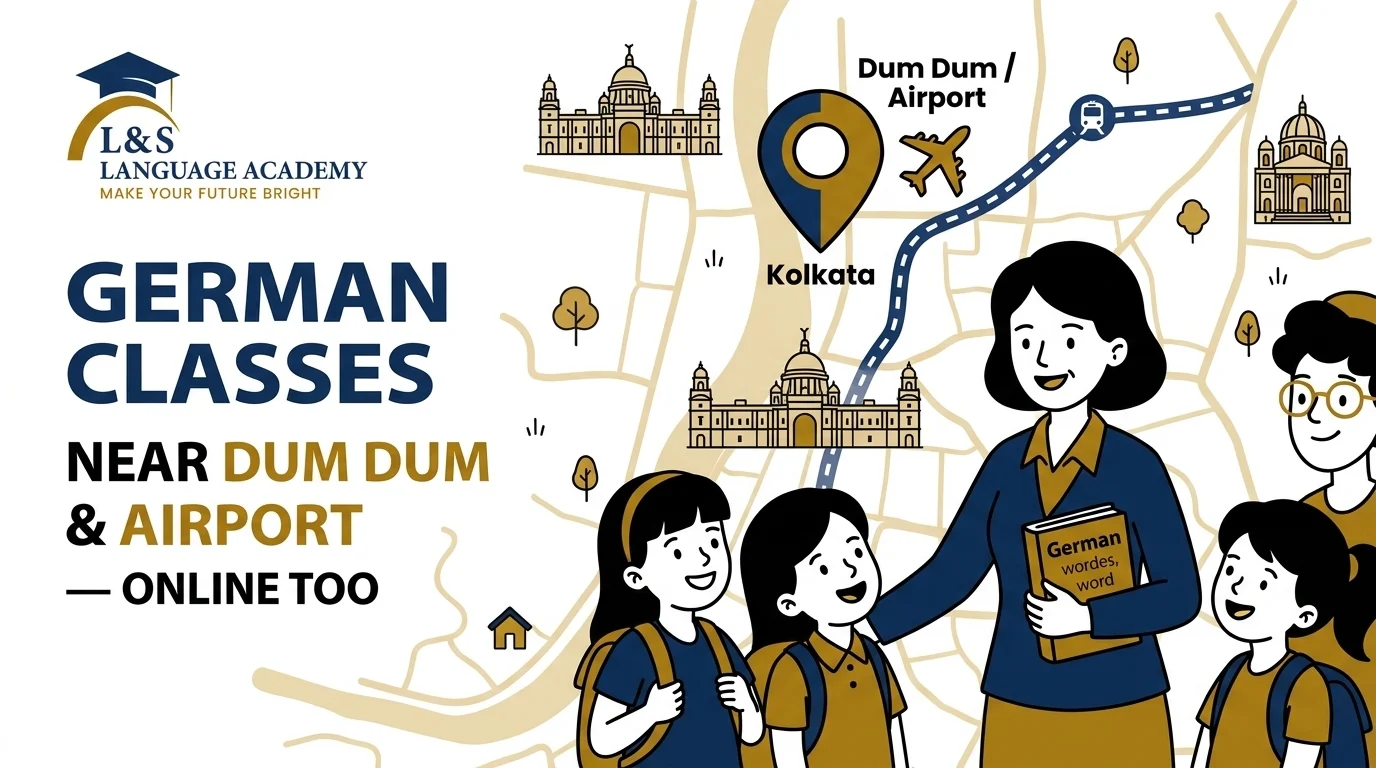 German classes near Dum Dum & Kolkata Airport — online batches also available
Offline batches run at our Dum Dum centre with small groups. If you've been searching "German class Dum Dum" or "German language classes near me" — this is the nearest dedicated option in the north Kolkata catchment.
Online batches are fully live — real-time instruction, not recorded videos. Students from Salt Lake, Behala, Garia, New Town, Howrah and anywhere in India attend. The quality and curriculum are identical.
Batch options we offer:
- Regular batches (weekday, 3–4 classes/week)
- Weekend batches (Saturday + Sunday)
- Evening batches (6 PM–8 PM, weekdays)
- Intensive batches (daily, for those on a visa deadline)
- One-to-one sessions (on request)
So if you need a weekend German class near me or an online German course with live interaction — both are available at LNS.
How Long Does It Take to Learn German?
Here's an honest answer, not a marketing one.
German A1: 6–10 weeks with 3–4 classes per week and daily practice.
German B1: 6–9 months total from scratch (A1 + A2 + B1), again at 3–4 classes per week.
German B2: 10–14 months from scratch with consistent effort.
From A1 to B2 (the nursing/study full journey): Most students take 14–20 months, depending on intensity and consistency.
The biggest variable isn't talent. It's daily practice outside class. German grammar — particularly the case system (Nominativ, Akkusativ, Dativ) and the three genders — takes repetition. Students who revise for 20–30 minutes daily between sessions progress significantly faster than those who rely on class time alone.
We recommend starting earlier than your visa deadline suggests. If you need B2 for Germany, working backwards from an intended departure date of 12 months from now — start today.
LNS vs Goethe-Institut & Others — Why Choose Us
Fair question. Here's an honest side-by-side.
| Feature | Goethe-Institut Kolkata | LNS Academy |
|---|---|---|
| Standard / curriculum | CEFR A1–C2, official Goethe | CEFR A1–C2, Goethe-aligned |
| Goethe exam | Conducted on-site | Students sit independently at Goethe-Institut; LNS preps you for it |
| Fee per level (approx) | ₹28,000–₹32,000 (offline) | Affordable — see our fees page |
| Batch flexibility | Fixed semester schedule | Weekday / weekend / evening / intensive / online |
| Batch size | Larger groups | Small batches, more personal attention |
| Location | Park Street | Near Dum Dum / Airport Gate |
| Online option | Self-paced digital platform | Live online batches (real-time) |
| Additional courses | German only | German + 9 other languages + Spoken English + IELTS |
We're not better than Goethe in every way — Goethe is the global authority and their certificate has maximum recognition. But for Kolkata students who want the same CEFR standard, Goethe-aligned teaching, smaller batches and more flexible scheduling at lower fees — LNS is the right fit. And since you'll be taking the Goethe exam independently anyway, our preparation gets you there.
Check our ISO certification to understand the quality standard behind the teaching. We're proud of it.
Student Results & Reviews
 Real German learner results — LNS Academy students
"I started German A1 at LNS knowing nothing — not even the alphabet. Eight months later, I passed the Goethe B1 exam on my first attempt. The trainer was extremely patient with the grammar and pushed us to speak from day one. I now have a confirmed Ausbildung place at a hospital in Bavaria."
— Mousumi Das, Dum Dum (nursing Ausbildung, Germany)
"I joined for B1 preparation as I already had A2 from somewhere else. The mock tests at LNS were very close to the real exam format. I cleared the Goethe B1 easily. The small batch made a real difference — the trainer actually noticed my mistakes instead of just covering material."
— Arko Sen, Salt Lake (engineering job, Germany)
"Weekend batches were the only option for me as I was working. LNS accommodated that without any problem. Cleared A1 and A2 in six months alongside my job. Highly recommend for people with busy schedules."
— Pritha Ghosh, New Town (German for career change)
Book a Free German Demo Class
 Book your free German demo — LNS Academy
Try the first class for free. No commitment, no pressure. You'll see how we teach, what a typical session looks like and what questions to ask before you enrol.
Address: 108, Majumder Para, 1no Airport Gate, Kolkata 700079
Call / WhatsApp: 62891 24658
Email: contact@lnsacademy.in
Online and offline batches available. Morning · Evening · Weekend slots open. Same-day response on WhatsApp.
Frequently Asked Questions
1. How much does a German language course cost in Kolkata?
German course fees in Kolkata vary widely — from ₹8,000 to ₹32,000 per CEFR level depending on the institute and mode. LNS keeps fees transparent and affordable, well below premium institutes like the Goethe-Institut. See our German course fees page or call 62891 24658 for the current rate for your preferred batch.
2. How long does it take to learn German A1 in Kolkata?
German A1 typically takes 6–10 weeks at LNS with 3–4 classes per week. Reaching B1 — the common work/study/visa threshold — usually takes around 6–9 months from scratch with regular practice outside class. Intensive batches can compress this timeline.
3. Which German exam should I take — Goethe, telc or TestDaF?
For general proficiency and most visa purposes, take the Goethe-Zertifikat (A1–C2) or telc at your level — both are widely accepted. For German university admission specifically, TestDaF or the Goethe C1 certificate is preferred. LNS prepares you for the right one based on your goal. You book and sit the actual exam independently at the Goethe-Institut.
4. Can I get a job in Germany after learning German?
Yes. B1–B2 German opens engineering, IT and nursing/healthcare roles in Germany. The healthcare visa (Anerkennungspartnerschaft) now accepts A2 to enter Germany, with B1/B2 required for full recognition. B2/C1 is the standard for most engineering and corporate roles. Higher levels widen opportunities significantly.
5. Is LNS cheaper than Goethe-Institut for German in Kolkata?
Yes, generally. The Goethe-Institut charges approximately ₹28,000–₹32,000 per level for offline courses. LNS teaches the same CEFR standard and prepares you for Goethe exams at significantly lower fees, with more flexible batch options and smaller groups. Since you take the Goethe exam independently regardless, the preparation quality is what matters.
6. Do you offer online German classes in Kolkata?
Yes — LNS runs fully live online German classes (not pre-recorded videos) with regular, evening and weekend batches. Students from anywhere in Kolkata and across India attend. The online programme covers the same curriculum as offline classes, including mock tests and speaking practice.
7. What level of German do I need for a nursing or healthcare visa in Germany?
Since March 2024, the Anerkennungspartnerschaft (Recognition Partnership) visa allows entry into Germany with A2 German. However, B1 is the standard minimum for most Ausbildung visa applications, and B2 is what 90% of German healthcare employers require for full nursing roles. A Goethe B2 or telc B2 certificate is typically needed. We offer a healthcare-focused track from A1 through B2.
8. Do you teach German near Dum Dum or the Airport?
Yes — LNS Academy is at 1no Airport Gate, Dum Dum, convenient for students from north Kolkata, Barrackpore, Belgachia, Lake Town and the Airport area. Online batches serve students from Salt Lake, Behala, New Town, Garia, Howrah and the rest of Kolkata and India.
9. Is German hard for Indian students to learn?
German is very learnable for Indians. The grammar has logical rules — once you understand the case system (Nominativ, Akkusativ, Dativ), it becomes consistent. Many German words also resemble English (Hand, Arm, Tiger, Bus). The script is the same Roman alphabet. With structured A1-to-B1 coaching and daily practice, most students reach a confident working level within 6–9 months.
10. Do I get a certificate after completing the German course at LNS?
Yes — LNS Academy conducts its own internal exam at the end of each level and issues an LNS Academy course completion certificate. This is separate from the internationally recognised Goethe-Zertifikat or telc certificate, which you take independently at the Goethe-Institut. We prepare you fully for those exams — but you register and appear for them yourself.
11. What's the difference between the Goethe exam and the LNS certificate?
The LNS Academy certificate confirms you've completed our German course and passed our internal assessment — it's issued by LNS. The Goethe-Zertifikat is issued by the Goethe-Institut itself, an internationally recognised body, after you take their official exam independently. Most visa and university applications require the Goethe or telc certificate. LNS's certificate confirms your training; the Goethe certifies your level to the world.
12. What's the study-in-Germany requirement for Indian students?
For German-taught university programmes, you need B2 German (usually Goethe B2 or TestDaF), an APS Certificate (document verification for Indian applicants), and a blocked bank account with approx ₹12 lakh (€11,904) for living expenses. German public universities charge little to no tuition — most charge only a semester contribution of €150–€350. For detailed admission guidance, refer to DAAD.