Dutch Language Course in Kolkata — A1 to B2, Classroom and Live Online
L&S Language Academy (LNS Academy) teaches Dutch in Kolkata from A1 to B2, in its Dum Dum classroom near 1no Airport Gate and in live online batches on Google Meet. A1 takes 2 to 3 months. Classroom fees run from ₹6,000 at A1 up to ₹15,000 per level, and online fees from ₹4,000 to ₹12,000. Our teaching follows the CEFR levels, you register for any exam yourself, and a free demo class comes first.
- Four CEFR levels, A1 to B2, with pronunciation corrected from the first class
- ISO 9001:2015 certified institute
- Online batches of up to 6 students, live and never recorded
- Free demo class, classroom or online
Call or WhatsApp 62891 24658, or book a free demo class. The classroom is at 108, Majumder Para, 1no Airport Gate, Kolkata 700079. Want numbers first? See the fees for every level and what to know about the Dutch exams.
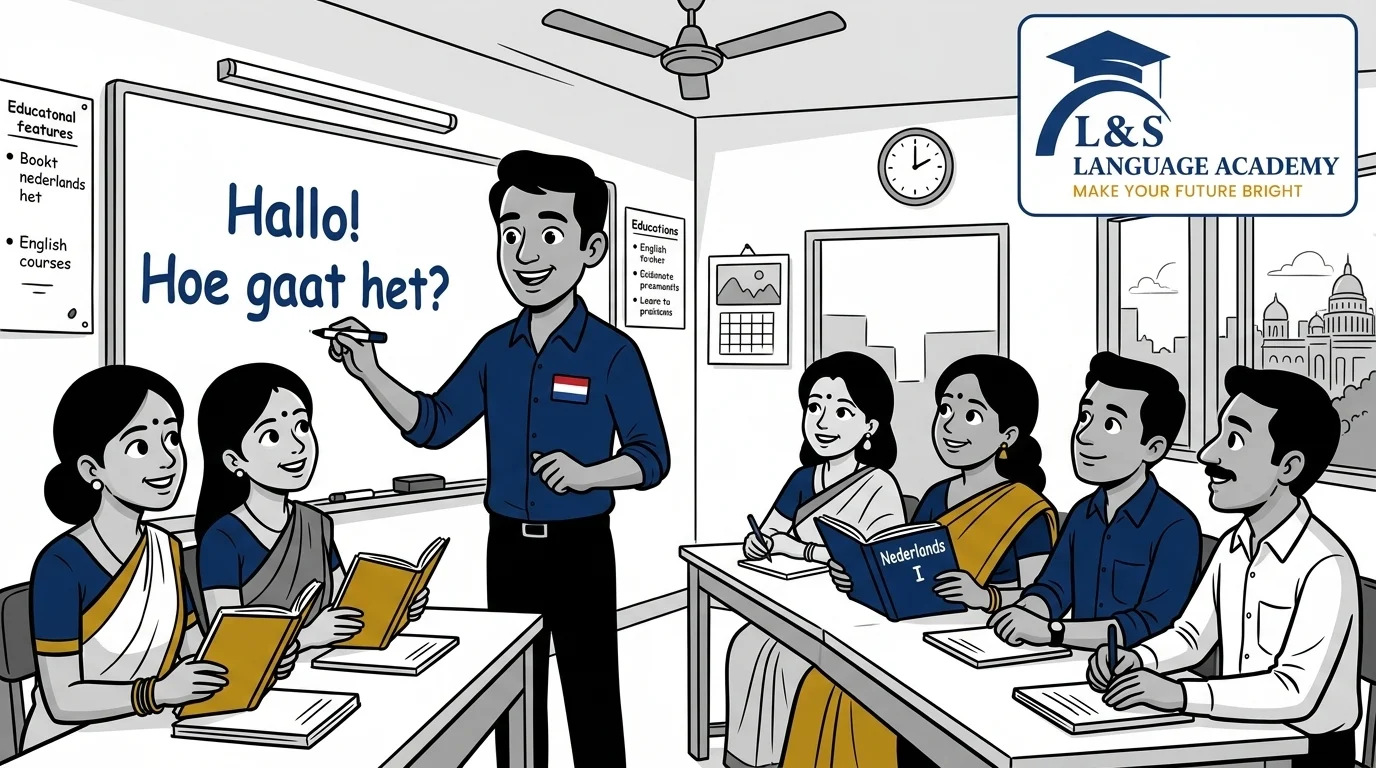
Table of Contents
Is Dutch the right choice for you?
People come to us for very different reasons. Some of the most common ones:
- You plan to study in the Netherlands and want to handle daily life, not only your classes.
- You plan to join a partner or family member in the Netherlands and need to start from the basics.
- You work with Dutch-speaking clients or colleagues and want to greet and write to them properly.
- You already know German or English and want a language that feels familiar from the first week.
- You enjoy learning a language that very few people in Kolkata speak.
What makes Dutch feel easier? It is a Germanic language like English, it uses the Roman alphabet, and many words look or sound familiar. What makes it hard? Some sounds, such as the Dutch g and the vowel pairs ui and eu, take practice, and word order and separable verbs work differently from English. A teacher who corrects your pronunciation early helps with both.
You need no Dutch to begin. We start with sounds and everyday phrases, and a short assessment places you at the right level if you already know some.
Why learn Dutch?
Dutch is the language of the Netherlands and of Flanders, the Dutch-speaking region of Belgium. It is used in study, work, official paperwork and daily life in both places. Learning it opens ordinary things that English alone does not always reach, such as a chat with a neighbour, a local form or a workplace conversation.
What level a university, an employer or an immigration office asks for depends on the programme, the company and the rules of the day, and these change. Please check the official sources before you plan. We do not promise a visa, an admission or a job, because those are not in our hands.
What does waiting cost you?
Dutch is built level by level, and each level needs weeks of steady practice, so a late start leaves less room for a deadline.
- You cannot skip A1 and A2 to reach B1. Each level builds on the last.
- Pronunciation habits are easier to fix in the first weeks than after months of wrong ones.
- Learners who start early have room to repeat a level, if they need to, without missing an exam date or a deadline.
The delay math: from zero, A1 to B1 takes about 7 to 10 months in our classes, and A1 to B2 about 10 to 15 months. Start today, 21 November 2026, and B1 lands between about June and September 2027, while B2 lands between about September 2027 and February 2028. Every month you put off starting moves those dates by a month. A free demo class takes an hour and shows you where to begin.
How do Dutch sounds, grammar and levels work?
Sounds. Dutch is written in the Roman alphabet, but several sounds differ from English, so we teach pronunciation from the first class. Grammar. Nouns take the articles de or het, a verb sits in the second place of a main sentence, and some verbs separate, so the pieces land in different spots. We teach these with short everyday sentences, not long rules. Levels. Our course follows the four CEFR levels from A1 to B2, as in the table.
| Level | What you work towards | Class time | Hours | Link to exams |
|---|---|---|---|---|
| A1 | Pronunciation, basic grammar, everyday words, greetings, self-introduction, numbers, directions | 2 to 3 months | 48 to 72 | The civic integration exam abroad is set at A1 |
| A2 | Past tense, separable verbs, daily routines, travel, shopping, health and short texts | 2 to 3 months | 48 to 72 | A step between the A1 exam and B1 |
| B1 | Modal verbs, opinions, work and media | 3 to 4 months | 60 to 80 | Staatsexamen NT2 programme I is set at B1 |
| B2 | More complex grammar, longer writing, debate and professional Dutch | 3 to 5 months | 60 to 80 | Staatsexamen NT2 programme II is set at B2 |
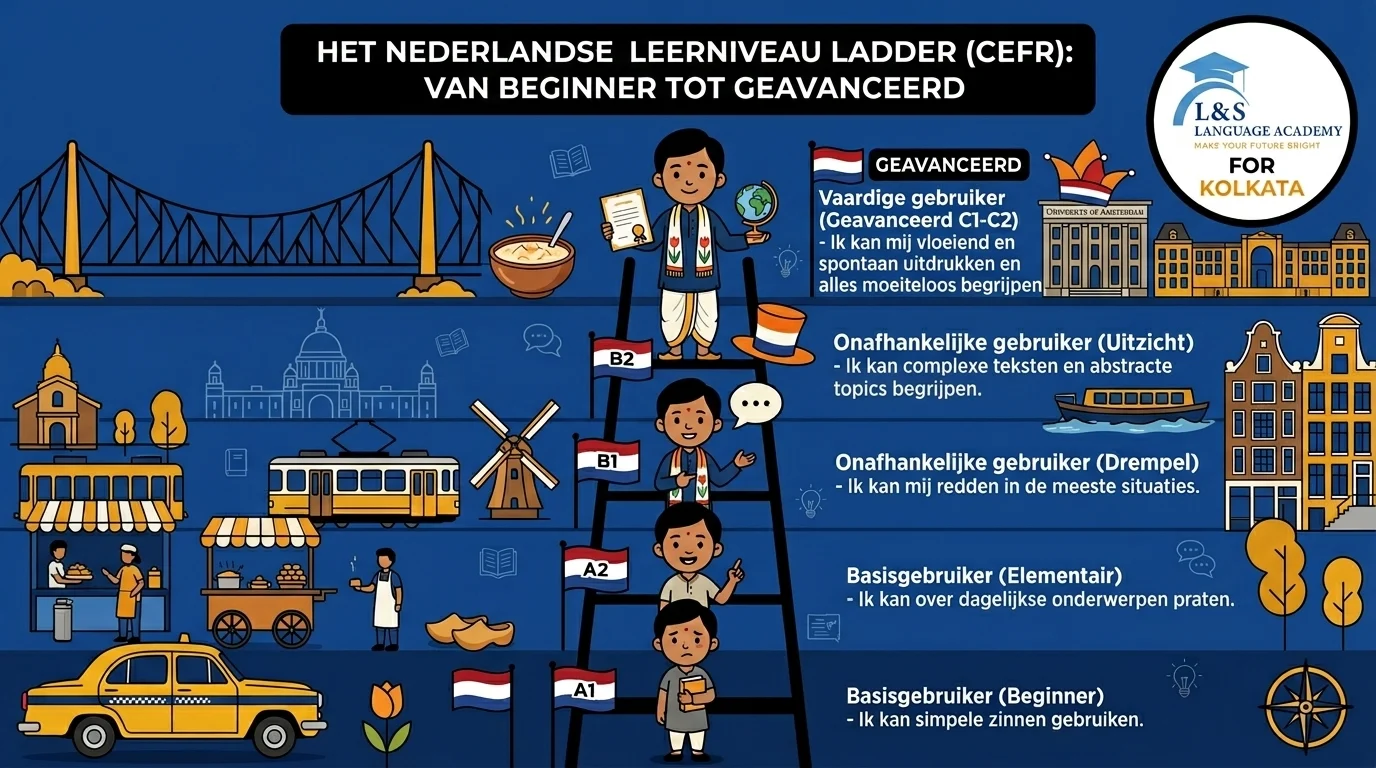
How long in all? Adding the level times, A1 and A2 take about 4 to 6 months, A1 to B1 about 7 to 10 months, and A1 to B2 about 10 to 15 months. Speaking and writing a little every day is the biggest speed-up.
How joining works, step by step:
- Book a free demo class, in the classroom or online.
- Take a short assessment so we can place you at the right level.
- Choose a batch: weekday morning, weekday evening or weekend. We confirm the exact slot by phone.
- Attend your classes and speak Dutch from the first week.
- At the end of the level, take our internal exam. If you pass, you receive an LNS Academy certificate.
An honest note: we do not register students for any Dutch exam, and our certificate is our own. Exam certificates come from the exam bodies after you sit and pass the test independently. Our teaching prepares you for the level.
How much does a Dutch course cost in Kolkata?
Here are our fees for every level, so you do not have to call to find them. Fees are per level and depend on whether you study in a group or one-to-one.
| Level | Class time | Hours | Classroom fee | Online fee |
|---|---|---|---|---|
| A1 | 2 to 3 months | 48 to 72 | ₹6,000 to ₹12,000 | ₹4,000 to ₹10,000 |
| A2 | 2 to 3 months | 48 to 72 | ₹6,000 to ₹12,000 | ₹4,000 to ₹10,000 |
| B1 | 3 to 4 months | 60 to 80 | ₹8,000 to ₹12,000 | ₹5,000 to ₹10,000 |
| B2 | 3 to 5 months | 60 to 80 | ₹8,000 to ₹15,000 | ₹6,000 to ₹12,000 |
The lower figure is a group batch and the higher one is one-to-one with a teacher dedicated to you. Call 62891 24658 for the fee of the batch that starts next, or compare everything on the Dutch fees page.
What the fee includes: teaching, progress tracking, plus our own end-of-level exam and LNS Academy certificate. Ask us about books before you pay, because institutes differ on whether books are included.
The whole path. Adding the fee ranges level by level, A1 and A2 come to about ₹12,000 to ₹24,000 in the classroom and ₹8,000 to ₹20,000 online, over 4 to 6 months. A1 to B1 comes to about ₹20,000 to ₹36,000 in the classroom and ₹13,000 to ₹30,000 online, over 7 to 10 months. A1 to B2 comes to about ₹28,000 to ₹51,000 in the classroom and ₹19,000 to ₹42,000 online, over 10 to 15 months, or about 216 to 304 class hours. This does not include exam fees, books or travel.
Which level to start with? If you have never studied Dutch, begin at A1. If you did a short course elsewhere, the assessment tells us whether A2 fits. If you are aiming at a particular level, count the levels between you and it before you pick a start date.
Dutch exams: what to know before you plan
We do not run any Dutch exam, and we do not register students for one. Three exams come up most often. The facts below were checked on 21 November 2026 and can change, so confirm them on the official pages before you pay or book.
- The civic integration exam abroad (A1). According to the Netherlands Worldwide page for India, it is taken at a Dutch embassy or consulate-general, and in India you book by email with the Dutch embassy in New Delhi. It is set at A1, has speaking, reading and knowledge of Dutch society, and costs €150 in total, paid to DUO. You register with DUO first. Results come by email, and a pass is valid for one year. See the India page.
- Who needs it. The IND says the exam is required for people who need a provisional residence permit (MVV) to join a partner in the Netherlands, with several exemptions, such as people from some listed countries and holders of listed Dutch diplomas. Whether it applies to you depends on your permit, so check with the IND.
- Staatsexamen NT2. DUO describes two programmes. Programme I is set at B1, for study or work at mbo level, and programme II at B2, for hbo or university study or work. Each has reading, listening, speaking and writing, taken on a computer. Dates, fees and where to take it are on the DUO page.
- CNaVT. The Dutch Language Union describes it as a certificate for learners of Dutch as a foreign language, open to people aged 16 and over. A news item dated 27 January 2026 says it is fully digital from May 2026. See the Taalunie page for levels and venues.
We do not name a Kolkata exam centre or quote fees for NT2 or CNaVT, because we could not confirm them from an official page. Ask the university, employer or office that will read your result which exam and which level it accepts.
An honest note: we teach to the level, and you register for and sit any exam yourself. Our own certificate comes from our internal exam.
Dutch or German: which comes first?
Both are Germanic languages, so many words look alike. The better question is which fits your goal and which you will enjoy practising for a year.
| Dutch | German | |
|---|---|---|
| Alphabet | Roman alphabet | Roman alphabet with umlauts and ß |
| Articles | Two: de and het | Three: der, die and das |
| Cases | Nouns no longer change for case | Four grammatical cases |
| Where it is used | The Netherlands and Flanders | Germany, Austria, Switzerland and more |
| Our class time | A1 takes 2 to 3 months | See the German course page for its levels |
If you already know one, the other feels familiar quickly. If you can, attend a demo class for each and see which one holds your attention. Our German course page has the full details.
Why choose L&S Language Academy?
Here is what to look for in any Dutch class, set beside what we offer.
| What matters | What to look for | What we offer |
|---|---|---|
| Levels | The CEFR path in order, from A1 | All four levels, A1 to B2, with a placement assessment |
| Pronunciation | Corrected speaking, not just listening | Sounds drilled from the first class, with your own pronunciation corrected |
| Structure | A planned syllabus, not loose chat sessions | A level-by-level syllabus with hours and an end-of-level exam |
| Batch size | Small enough that everyone speaks | Online batches of up to 6 students |
| Live or recorded | Caution with recordings sold as classes | Online classes are live and never recorded |
| Trying it first | A demo before you pay | A free demo class, classroom or online |
| Flexibility | Room to change mode or catch up | Switch between online and classroom, and a make-up class if you tell us in advance |
| Certificate | Clarity about who issues it | An LNS Academy certificate after our own internal exam |
| Fees | Ranges stated openly | Every level on this page and on the fees page |
L&S Language Academy was started by Haimanty Choudhury and Biplab Podder, and our teachers come from well-known colleges. Learn more on our About page.
How do we teach Dutch?
We teach speaking, listening, reading and writing together, because every Dutch exam tests all four and daily life needs them too. In practice:
- Sounds first. Pronunciation is drilled with audio examples from the first class, until the Dutch g and the vowel pairs feel natural.
- Grammar in short sentences. Articles, word order and separable verbs are taught with everyday sentences you can use the same week.
- Speaking in every class. You work in pairs and small groups and use new words and patterns straight away.
- Writing practice. Short texts at every level, corrected, so you build towards the longer writing of B1 and B2.
- Revision between classes. A short daily habit of 15 to 30 minutes, with listening, flashcards and a few written lines, does more than a long session once a week.
Classroom or online: which fits you?
Classroom. Our classroom is at 108, Majumder Para, near 1no Airport Gate in Dum Dum. It suits you if you live or work in North Kolkata and learn best face to face.
Online. A teacher takes each class live on Google Meet. A session is 60 minutes, a batch has up to 6 students and we do not record the classes. You need a phone, tablet or laptop with a camera and microphone, a steady connection and a quiet corner. Students outside Kolkata can join as well, which helps because few places teach Dutch.
Batches. Weekday morning, weekday evening and weekend batches run online and in the classroom, and one-to-one classes are available. Exact timings are fixed per batch, so call us for what is open now.
What do students say?
Here is what three of our Dutch learners say. Each student's result and pace are their own and depend on their effort and on the exam body's rules. More are on our testimonials page.
“I was preparing to move to the Netherlands for a Master's programme. My English was enough for the course, but I wanted to handle daily life and maybe a part-time job. LNS took me from zero to A2 in about three months. The trainer was very methodical about pronunciation from the start. I'm now in Amsterdam and the A2 foundation helped enormously with settling in.”
“I work at a company in Kolkata that has Dutch clients. I started Dutch A1 at LNS to be able to greet them properly and handle basic communication. The small batch size meant I could ask questions freely. Reached A2 and the clients noticed — and appreciated — the effort.”
“I already speak German reasonably well. My LNS trainer helped me map the Dutch-German parallels from the first session, which made the A1 course feel faster and more intuitive. The two languages really do share a lot.”
What support do you get after joining?
- Missed an online class? Tell us in advance and we arrange a make-up class.
- Change of plans? Online students can move to a classroom batch at Dum Dum, and can drop in for a single class in person.
- Studying from outside Kolkata? You receive your LNS Academy certificate as a digital copy and by courier.
- Heading for an exam? Tell your trainer which exam and which date, so the practice in class follows its four skills.
Start with a free demo class
Come to a demo class, in the classroom or online, before you pay. You will hear how Dutch sounds, see how the lessons run and ask whatever you like. There is no pressure to join afterwards.
New-student, referral and course-combo offers run from time to time, so ask us what is on when you call.
Dutch for study, work and family
Dutch is used in study, in offices and shops, in official paperwork and in daily life in the Netherlands and Flanders. It also matters when you join a partner or family member there. We make no visa, admission or job promise, because those depend on the university, the employer and the immigration rules. Look for the places where your own skills and Dutch meet, and check what each programme, employer or office asks for.
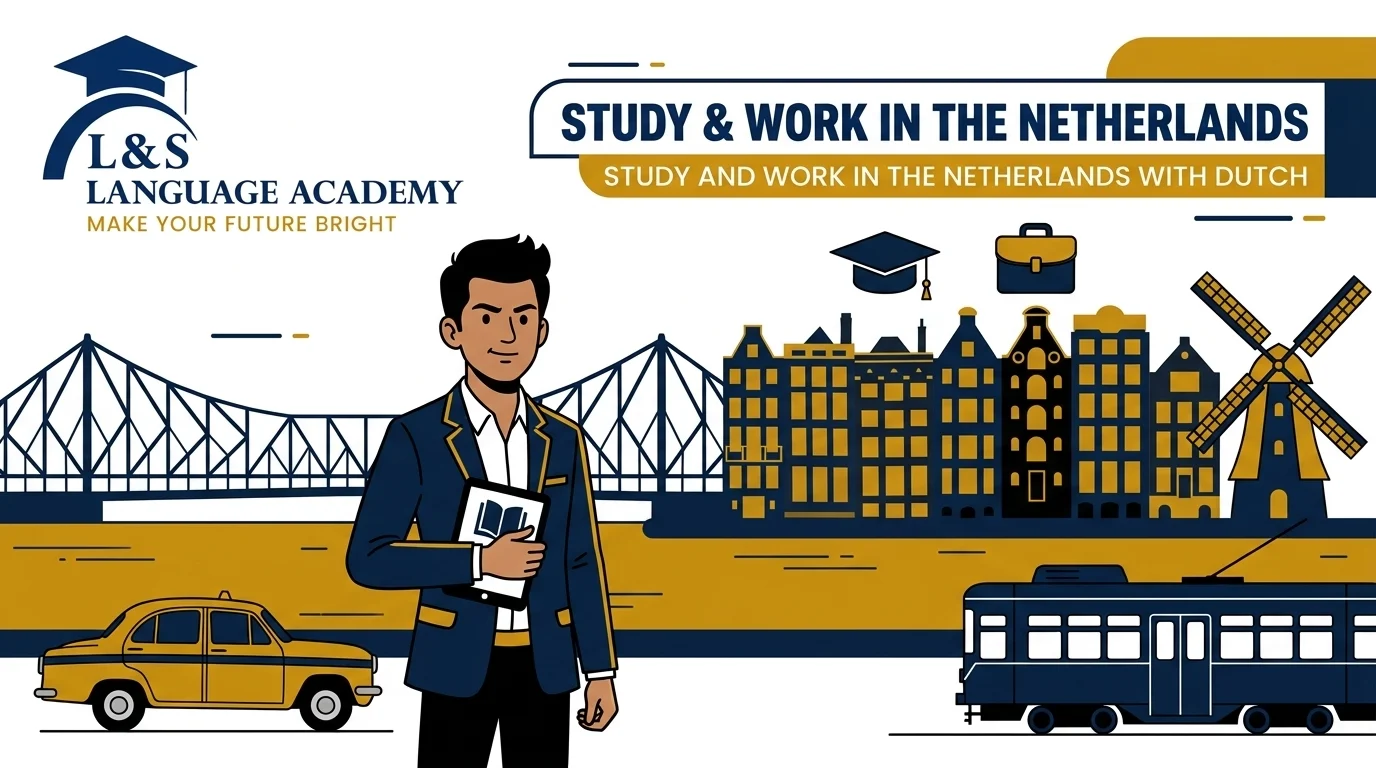
For study in the Netherlands, language requirements are set by each university and programme, and some programmes are taught in English. For daily life, work and settling in, Dutch helps even when English is enough for the course. If your goal is Flanders, check what the university or employer there asks for.
Also comparing European languages? See our German course and our French course.
Which Dutch class suits you?
- Complete beginner: start at A1 and let the assessment confirm it.
- Moving to the Netherlands for study or family: match your level to the requirement you need, then plan your months around your dates.
- German speaker: start with the assessment, because you may move through A1 quickly.
- Short on time: choose a weekend batch or learn online from home.
- Prefer individual attention: ask about one-to-one classes, which are good for pronunciation correction.
Areas we serve
Our classroom is in Dum Dum, close to the Airport Gate, so students from North Kolkata and the north-east of the city can reach it most easily. If you live in Salt Lake, New Town, Howrah, Behala or further away, ask us which mode suits your route, or join the live online batch from home. For route times to our centre, see our Dum Dum page.

Call 62891 24658 and we will help you choose between the classroom and online.
Mistakes and myths to avoid
Six questions to ask any Dutch institute before you pay, including us:
- How many students are in a batch?
- Are the classes live, or recorded?
- How many class hours does each level have?
- Is pronunciation corrected in speaking, and is there a written syllabus for each level?
- What does the fee include, and what costs extra, such as books or registration?
- Who issues the certificate, and what does it mean?
| Myth | Reality |
|---|---|
| I can learn Dutch in a month. | A month covers a few greetings and phrases. A1 takes 2 to 3 months in our classes, and the higher levels take longer. |
| Dutch is just German with English words. | The languages are related, but articles, cases, word order and sounds differ. Treat Dutch as a language of its own. |
| English is enough in the Netherlands, so Dutch is optional. | It may be enough for some courses and jobs. For paperwork, daily life and many workplaces, and for any exam or permit that asks for Dutch, you need it. |
| The institute registers me for the exam. | You register with the exam body yourself. Check who actually does what before you pay. |
| One exam fits every purpose. | The A1 exam abroad, the NT2 exam and CNaVT are different tests with different purposes. Ask the office that will read your result which one it accepts. |
| A very cheap course is a bargain. | Check batch size, hours and structure. A cheap course for few hours is a different product from a dearer one for many. |
Who is behind these classes?
L&S Language Academy was started by Haimanty Choudhury and Biplab Podder. It is an ISO 9001:2015 certified institute that offers 10 courses, from Chinese, Japanese and French to Spoken English, German and IELTS. Our teachers come from well-known colleges.
Our promise is a plain one: you see the fees before you pay, you try a class free, you learn from a live teacher, and the certificate you receive is the one we issue after our own exam.
You can find us at 108, Majumder Para, 1no Airport Gate, Kolkata 700079. Call 62891 24658 or write to contact@lnsacademy.in.
What does one class hour really cost?
Divide the lowest fee in each range by the class hours and you get a feel for what an hour of live teaching costs at the group-batch rate. Your exact fee depends on the batch, so treat this as a guide.
| Level | Classroom, per class hour | Online, per class hour |
|---|---|---|
| A1 and A2 (48 to 72 hours) | About ₹83 to ₹125 | About ₹56 to ₹83 |
| B1 (60 to 80 hours) | About ₹100 to ₹133 | About ₹63 to ₹83 |
| B2 (60 to 80 hours) | About ₹100 to ₹133 | About ₹75 to ₹100 |
Online has no travel cost on top. For the classroom, add your fare and travel time, and use the free demo to test the journey once. A cheap course for few hours is a very different product from a dearer one for many.
What can you do for free?
Free methods are worth using, and they work best alongside a teacher.
| Free option | What is good about it | Where it stops |
|---|---|---|
| Free language apps | Handy for daily vocabulary and short drills | Little real conversation, and no one checks your pronunciation |
| Dutch songs, shows and podcasts | Train your ear and keep you motivated | You listen far more than you speak, and no one corrects you |
| Sample papers from the exam body | Show the real test format, where the body publishes them | No one explains your mistakes |
| Practising with a friend | Relaxed and costs nothing | Pronunciation and word-order mistakes can pass uncorrected |
Why take this class?
- All four levels, A1 to B2, in one place, with fees and hours shown for each.
- Pronunciation corrected from the first class, and a written level-by-level syllabus.
- Live teaching, small online batches and a free demo before you pay.
- Classroom or online, and the freedom to move between the two.
Book a free demo class and see for yourself.
Frequently Asked Questions
At L&S Language Academy, classroom fees run from ₹6,000 to ₹15,000 per level and online fees from ₹4,000 to ₹12,000, depending on the level. A group batch is at the lower end of each range and one-to-one at the top. The full table is above.
A1 costs ₹6,000 to ₹12,000 in the classroom and ₹4,000 to ₹10,000 online. The lower figure is a group batch and the higher one is one-to-one with a dedicated teacher.
A1 takes 2 to 3 months in our classes, about 48 to 72 hours. How quickly you move on also depends on how often you practise outside class.
To a very basic level, yes. A1 takes 2 to 3 months in our classes, and after it you can greet people, introduce yourself and handle simple everyday phrases. Fluency takes the higher levels and regular practice.
It depends on your goal. Adding the level times in our classes, A1 to B1 takes about 7 to 10 months and A1 to B2 about 10 to 15 months. Regular daily practice is what shortens it, and a language is never really finished.
Both are Germanic languages with many shared words. Dutch has two articles and no case endings on nouns, while German has three articles and four cases, so many learners find Dutch grammar lighter. Pick the one that fits your goal, and try a demo class for each.
Most of the work is in the sounds and the word order. The alphabet is the Roman one, and English speakers meet many familiar words. A teacher who corrects your pronunciation in the first weeks makes the biggest difference.
DUO describes two programmes: programme I at B1 and programme II at B2. Which one a university or employer asks for depends on the programme, so check with them and see the DUO page for dates and fees.
It is an A1 exam with speaking, reading and knowledge of Dutch society. According to the Netherlands Worldwide India page, you register with DUO, pay €150, and book an appointment by email with the Dutch embassy in New Delhi. Whether you need it depends on your permit, so check with the IND.
It depends on the programme. Some programmes are taught in English and some in Dutch, and each sets its own language requirement. Check the exact programme, and count the months from your level today to the level it asks for.
No. You register for any exam yourself with the exam body. We teach to the level and give you practice in the exam's four skills.
You can start for free with apps, songs, shows and podcasts, and they help with listening and vocabulary. They rarely correct your pronunciation or give you a structured path. Many learners use free methods alongside a teacher.
Our classroom is at 108, Majumder Para, near 1no Airport Gate in Dum Dum, and we also run live online batches on Google Meet that students across Kolkata and India can join.
Yes. Our online classes are live on Google Meet, last 60 minutes and have up to 6 students in a batch. We do not record them, and you can move to a classroom batch later.
Yes. After the internal exam at the end of each level, you receive an LNS Academy certificate. Exam certificates are separate and come from the exam bodies after you sit and pass the exam yourself.
Dutch is the language of Flanders, the Dutch-speaking region of Belgium. What a Flemish university or employer asks for depends on the programme and the company, so check the requirement. The exam facts on this page are for the Netherlands.
Yes, and many find the first levels quicker. The two languages share many words and structures, but articles, cases and pronunciation differ, so we point out the parallels and the differences from the first class.
Yes. You can attend a free demo class in the classroom or online before you pay, and decide afterwards whether to join. We also run weekday morning, weekday evening and weekend batches, so call 62891 24658 to hear what is open.
Book a free demo class
Reserve your free demo class, in the classroom or online, and we will help you choose a level and a batch.
Call or WhatsApp 62891 24658, write to contact@lnsacademy.in, or use the contact page.

More from L&S Language Academy: German classes, French classes, spoken English classes, all language courses and the full course fees.