
French From Zero: What Your First 90 Days to A1 Actually Look Like

A1 French takes three to four months and roughly 60 to 80 class hours. By week two you can introduce yourself. By week eight you can order food and shop. By week twelve you can talk about what you did yesterday. What A1 will not give you is real conversation — and this page is honest about that too.
We run French classes in Kolkata from A1 to C2. The most common question before somebody joins is not about fees. It is "what will I actually be able to say?"
Fair question. Here is the whole thing, week by week.
Table of Contents
Can a complete beginner start French from zero?
Yes, and most A1 students do. No school French, no background, nothing.
What you need is three to four hours a week, and twenty minutes a day at home. That second one matters more than people think.
Age is not a barrier. We have students in their twenties and students past fifty in the same batch. Younger learners pick up the sounds a bit faster. Older learners understand the grammar faster. It evens out by week six.
What exactly is A1, and what can you do at the end of it?
A1 is the first of six levels on the CEFR scale, which runs A1 to C2 and is used across the world.
At the end of A1 you can understand and use everyday expressions, introduce yourself, and ask and answer simple personal questions.
The honest translation of that: you can survive a conversation about yourself. Who you are, where you are from, what you do, what you like, what you did yesterday.
You cannot yet have a conversation about anything else. That is A2 and B1 work.
What happens in your first two weeks?

Sound first. Alphabet, the nasal vowels, silent endings, the R.
Some of this will be easier than you expect. If you speak Bengali or Hindi you already make nasal sounds — চাঁদ, হাঁস, हाँ. French uses the same trick. English speakers spend weeks on this and you will not.
Then the two verbs everything hangs off, être and avoir. Numbers to a hundred. Greetings.
Your first real win comes in week two. You can stand up and say who you are, where you are from and what you do. Out loud, to a stranger, in French. Most people do not expect that so early.
We start with sound rather than grammar for a reason. Pronunciation habits form in the first month and harden. Fix them now and you never think about it again.
Week by week, what do the first 90 days look like?
| Weeks | What you learn | What you can do by the end |
|---|---|---|
| 1–2 | Alphabet, pronunciation, nasal vowels, greetings, être and avoir, numbers 0–100 | Introduce yourself. Say where you are from and what you do. |
| 3–4 | Articles and gender, common nouns, -ER verbs, everyday objects, family | Describe people, things and your home. |
| 5–6 | -IR and -RE verbs, negation, the three ways to ask a question, time and dates | Ask and answer simple questions. Fix a time to meet. |
| 7–8 | Food, shopping, quantities, partitive articles, prices | Order in a café. Finish a shop transaction. |
| 9–10 | The city, directions, prepositions of place, the imperative | Ask for directions. Give them to somebody else. |
| 11–12 | Passé composé, talking about yesterday and last weekend, revision | Talk about what you did. Hold a short personal conversation. |
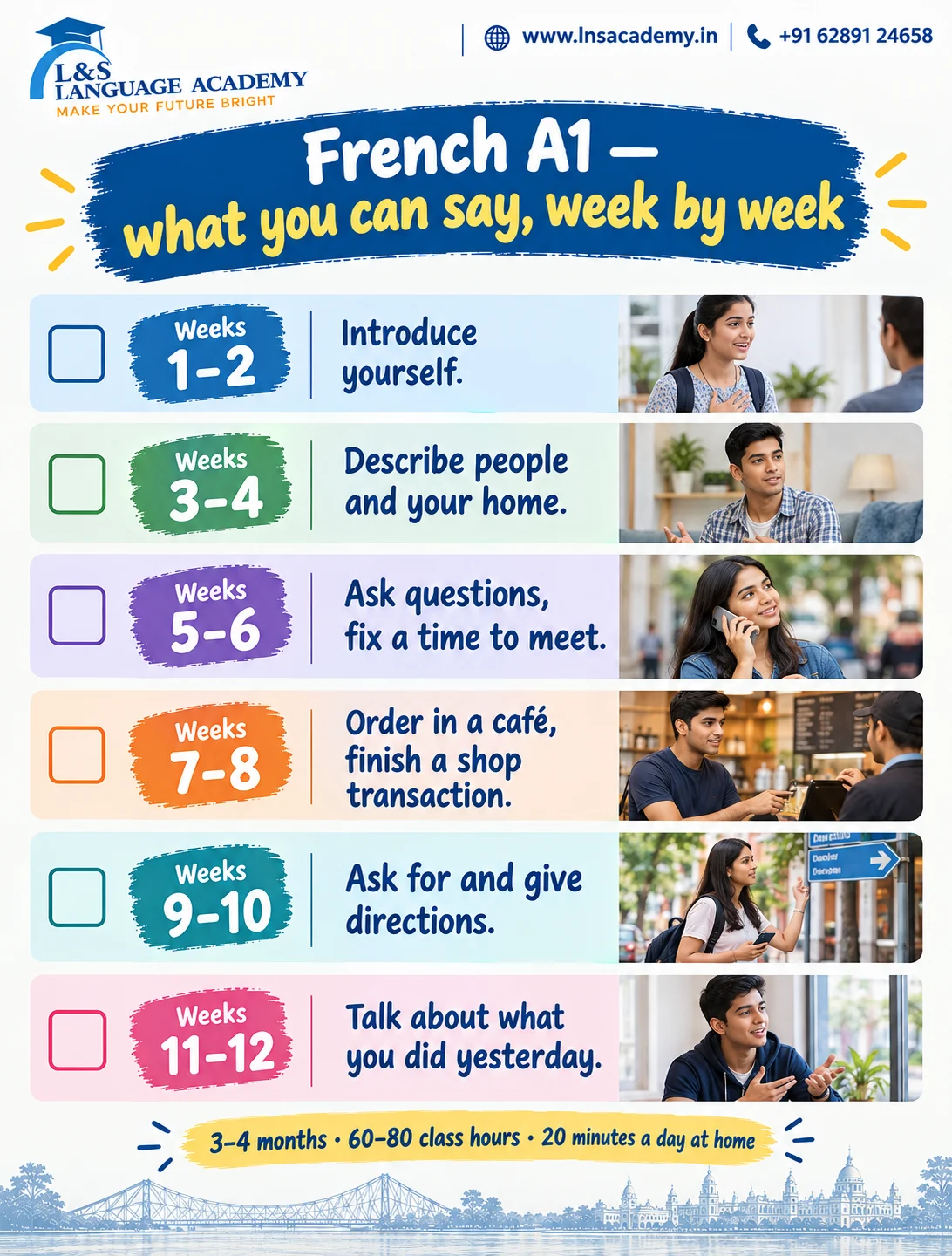
That pace assumes three to four classes a week. Intensive batches compress it into less time, weekend batches stretch it out. Both work.
How many hours a week does this actually take?
Sixty to eighty class hours over three to four months. So four to six hours a week in class.
Plus twenty to thirty minutes a day on your own. Not optional, and this is the single best predictor of who finishes A1 on time.
That daily half hour is nothing dramatic. Reviewing yesterday's words. Listening to something French while you travel. Reading a page out loud.
Students who do it finish comfortably. Students who only attend class finish behind, or repeat the level.
What can you NOT do after A1?
This is the part most institutes skip, so here it is plainly.
After A1 you cannot hold an unscripted conversation about a topic you did not prepare for. You cannot follow a French film. You cannot understand two French people talking to each other at normal speed. You cannot work in French, study in French, or meet any immigration language requirement.
You will still translate in your head. That is normal at A1 and it fades around A2.
Why say all this? Because anybody promising conversational fluency in three months is describing A1 and calling it something bigger. Knowing the real ceiling lets you plan properly instead of feeling let down in month four.
A1 is a foundation. A good one. It is not the destination.
How many words do you actually need?
About 500 to 700 active words gets you through A1.
That is far fewer than most people fear. Roughly six new words a day for three months.
And you already know more than you think. A lot of English vocabulary came from French, so words like nation, important, restaurant, question, culture and université arrive free. We have written more about that in what is genuinely hard about French and what is not.
The trick is which 500. High-frequency words cover most of everyday speech. Your course material should be built around those, not around a long list of animals and fruits.
What is the hardest week, and how do people get past it?
Weeks five to seven. Almost always.
The excitement of starting has worn off. Verb conjugations have multiplied. Gender still feels random. And you are not yet able to say anything impressive, so there is no reward to point at.
This is where people learning alone stop. In a batch, fewer do, because there is a class on Tuesday and somebody notices if you are not in it.
Four things that genuinely help.
- Stop advancing for one week. Revise instead. Nothing new.
- Speak more, study less. Output feels better than input at this stage.
- Go back to your week-two recording and listen to it. The progress is there, you just cannot feel it day to day.
- Tell your trainer you are struggling. Every batch has three people feeling exactly the same and nobody says it.
Should I start online or offline?
Both work at A1, as long as the class is live. Recorded videos are not a course, whatever they cost.
Offline suits total beginners who want the sound work done in the room, and anybody near our centre. The first six weeks are easier face to face.
Online suits working professionals, people outside easy reach of Dum Dum, and anybody who needs schedule flexibility. Our online fees are lower too.
A fair number of students start offline for A1 and move online from A2, once the pronunciation base is set. That works well.
What materials do I need, and what should they cost?
A coursebook and workbook. A notebook you use only for mistakes. Audio access, which normally comes with the book.
Budget ₹500 to ₹2,000 for books, separately from the course fee. Ask any institute whether material is included before comparing two prices, because that alone can explain a gap.
The mistake notebook is worth more than it sounds. One page per week, every error your trainer catches. Read it before each class. Students who keep one make noticeably fewer repeat mistakes by week eight.
What if I miss classes or fall behind?
Ask this before you enrol anywhere, because it is the question people forget and then need.
Find out whether sessions are recorded, whether there are make-up classes, and whether you can join a later batch without paying again.
At A1 specifically, missing two classes in a row hurts more than at higher levels. The building blocks stack tightly. Miss the week on articles and weeks four to twelve get harder.
If you know a busy month is coming, tell us before you start. Picking the right batch is easier than rescuing a bad one.
Do I need to take the DELF A1 exam?
Usually no. Most students go straight on to A2.
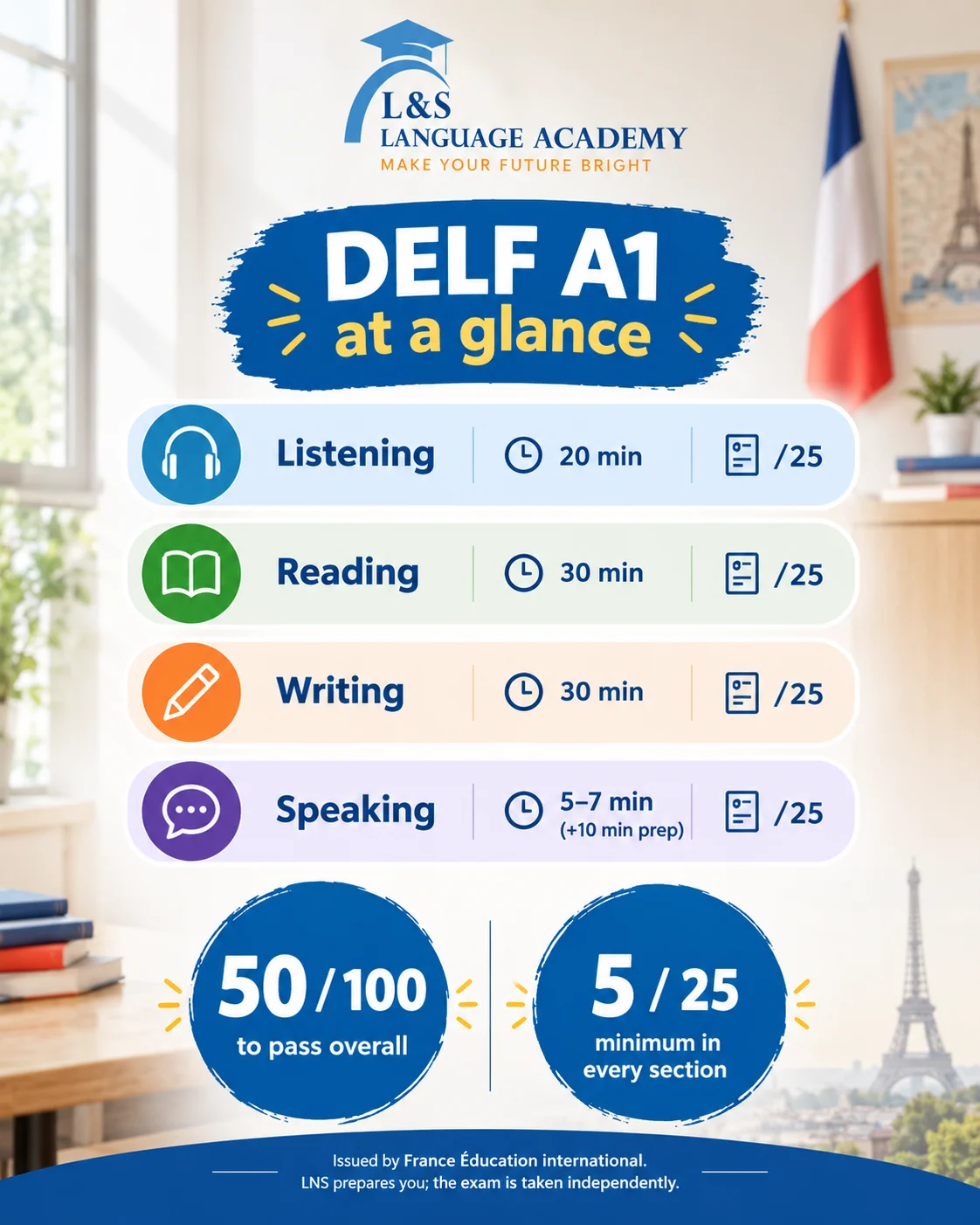
If you want to know what it involves, DELF A1 is issued by France Éducation international and tests four skills. Listening runs about 20 minutes, reading 30 minutes, writing 30 minutes, and speaking 5 to 7 minutes with 10 minutes of preparation. Each section is out of 25, so 100 in total. You need 50 overall and at least 5 in every section.
Worth taking if you may apply abroad later, or if you need a formal record, or simply if a deadline helps you study.
One thing to be clear about. We prepare students for DELF and the other French exams. We do not conduct them, register students for them, or issue their certificates — those are run by their own exam bodies and you sit them independently. At the end of your course with us there is an internal test and our own institute certificate.
And if Canada is your long-term reason, note that DELF is not the exam used for immigration. That route uses TEF Canada or TCF Canada. We have covered that in French for career and Canada PR.
What comes after A1, and how long to B2?
| Level | Duration | Hours | What changes |
|---|---|---|---|
| A2 | 3–4 months | 60–80 | You stop translating. Past and future become comfortable. |
| B1 | 4–6 months | 80–100 | You can give opinions and handle unexpected situations. |
| B2 | 4–6 months | 80–100 | You can argue a point and follow fast native speech. |
A1 to B2 is realistically fourteen to twenty months at a steady pace.
B2 is the level that opens things — university admission in French-taught programmes, the proficiency band relevant to Canadian immigration, roles at companies that want French. We teach right through to C2 for the few who need it.
Decide the destination before you buy the first step. A1 on its own has limited practical use. A1 as step one of four is a different purchase entirely.
Can I learn A1 French free on my own?
You can learn the content of A1 free. There is plenty of good free material and you should use it alongside any class.
What is hard to do free is the pronunciation, and A1 is exactly where pronunciation gets set. Nobody can hear their own nasal vowels. Nobody can tell themselves their R is wrong. And nobody catches le table before it becomes a habit.
Gender is the other one. It needs somebody correcting you a hundred times in the first two months, or it never settles.
Our full method for practising a language on your own is written out in this piece. It is built for English but the routine transfers straight across.
What does A1 cost at LNS?
| Level | Duration | Offline | Online |
|---|---|---|---|
| A1 | 3–4 months | ₹10,000–26,000 | ₹6,000–15,000 |
| A2 | 3–4 months | ₹10,000–26,000 | ₹6,000–15,000 |
| B1 | 4–6 months | ₹12,000–48,000 | ₹8,000–20,000 |
| B2 | 4–6 months | ₹12,000–48,000 | ₹8,000–20,000 |
Details on our course fees page. Call 62891 24658 for current batches, including evening and weekend slots.
Think about the timeline rather than only the fee. If B2 is the goal, you are looking at fourteen to twenty months from today. Starting six months later moves that finish date by six months, and for anybody working towards an application deadline that is the number that actually matters.
Where is LNS, and which areas do you cover?
108, Majumder Para, 1 No Airport Gate, Kolkata 700079. Convenient from Dum Dum, Nagerbazar, Baguiati, Kestopur, Lake Town, Birati and Madhyamgram.
Online batches cover Salt Lake, New Town, Barasat, Behala, Howrah and the rest of India.
Frequently Asked Questions
Unlikely. Younger students pick up sounds faster. You will pick up grammar faster because you can apply a rule consciously. Most batches even out by week six.
At A1, usually yes. The first two weeks are the sound system and everything sits on top of it. Joining late means catching up on the hardest part alone.
Knowing words is not the same as knowing A1. Take a placement check. Most people who ask this turn out to be a strong A1 start, not an A2.
Talk to yourself. Narrate what you are doing. Record a one-minute voice note daily. It feels odd for a week and then it does not.
Completely normal at A1, and it is why the twenty minutes a day matters. Memory fades fastest in the first 24 hours after a class.
Write by hand at A1. Accent marks and spelling stick better when you write them. Type later if you prefer.
Yes, from day one. They change pronunciation and sometimes meaning. Learning them later means unlearning a habit.
Now. Accent work at A1 takes weeks. The same work at B1 takes months, because by then it is a habit and not a mistake.
Three to four months, 60 to 80 hours. Intensive batches are shorter, weekend batches longer.
Introduce yourself, describe people and places, order food, ask directions, and talk about what you did yesterday.
No. Most French-using roles want B1 or B2. A1 is the foundation for getting there.
Yes. Our online batches take students from across India.
Fourteen to twenty months at a steady pace. Faster with intensive batches.
Yes. Sit through one before you decide anything.
Start with week one
Ninety days from now you could be talking about your weekend in French. That is not a sales line, it is just what A1 is.
Come to a free demo class and see how the first session runs. We will also tell you honestly whether A1 is the right starting point for you, or whether you should go in a level higher.
Call 62891 24658 or write to contact@lnsacademy.in. Full French course details are here. If you are asking on behalf of a school-age child, we have written a separate guide for parents.