Book Your Free Demo Class
Submit this form and get an instant call from us. We will share you a demo class schedule.
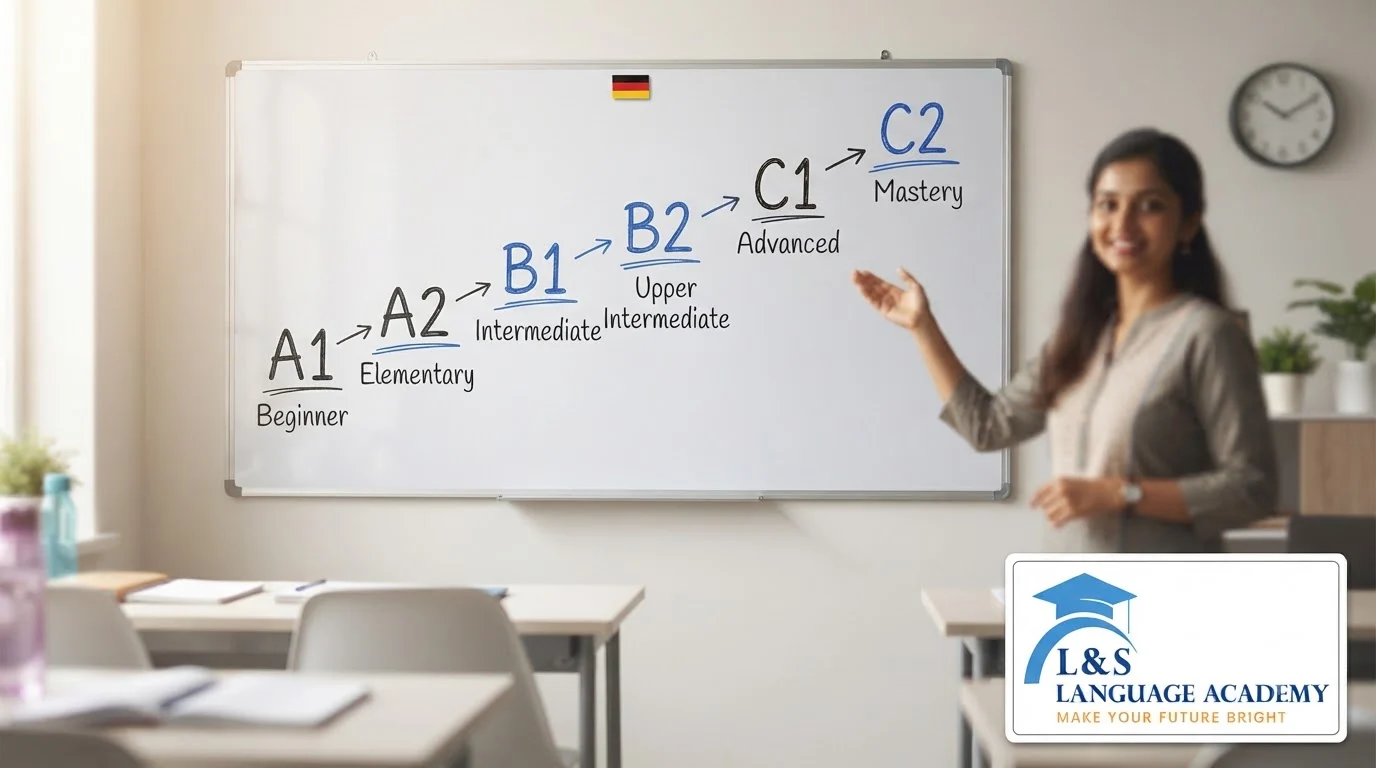
A genuine German language course in Kolkata should take you somewhere specific at every level, from A1 all the way to C2, not just "teach German" in a general sense. And here's something worth knowing before you enrol anywhere: not every course in Kolkata actually goes the full distance. Some stop at B2. Below, we've broken down what each level really means, what it costs, and how to check whether a course covers the range you actually need.
Let's start with something most course pages gloss over. A1 through C2 aren't just labels on a brochure. They're a real, internationally recognised framework, and each one represents a genuinely different level of ability.
At A1, you're learning the alphabet, basic greetings, self-introduction, and present tense — enough to introduce yourself and handle simple, everyday exchanges. A2 builds on that with past tense, daily routines, and slightly more complex sentences. By B1, you're dealing with most everyday situations in German-speaking countries and can describe experiences and plans — this is also the threshold most study and work visa requirements point to. B2 steps up again: complex grammar, academic writing, arguing a viewpoint, and it's the level most German universities and jobs actually require. C1 and C2 move into genuinely advanced territory — nuanced, spontaneous expression, academic and professional German, the kind of fluency needed for translation work or postgraduate study.
Here's the part worth being direct about: not every Kolkata institute teaches all six levels. We checked, and at least one well-known local competitor's own course page caps out at B2 — no A1 through B2 pathway is followed by anything further. That's not necessarily a problem for every learner. If your goal is a B1 visa requirement, you don't need C2. But if you're aiming for German university admission, translation work, or long-term career growth in Germany, you need to know whether the course you're choosing actually goes that far — before you're three levels in and discover it doesn't.
This is exactly why "German language course" isn't a single, fixed thing. A search for a German language course in Kolkata can turn up anything from a three-month conversational crash course to a genuine six-level pathway toward near-native fluency, and the course pages themselves don't always make that distinction obvious upfront. Reading the fine print on level coverage, honestly, matters more than most people realise going in — it's a five-minute check that can save you from switching institutes halfway through your German learning journey.
Let's talk real numbers rather than "contact us for pricing." Across Kolkata, A1-level German training commonly runs somewhere in the ₹13,500 to ₹16,000 range at several well-known local institutes, based on current published fees. Goethe-Institut itself, the official German cultural institute on Park Street, sits well above that — around ₹28,500 per level for their Standard and Intensive courses, reflecting their 160 teaching units per level and native-trained faculty.
At LNS, our German course runs from ₹8,000 for batch classes offline (₹6,000 online) at A1 and A2, rising through the levels to ₹15,000–25,000 for one-to-one Advanced coaching at C1 and C2 offline. That puts our batch entry point comfortably below the typical local competitor band, while our premium one-to-one track gives you the option of genuinely intensive, personalised coaching if that's what you need. Either way, the course runs the full A1 through C2 pathway — not a partial one.
| Level | Duration | Offline Fee | Online Fee |
|---|---|---|---|
| A1 (Beginner) | 2–3 months (60–80 hrs) | ₹8,000 – ₹28,500 | ₹6,000 – ₹20,000 |
| A2 (Elementary) | 2–3 months (60–80 hrs) | ₹8,000 – ₹28,500 | ₹6,000 – ₹20,000 |
| B1 (Intermediate) | 3–4 months (100–120 hrs) | ₹10,000 – ₹28,500 | ₹8,000 – ₹22,000 |
| B2 (Upper-Intermediate) | 3–5 months (120–150 hrs) | ₹12,000 – ₹28,500 | ₹8,000 – ₹22,000 |
| C1 (Advanced) | 4–6 months (120–140 hrs) | ₹15,000 – ₹25,000 | ₹10,000 – ₹20,000 |
| C2 (Mastery) | 4–6 months (140+ hrs) | ₹15,000 – ₹25,000 | ₹10,000 – ₹20,000 |
The lower figure in each range is our batch (group) fee; the higher figure is one-to-one personal coaching. If budget's a real concern, a genuinely practical approach many students take is completing A1–B1 at a local institute and reassessing from there — you'll have the real foundation either way.
This part needs to be precise, so let's be precise. LNS prepares students for Goethe-Zertifikat levels through structured, level-by-level training. The Goethe exam itself — the actual internationally recognised certificate — is taken independently at Goethe-Institut Max Mueller Bhavan, not administered by LNS or by most local training institutes, for that matter. That's simply how the German certification system works: training and the official exam are two separate things, wherever you study.
On completion of a level with us, you'll receive our own institute certificate confirming the training you've completed. If your goal also requires the Goethe-Zertifikat itself — for a visa application or university admission, say — that's a separate registration and fee (roughly ₹7,000–12,000 per level) handled directly with Goethe-Institut. Worth knowing too: the exam is genuinely optional. Plenty of learners study German for career or personal reasons without ever sitting a formal exam, though most employers and universities will want to see a certified level if German proficiency is part of the requirement.
It's a wider group than "people who like Germany," honestly. A significant share of our students are aiming at Germany's job market directly — engineering and IT roles are in real, ongoing demand there, and B1–B2 German alongside technical skills makes for a genuinely strong application. Germany's shortage of skilled workers extends well beyond tech, too: the healthcare and nursing pathway specifically needs A2–B1 German for the recognition process (Anerkennungsverfahren), and a realistic timeline for reaching that B1 threshold from scratch runs roughly 9 to 14 months.
Then there's Ausbildung — Germany's paid vocational training system, which typically requires B1–B2 German and offers a genuinely practical route into a skilled trade with income from day one. Students preparing for German university admission need B1 to C1 depending on the program, since German public universities offer remarkably low or zero tuition for a world-class education, provided the language requirement is met. And closer to home, German-headquartered companies operating in India — Siemens, Bosch, BMW, SAP, and Deutsche Bank among them — treat B1-plus German as a genuine differentiator for hiring, even for roles based in India rather than Germany itself.
Not everyone has an immediate visa or career deadline attached, either. Plenty of learners simply want the language for its own sake, or because it opens doors they're not in a hurry to walk through yet. Both are perfectly good reasons to start.
Whichever institute you're considering, ask these directly:

LNS runs the full pathway, A1 through C2. Not every institute in Kolkata does — worth confirming with any course you're considering, since some stop at B2.
At LNS, A1 starts from ₹8,000 offline (₹6,000 online) for batch classes, rising to ₹15,000–25,000 for one-to-one Advanced coaching. Local Kolkata institutes generally range ₹13,500–16,000 for A1, with Goethe-Institut itself around ₹28,500 per level.
Roughly 7 to 10 months of consistent study, covering A1 (2–3 months), A2 (2–3 months), and B1 (3–4 months) — the level most work and study visa requirements point to.
No, the exam is optional. LNS issues its own institute certificate on completing a level. The Goethe-Zertifikat is a separate exam, registered and taken independently through Goethe-Institut, needed only if your specific goal requires that certification.
Both prepare you for the same Goethe-Zertifikat levels. Goethe-Institut is the official institute and administers the exam itself, at a premium price point (around ₹28,500/level). Local institutes like LNS offer the same level structure at a lower training cost, and the exam itself is sat at Goethe-Institut either way.
Generally A2 to B1 for the recognition process (Anerkennungsverfahren). A realistic timeline from scratch to B1 is roughly 9 to 14 months of consistent study.
B1 or above is typically treated as a meaningful differentiator by German-headquartered companies operating in India, including firms like Siemens, Bosch, and SAP, even for India-based roles.
Many German public universities offer low or zero tuition, but you'll generally need B1 to C1 German depending on the program, alongside meeting the academic admission requirements.
We follow a structured, level-appropriate syllabus; books typically cost an additional ₹500–1,500 depending on level and are not always bundled into the course fee — worth confirming with any institute you're comparing.
Both cover the same levels and syllabus at LNS; online tends to be more affordable and convenient, while offline offers more in-person interaction. Choose based on your schedule rather than assuming one is inherently better.
Ausbildung is Germany's paid vocational training system, which typically requires B1–B2 German and offers a genuinely practical route into a skilled trade with income from day one.
For many students, yes — building the foundation at a local institute costs less, and you can always move to Goethe-Institut for B2 and above, or for exam-specific preparation, once you've confirmed your goals.
Know exactly what level you need and what it costs before you commit. Book a free demo class and see how our German course actually runs.
Book Your Free Demo Class