Book Your Free Demo Class
Submit this form and get an instant call from us. We will share you a demo class schedule.
A spoken English course in Kolkata is worth your money if three things are true: the certification is something you can verify, the trainers are named real people with real degrees, and the fees are written down in rupees, not hidden behind a "contact us" form. If a course can't show you all three, keep looking. That's really the whole test, and everything below explains why.
Let's be honest about it. Most people typing "spoken English course in Kolkata" into Google aren't looking for a definition of what spoken English is. They already know. What they actually want is a way to tell a genuine institute apart from a page that's dressed up to look like one.
And that's a fair worry. We've seen plenty of "Best Spoken English Institute" lists floating around online, and more than a few of them are written by companies that also happen to run a course of their own — which they, unsurprisingly, put at number one. So the real question isn't "who's the best." It's "how do I check, myself, without trusting a stranger's list."
That's what this guide does. No rankings, no "top 10." Just the specific things worth checking before you hand over your fee.
Here's where most course pages get vague. They'll say "expert faculty" or "quality training" and leave it there. In our experience, those phrases mean nothing unless they can be checked. So let's go through what actually can be checked.
Anyone can write "ISO certified" on a website. Far fewer institutes can tell you what that certification actually covers. L&S Language Academy is ISO 9001:2015 certified, and that specific standard isn't a vague quality badge — it's an audit of how a business runs its teaching process, its administration, and its delivery consistency, year after year. Ask any institute you're considering a simple question: which ISO standard, and what does the audit actually check? If they can't answer, that tells you something too.
"Expert faculty" is an adjective. A name, a photograph, and a college attached to that name is a fact. At LNS, faculty are drawn from well-known Kolkata colleges — and honestly, that's the differentiator that matters more than most marketing copy admits. When you're trusting someone to fix your pronunciation and your grammar for two to three months, you're entitled to know who that person actually is before you pay them.
This one's simple, but so many institutes get it wrong. If a course page won't show you a number, be a little suspicious. Fair, transparent pricing looks like a table, not a lead-capture form. So here's ours, straight from our own course structure — batch (group) pricing at the lower end of each range, one-to-one personal coaching at the higher end.
| Level | Duration | Offline Fee (Batch → 1:1) | Online Fee (Batch → 1:1) | What You'll Be Able to Do |
|---|---|---|---|---|
| Beginner | 2–3 months (60–80 hrs) | ₹5,000 – ₹12,000 | ₹3,000 – ₹8,000 | Hold simple everyday conversations, introduce yourself, ask and answer basic questions |
| Intermediate | 2–3 months (60–80 hrs) | ₹6,000 – ₹15,000 | ₹4,000 – ₹10,000 | Take part in meetings, write emails, handle phone calls, give short presentations |
| Advanced | 2–3 months (60–80 hrs) | ₹8,000 – ₹25,000 | ₹5,000 – ₹15,000 | Speak with confidence in interviews, corporate settings, and public speaking |
Note: The lower figure in each range is our batch (group) fee. The higher figure is one-to-one personal coaching. Many students take Beginner through Advanced as a combined package over 3–6 months rather than paying level by level — ask us about this if a straight run to fluency is your goal.

Here's the thing about fluency: it isn't built by memorising a script and reciting it back. It's built through guided speaking, real correction, and enough repetition that the right sentence starts coming out without you translating it in your head first.
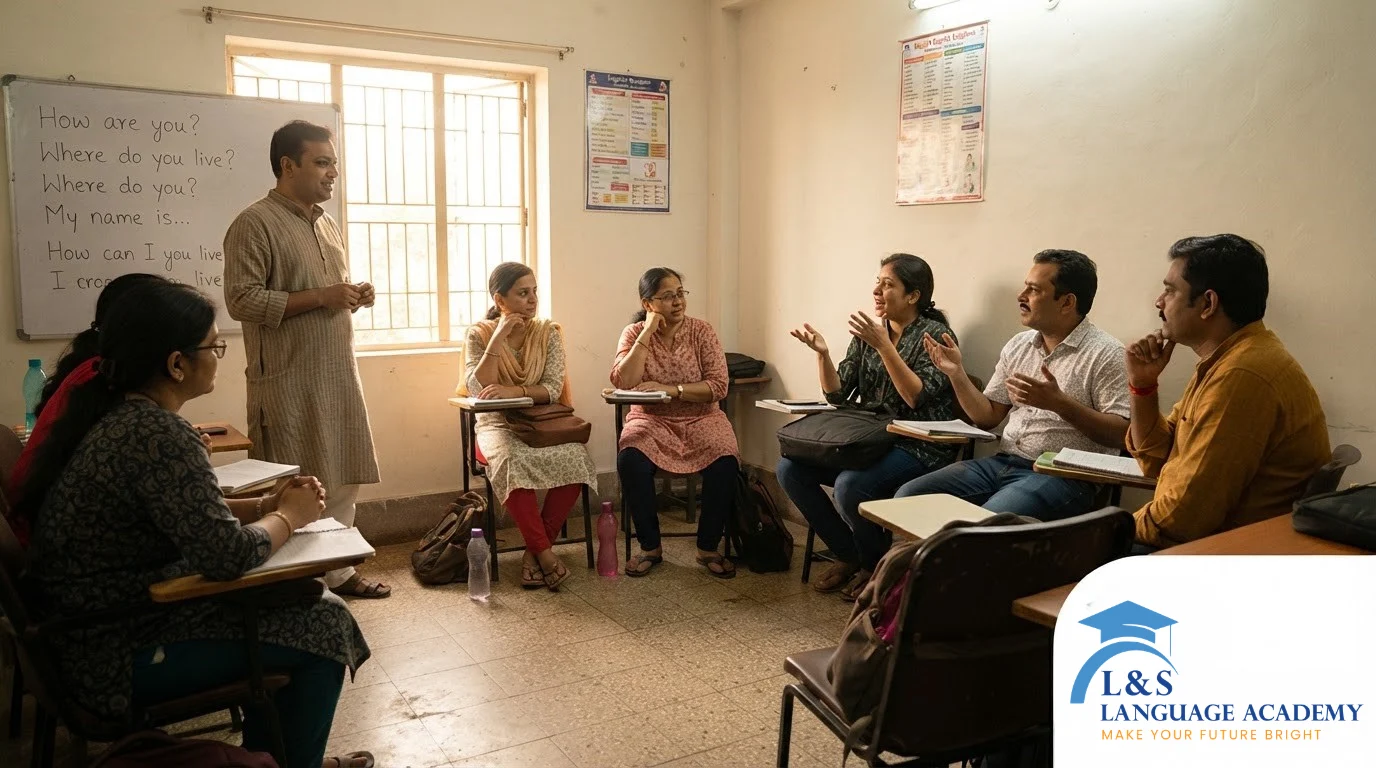
A course worth its fee covers pronunciation properly — not just "speak clearly," but actual work on stress, rhythm, and the sounds that trip up Bengali and Hindi speakers specifically. It teaches grammar in use, inside real sentences, rather than as a list of rules to memorise and forget. It trains your ear across different accents and speaking speeds, because the person interviewing you won't necessarily talk like your teacher does. And it builds vocabulary for situations you'll actually be in — job interviews, BPO floor conversations, hospitality guest interactions, everyday office English.
At LNS, we structure this across three levels: Beginner, Intermediate, and Advanced. We won't dress this up as a CEFR framework, because honestly, it isn't one — that labelling belongs to our European language courses, not this one. Our levels are built around what you can actually do by the end of each stage, which is a more useful measure anyway.
We could write three thousand words on this alone — and honestly, we have, in a separate guide. But here's the short version. If you're the kind of person who needs a physical room and a bit of peer pressure to actually show up, offline usually wins. If your schedule changes week to week, or your commute eats into study time, online with a live trainer works just as well for correction and feedback — the research increasingly backs this up. What matters far more than the medium is whether someone is actually correcting you in real time. Recorded, one-way content doesn't do that, regardless of whether you're sitting in a classroom or on your sofa.
We run both formats, structured the same way, so you're not choosing between quality — just between what fits your week.
It's a wider group than most people assume. College students walk in wanting interview confidence and end up more comfortable presenting in class too. Working professionals in BPO and hospitality roles often join because fluent spoken English is, quite simply, a hiring requirement in those sectors — not a nice-to-have. We also see a steady stream of students preparing for IELTS or TOEFL down the line, who come to us first to build the spoken foundation before they start exam-specific coaching, since those are separate skills built on the same base.
Then there's the quieter group: homemakers returning to the workforce after a gap, and parents bringing in children from age eight upward for exam English and everyday confidence. There's no upper age limit either, for what it's worth — we've taught working professionals well into their careers who simply never had the chance earlier.
We'd rather you make a genuinely informed choice than a rushed one, so here's a short, honest checklist, whichever institute you end up choosing:
We'll keep this part short, because we'd rather you check the claims above yourself than just take our word for it. L&S Language Academy is ISO 9001:2015 certified. We're based at one address — 108, Majumder Para, 1 No. Airport Gate, Kolkata 700079 — not a rotating list of "service areas" with no physical centre behind them. Our faculty come from known Kolkata colleges, and we'll tell you their names before you enrol, not after. You get an institute certificate on completion, and you can choose batch or one-to-one, online or offline, based on what actually fits your week.
If that sounds like what you were checking for, the next step is easy.
There isn't one single "best" — it depends on your starting level, your budget, and whether you learn better in a batch or one-to-one. What you can check, whichever institute you pick, is whether the certification is verifiable, the trainers are named, and the fees are written down clearly. That test matters more than any ranking.
Same answer, really — "best" depends on you. Visit or call a couple of shortlisted institutes, ask to see a trainer's credentials, and sit in on or ask for a demo class before deciding. That tells you far more than a review score.
At LNS, Beginner starts from ₹5,000 offline (₹3,000 online) for batch classes, rising to ₹25,000 for one-to-one Advanced coaching offline. Across Kolkata generally, fees range roughly ₹5,000 to ₹30,000 depending on level, format, and whether an international certification like Cambridge or TOEIC is bundled in.
Yes. LNS issues an institute certificate once you complete a level. If you're also aiming for an internationally recognised certificate — Cambridge English or TOEIC, for example — that's a separate exam administered by the respective exam body, and we can help you prepare for it alongside your course.
Neither is inherently better — what matters is whether you're getting live correction, not whether you're in a room or on a screen. Offline suits people who need structure and peer energy to stay consistent. Online suits people juggling a tighter schedule. We run both the same way, so you can pick based on your week, not on quality.
Each level — Beginner, Intermediate, Advanced — typically runs 2 to 3 months at 60 to 80 hours of instruction. Many students combine all three into a single 3-to-6-month package rather than stopping between levels, which tends to build momentum better than long breaks in between.
No. We teach children from age eight upward, school and college students, freshers, working professionals, and homemakers returning to work. The course content and pace adjust to the group, not the other way round.
Spoken English builds your everyday speaking, listening, and confidence. IELTS and TOEFL are separate, exam-specific certifications for study-abroad applications, with their own format and scoring. A solid spoken English foundation makes IELTS or TOEFL prep considerably easier later — which is exactly why many of our students do one before the other.
Complete beginners are welcome. That's what the Beginner level is built for — basic vocabulary, grammar foundations, and everyday conversation from the ground up. You don't need any prior spoken English to start.
You'll see real, honest progress in a few months — clearer pronunciation, fewer pauses, more confidence in real conversations. Full fluency is a longer road for most people and depends heavily on how much you practise outside class, not just the hours you spend inside it. Anyone promising fluency in thirty days without qualifying that statement isn't being fully straight with you.
Yes. We'd recommend attending one before enrolling anywhere, honestly, not just with us — it's the fastest way to judge a trainer and a teaching style before committing your fee.
You've now got the checklist. Certification you can verify, trainers you can name, fees you can read in black and white. If L&S Language Academy checks those boxes for you, book a free demo class and come see the classroom for yourself.